Svaneti
Georgia · 9 places
Photo: Levan Gokadze (uploader Giorgi Balakhadze), CC BY-SA 2.0
Mestia sits in the Svaneti mountains, high enough that the air thins and the days stretch. At fifteen hundred meters, pine and woodsmoke drift between the stone towers that rise from the ground. These towers were built to protect families from raids; now they mark the landscape, their walls holding centuries of stories. Even when skiers arrive in winter, the town moves slowly, without the crowds of busier resorts.
The heart of Svaneti
The Svans, an ethnic group with their own language, have lived here for generations. Their traditions remain visible: polyphonic songs still fill village gatherings, and recipes for khachapuri—cheese-filled bread rich with butter—are passed down like secrets. The local museum displays icons and manuscripts, but the real history isn’t behind glass. It’s in how people greet you, offering tea as if you’ve walked into a neighbor’s home.
You’ll hear the Svan language spoken in the streets, a sound distinct from Georgian. The salt here is tangy, the cheese aged, the honey thick with wildflower notes. These aren’t just products; they’re part of a way of life that hasn’t changed much over time.
Trails and peaks
From Mestia, trails lead to Ushba and Shkhara, where glaciers gleam under the sun. In summer, cattle graze in alpine meadows; in winter, skiers carve down slopes quieter than those in Gudauri. The roads are rough, often just dirt winding through valleys. But every turn reveals something new—a jagged peak, a hidden gorge, a cluster of stone houses on a hillside.
Trekkers use Mestia as a base for multi-day hikes. The Greater Caucasus range unfolds step by step, with lakes reflecting the sky and ridges cutting sharp lines against it. There’s no rush here. The mountains set the pace.
The town itself
Mestia is small enough to walk in a day. The central square has cafés and guesthouses, while the Church of St. George stands as a quiet landmark. Shops sell local goods: Svan salt, aged cheese, honey, and dried meat cured in mountain air.
Evenings are quiet. The sun drops behind the ridges, and hearths glow in the dusk. Guesthouses are family-run, with hosts serving homemade breakfasts and sharing stories over tea. There are no luxury hotels, just rooms where the walls feel lived-in.
Mestia isn’t for those who want nightlife or shopping. It’s for travelers who come to feel the pulse of the Caucasus—its rawness, its warmth, its pace. The mountains don’t hurry, and neither do the people. Time here isn’t something to keep; it’s something to let pass.
See & Do
9 places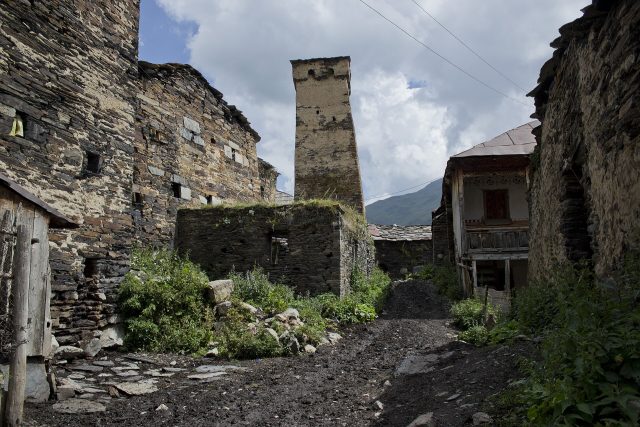


Places on the map
Marker colour follows the categoryClimate and weather
Detailed weather: Svaneti- Average temperature
- 7 °C
- Precipitation per year
- 1783 mm
- Average humidity
- 70 %
- Sunshine hours per day
- 8.5 h
- Time zone
- UTC+4 (GMT+4)
Average air temperature
°C
-4
-4
2
7
9
14
18
19
14
7
2
-2
Jan
Feb
Mar
Apr
May
Jun
Jul
Aug
Sep
Oct
Nov
Dec