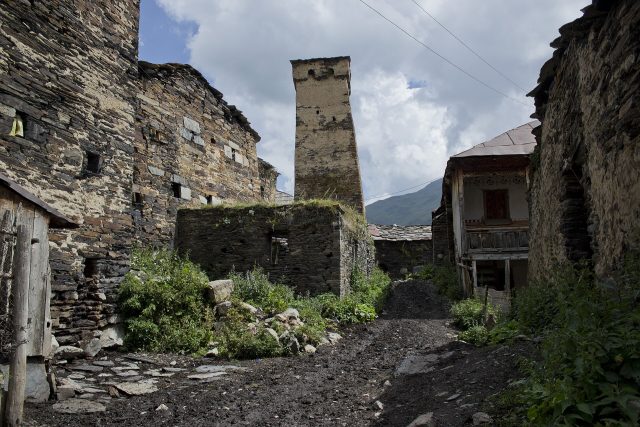
The Museum of Svaneti History and Ethnography in Mestia isn’t just a place where the past is preserved behind glass—it’s where history still breathes in every exhibit. Housed in a traditional Svan tower house, the building itself is a testament to the region’s enduring legacy. Built from stone and timber, with thick walls and narrow windows, it reflects the defensive architecture that once shielded Svan communities from raids and the harsh mountain winters. Stepping inside, the dim lighting and low ceilings slow time to a crawl, making it easy to imagine the lives of those who called this place home centuries ago.
The museum’s collection spans millennia, beginning with Bronze Age artifacts unearthed in the surrounding valleys. Weapons, jewelry, and everyday tools reveal the sophistication of early Svan tribes, while medieval icons and religious relics highlight the region’s role as a center of Christianity in the Caucasus. Many of these icons were painted by local artists, their solemn faces blending Byzantine tradition with a distinctly Svan perspective—a quiet defiance against the isolation of the mountains.
The ethnographic exhibits offer the most intimate glimpse into Svan life. Here, you’ll find objects still in use today: intricately carved wooden chests, handlooms, clay pottery, and woolen garments woven from homespun fabric. The most striking pieces are the traditional Svan belts—wide, silver-trimmed sashes adorned with coral, worn by men as symbols of status and protection. These weren’t just decorative; metal plates were often sewn into them to deflect knife strikes. Nearby, musical instruments like the *chonguri*, a three-stringed lute, evoke the sounds that once filled village gatherings, weddings, and funerals.
A dedicated hall explores Svaneti’s iconic defensive towers, which have become the region’s defining architectural feature. Built between the 10th and 13th centuries, these structures served as fortresses, homes, and granaries, constructed from local slate without mortar. Remarkably, many still stand today, having withstood earthquakes and centuries of wear. The museum displays models of these towers, along with tools used in their construction, and explains their multifaceted role in Svan society—from storing grain to sheltering families during feuds, and even hosting weddings when alliances were fragile.
The museum also preserves Svaneti’s intellectual heritage, showcasing the region’s tradition of scholarship. Long before modern education took hold, Svan schools taught not only literacy but also crafts, medicine, and astronomy. Ancient manuscripts in Georgian and Svan, alongside 19th-century textbooks, reveal a society that valued knowledge deeply. Some of the most precious items are handwritten records of folk songs and legends, many of which survive only because local scholars took care to preserve them.
While the museum honors the past, it also bridges the gap to the present. Exhibits on contemporary crafts—blacksmithing, weaving, and jewelry-making—demonstrate how traditions evolve without losing their essence. Svan knives, once tools of war, are now sought-after souvenirs, while handwoven rugs and blankets find homes far beyond Georgia’s borders. The museum doesn’t romanticize history; it shows how these skills have adapted, ensuring they remain relevant in a changing world.
What makes this museum unique is its unflinching honesty. It doesn’t shy away from the harsh realities of mountain life—blood feuds that divided families for generations, winters that cut villages off from the world, the constant struggle for survival. Yet it also reveals how these challenges forged a culture of resilience, one that became an integral part of Georgia’s broader identity. The exhibits feel lived-in, not just curated, as if the stories they tell are still unfolding.
After visiting, a walk through Mestia brings the museum’s stories to life. The narrow streets, the stone houses with their carved balconies, the towers looming over the town—all of it feels like a continuation of the past, not a relic of it. The Museum of Svaneti History and Ethnography isn’t just a collection of artifacts; it’s a key to understanding a place where history isn’t confined to books or displays but lives in the very stones underfoot.