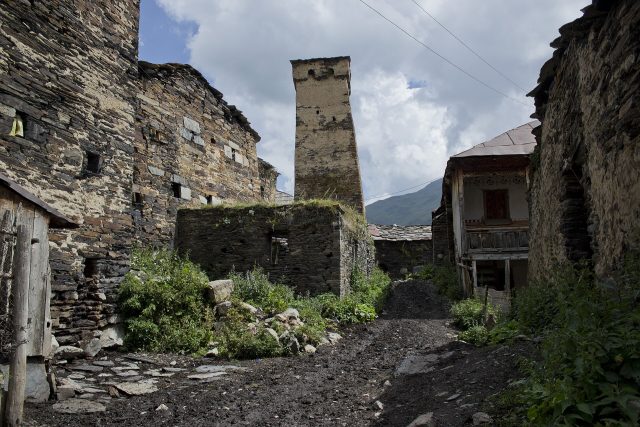
Shkhara Glacier isn’t just a destination—it’s a presence. Towering over the Svaneti region of Georgia, it dominates the skyline like a silent guardian, its ice-clad slopes shifting with the seasons yet remaining constant in their grandeur. For centuries, this glacier has been more than a natural wonder; it’s been a part of life here, shaping the land, the culture, and even the way people think about time. In a place where stone towers stand as relics of medieval defense and narrow paths wind through villages frozen in another era, Shkhara feels like the final piece of a puzzle—something ancient and unyielding, yet alive in its own quiet way.
The journey toward the glacier begins in Mestia, the heart of Svaneti. From there, the road unfurls into the mountains, climbing steadily toward Ushguli, Europe’s highest permanently inhabited settlement. The drive itself is a slow revelation. At first, Shkhara is just a distant smudge of white against the jagged peaks, but as you ascend, it grows clearer, its glacier spilling down the slope like a frozen river caught mid-motion. The closer you get, the more the landscape changes. Alpine meadows give way to rocky moraines, and the air grows thinner, sharper. By the time you reach the base, the glacier is no longer a distant sight—it’s something you can almost touch, its cold breath rising to meet you.
What strikes you first about Shkhara’s glacier is its movement. It isn’t static; it’s a living, shifting force, creeping downward at a pace imperceptible to the eye but undeniable over centuries. Deep crevasses split its surface, their edges jagged like broken glass, while dark streaks of rock and debris trace the paths of past collapses. In summer, meltwater carves thin streams across the ice, their murmur the only sound in the vast silence. The glacier’s color shifts with the light—opaque white in the midday sun, translucent blue in the shadows, and at dusk, a ghostly gray that seems to glow from within. It’s easy to see why the Svan people, who have lived in these mountains for generations, once regarded such places with reverence. To them, the glacier wasn’t just ice; it was a reminder of nature’s power, something both beautiful and untamable.
For climbers, Shkhara is a formidable challenge. At 5,201 meters, it’s the third-highest peak in Georgia, and its ascent demands skill, patience, and respect for the mountain’s moods. The routes to the summit cross the glacier itself, where hidden crevasses lurk beneath fresh snow, and sudden storms can turn a clear day into a fight for survival. Those who make it to the top are rewarded with a view that few ever see—a panorama of the Greater Caucasus stretching endlessly, its peaks sharp against the horizon. On rare, perfectly clear days, even Mount Elbrus, hundreds of kilometers away in Russia, appears as a faint silhouette. But you don’t need to climb to understand the mountain’s pull. Even from the valley floor, Shkhara commands attention, its sheer scale making everything else feel small.
The glacier changes with the seasons, and each time of year offers a different kind of beauty. In summer, the lower reaches of the ice retreat, revealing more of the rocky slope beneath, while meltwater feeds the rivers that sustain Svaneti’s villages. The days are long, the light golden, and the higher you go, the more the world narrows to just you, the ice, and the wind. Winter transforms the landscape entirely. Snow blankets the valleys, softening the edges of the stone towers and turning the glacier into a seamless part of the white expanse. The silence deepens, broken only by the occasional crack of shifting ice or the distant call of a bird. Getting here in winter is harder—roads close, temperatures plummet, and the weather can turn in an instant—but those who make the effort find a solitude that’s increasingly rare.
What makes Shkhara special isn’t just its height or its ice, but the way it exists in the world. There are no crowds here, no souvenir stands, no signs pointing the way. The glacier doesn’t announce itself; it simply is, indifferent to those who come to see it. That indifference is part of its allure. Standing at its base, you’re reminded of how small human concerns are in the face of something so vast and enduring. The Svan people understood this. Their ancestors built their towers not to conquer the mountains, but to live alongside them, to find a balance between human life and the forces that shaped the land. That balance is still here, in the way the wind carries the sound of distant water, in the way the light lingers on the ice long after the sun has set.
There’s a practical side to the glacier, too. For generations, it’s been a source of water, its melt feeding the rivers that irrigate the valleys below. But its role goes beyond utility. In a region where survival has always depended on reading the land, Shkhara has been a constant—a landmark, a calendar, a measure of time. The Svan language has words for the way the glacier looks in different seasons, for the sounds it makes as it shifts, for the way its presence shapes the rhythm of life. Even now, when helicopters and four-wheel drives have replaced footpaths and horses, the glacier remains a touchstone, a connection to something older than roads or borders.
Visiting Shkhara isn’t about ticking a box on a travel list. It’s about stepping into a different kind of time, one where the hours aren’t measured in minutes but in the slow creep of ice and the changing angle of sunlight. You might spend an afternoon sitting on a rock, watching the way the glacier’s surface fractures the light, or you might hike to a viewpoint where the entire valley unfolds below you. There’s no script for what to do here, no must-see attractions beyond the glacier itself. That freedom can feel disorienting at first, especially if you’re used to places where every moment is planned. But that’s the point. Shkhara doesn’t offer experiences; it offers space—to think, to breathe, to simply be.
The best way to leave is the same way you came: slowly, with one last look over your shoulder. The glacier won’t change in the time it takes you to descend, but you might. That’s the strange thing about places like this. They don’t just show you something new; they show you something about yourself. Maybe it’s the realization that the world is bigger than you thought, or that some things—mountains, ice, time—can’t be rushed. Or maybe it’s just the quiet understanding that some places don’t need to be explained. They just are, and that’s enough.