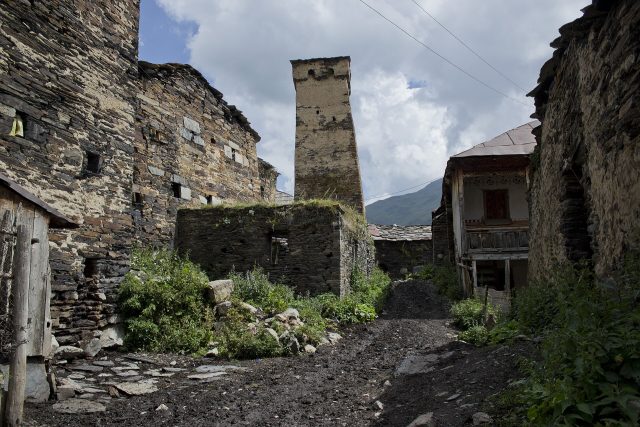
Standing tall against the rugged backdrop of the Caucasus, the Svan towers are the first thing that strikes you when you arrive in Mestia. These stone sentinels dot the town and its surrounding valleys, their weathered forms a silent testament to centuries of isolation and resilience. Built not for grandeur but for survival, they were fortresses, lookouts, and sanctuaries in a land where blood feuds and raids were once part of everyday life. Today, they remain one of the most recognizable symbols of Svaneti, their stark simplicity a reminder of the harsh realities that shaped this remote mountain region.
Most of the towers were constructed between the 9th and 13th centuries, though some may have appeared later. Local slate, quarried from nearby gorges, was the material of choice—stacked without mortar, fitted together with precision. Despite the absence of binding agents, many have withstood earthquakes and conflicts, their thick, tapering walls rising twenty to twenty-five meters high. Inside, narrow staircases wind upward to small chambers where families once took shelter, storing food and supplies for sieges that could last weeks or even months.
The towers rarely stood alone. More often, they were part of a larger complex known as a Svan courtyard, which included living quarters, barns, and sometimes even tiny churches. These compounds were self-sufficient fortresses, designed to protect entire clans. While modern life has softened some of the edges—electricity now powers homes, and glass windows have replaced wooden shutters—the towers themselves remain untouched, preserved as a nod to tradition. In some courtyards, you can still find intricately carved wooden balconies, heavy oak doors, and old tools, all hinting at a way of life that has changed little over the centuries.
Beyond their defensive purpose, the towers played a crucial role in Svan society. Each one belonged to a specific family, and its height often reflected the clan’s status. The taller the tower, the more influential its owners were considered. During conflicts, they became strongholds; in peacetime, they safeguarded family heirlooms, religious icons, and ancient manuscripts. Some say that hidden treasures still lie within their walls, though the Svans have always been a private people, reluctant to share their secrets with outsiders.
Today, the towers are more than just historical relics—they’re woven into the fabric of daily life in Mestia. Many have been restored, and some now house museums or guest rooms. The Margiani Tower, one of the most famous, offers visitors a chance to climb to its upper levels for a sweeping view of the town and the surrounding peaks. From that height, the Caucasus Mountains seem almost within reach, though in reality, they’re still hours away. On clear days, the panorama is breathtaking, with other towers scattered across the slopes like silent guardians of the past.
The towers are a living piece of Svaneti’s unique culture, which has endured with remarkable continuity. The Svans still speak their own language, sing their own songs, and uphold traditions that have faded elsewhere. Here, the towers aren’t museum exhibits but active participants in a way of life that has survived centuries of isolation. Standing beside one, you can almost feel the weight of history pressing in—the stones seem to hum with stories of survival, defiance, and quiet pride.
Mestia isn’t a place you simply pass through. Every tower, every courtyard has its own tale, and if you listen closely, the past doesn’t feel so distant. The Svans have always been a proud and independent people, and their towers embody that spirit. They’re a reminder that even in the harshest conditions, humans can create something enduring. While Svaneti is no longer as cut off from the world as it once was, its essence remains unchanged—wild, unyielding, and just a little mysterious.