Nestled in the heart of Upper Svaneti, the Svaneti Museum of History and Ethnography feels like a place where time moves differently. The building itself is a piece of history—a sturdy stone house built in the traditional Svan style, with thick walls and narrow windows that once belonged to a noble family. Its architecture speaks of a way of life shaped by the mountains, where every beam and corner tells a story of survival and resilience. Walking through its rooms, you don’t just see artifacts; you step into the world of the Svans, a people who have preserved their identity through centuries of isolation and upheaval.
The museum’s collection began long before it was officially founded in the mid-20th century. Many of the items on display were donated by local families, for whom these objects were never just relics but living parts of their daily existence. Tools for farming and craftsmanship, weapons for defense, intricate jewelry, and everyday household items paint a vivid picture of Svan life across generations. The exhibits reveal how closely the Svans’ existence was tied to the land—how they adapted to the harsh climate, how they protected their homes, and how they celebrated their faith.
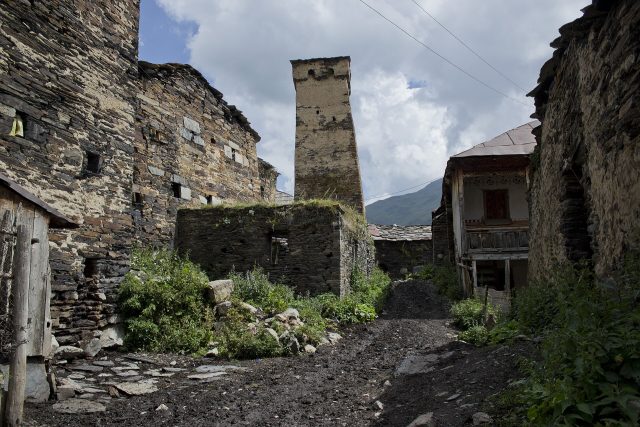
One of the most striking features of the museum is its collection of Svan crosses—elaborate metalwork pieces that once adorned churches and homes. Their intricate designs and symbolic meanings continue to fascinate historians and visitors alike. Equally compelling are the models of Svan defensive towers, which stand like silent sentinels over the region’s villages. These towers, built to withstand raids and feuds, are a defining feature of Svaneti’s landscape. Their imposing presence is a reminder of a time when safety depended on the strength of one’s walls and the loyalty of one’s kin.
Beyond the past, the museum also offers a glimpse into the living traditions of the Svans. Musical instruments used in festivals, traditional clothing worn during celebrations, and early 20th-century photographs capture the continuity of Svan culture. The images, in particular, are striking—they show villages that look almost unchanged today, with the same stone towers, the same rugged mountains, and the same faces bearing the unmistakable features of the Svan people. It’s as if the photographs were taken yesterday, not a century ago.
What makes the museum special is its atmosphere. The rooms are quiet, the light soft, and the air carries a sense of reverence for the objects on display. The guides, often locals with deep roots in the region, don’t just recite facts; they share stories passed down through generations. Their narratives bring the exhibits to life, turning a visit into something more than a tour—it becomes a conversation with history. There’s no rush here, no forced enthusiasm, just a quiet invitation to listen and understand.
After leaving the museum, a walk through Mestia’s streets feels like a natural extension of the experience. The ancient towers, the stone houses with their wooden balconies, and the narrow lanes winding between them all echo the stories told inside the museum. If you’re lucky, you might hear the sound of Svan polyphonic singing drifting through the air—a tradition as old as the mountains themselves. The museum isn’t just a stop on a journey; it’s a gateway to understanding what makes Svaneti unique.
This is a place where the past isn’t confined to glass cases. It lives in the way people build their homes, in the songs they sing, and in the way they greet strangers. The Svans have managed to hold onto their heritage not by clinging to the past, but by letting it shape their present. The museum captures that balance—between preservation and evolution, between isolation and connection. For anyone visiting Svaneti, it’s the first step in seeing the region not just as a destination, but as a living culture.