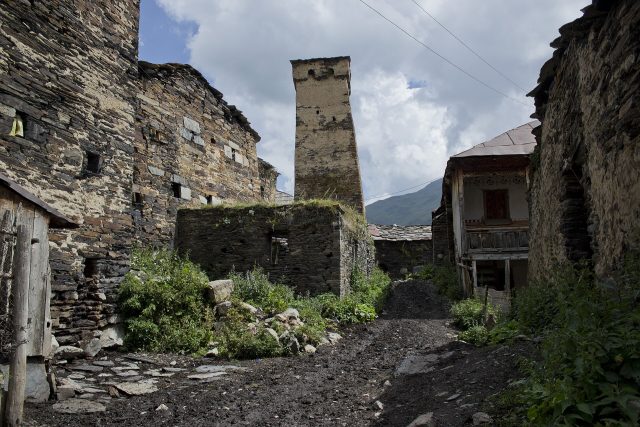
Svaneti’s jagged peaks rise like ancient watchtowers over the valley. Medieval stone towers, weathered by centuries, stand guard along the slopes. The past isn’t distant here—it’s in the way sunlight spills over worn paths, in the unhurried rhythm of life that hasn’t changed since the Middle Ages. The Chalaadi Glacier belongs to this world, not as a tourist stop, but as something older, something the locals have known since childhood. No signs point the way, no crowds gather. Only the glacier, the mountains, and the quiet understanding that some things don’t need words.
The path to Chalaadi starts where the paved road ends. From there, a narrow trail winds through the valley, past shepherds’ huts and grazing livestock. The glacier spills down from Tetnuld, one of Svaneti’s highest peaks, its pale blue-gray tongue visible long before you reach it. On clear days, the ice glints in the sunlight, shifting from silver to deep blue as the hours pass. Even those who know mountains well pause to watch.
For centuries, Chalaadi shaped life in these valleys. Its meltwater fed rivers that sustained crops and livestock. Its sheer mass acted as a natural barrier, making the region harder to invade. In colder times, the glacier stretched farther down the mountain, its edges creeping closer to the villages below. Now, like many glaciers in the Caucasus, it’s retreating. Its slow withdrawal is a quiet sign of change, but it remains a vital part of the landscape—a source of water and a reminder of how deeply the land and its people are tied.
Up close, the glacier is rough and uneven, scarred by crevasses and strewn with moraines. In some places, the ice glows translucent blue, as if lit from within. In others, it’s opaque and gray, marked by dust and sediment. In winter, it blends into the snow-covered slopes. But in summer, its lower reaches emerge, revealing layers of ice that tell a story of accumulation and movement. It’s not static. It’s alive, reshaping itself under wind, water, and time.
The hike to Chalaadi isn’t easy. It starts a few kilometers from Mestia, following a trail that climbs steadily through the valley. The walk takes about two hours each way. The path can be rocky, the weather unpredictable—sunshine can turn to mist in minutes. June to September is the best time to visit, when the trail is clear of snow and the glacier is most accessible. Even then, the air stays cool, the wind sharp.
Silence around Chalaadi isn’t the absence of sound. It’s the rush of wind, the echo of a bird’s call off the cliffs, the bleat of sheep on the slopes. Sometimes a shepherd leads his flock near the glacier, their figures small against the ice. In those moments, it’s clear why Svaneti draws people who seek more than scenery. The glacier doesn’t ask for admiration. It simply exists, indifferent yet impossible to ignore.
Chalaadi is retreating. Over the past few decades, its edges have pulled back up the mountain. For the people of Svaneti, this isn’t just about climate—it’s a shift in something fundamental. The glacier’s meltwater irrigates their fields and sustains their communities. Its retreat is a reminder of how fragile even the most imposing natural features can be. Yet for now, it still dominates the landscape, a frozen river that has flowed for millennia.
No tour buses stop here. No souvenir stands or cafes line the path. Just ice, mountains, and sky. You can walk right up to the glacier’s edge, press your hand against its cold surface, feel the ancient ice melting beneath your fingers. It’s not a place for those who want entertainment. It’s for those who want to see nature as it is—raw, beautiful, and slightly mysterious. The glacier doesn’t offer answers. Only questions.
When you return to Mestia, the glacier stays with you. From a distance, it blends into the mountains. But you know it’s there—a silent force that has shaped this valley for centuries. Its future is uncertain. Maybe that’s why it’s worth seeing now. Not as a monument to the past, but as a living piece of history, one that reminds us how quickly the world can change, even in places that seem untouchable.