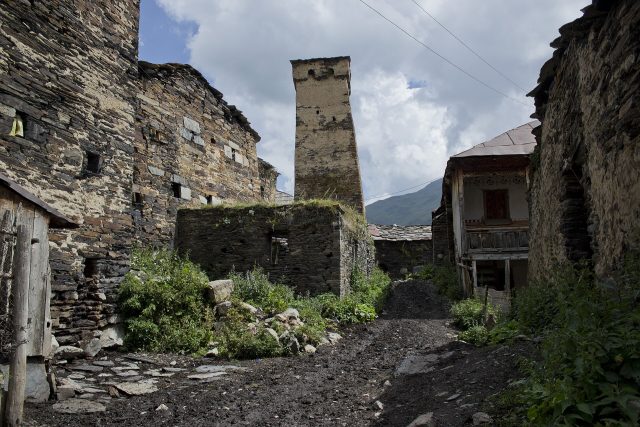
Perched on a gentle hill at the edge of Mestia, Lamaria Church feels less like a building and more like a natural extension of the landscape. The gray stone walls, weathered by centuries of wind and snow, blend seamlessly with the rugged peaks of the Greater Caucasus that rise in every direction. From here, the view stretches across the village and the valley below, where the Mestiachala River winds its way toward the Inguri. On clear days, the snow-capped summits of Ushba and Tetnuldi seem to dissolve into the sky, their outlines shimmering in the thin mountain air. The church itself is small, almost modest, yet its presence is undeniable—a quiet sentinel overlooking the land it has watched over for a thousand years.
Lamaria is more than just a place of worship; it is a living piece of Svaneti’s history, where faith and daily life have always been intertwined. Dedicated to the Virgin Mary, the church embodies the distinctive features of Svan architecture: sturdy walls built from local stone, low vaulted ceilings, and an almost complete absence of ornate decoration. Everything about it speaks of practicality, of a people who built to endure. Constructed between the 10th and 11th centuries, Lamaria emerged during a time when Svaneti was not only a remote mountain stronghold but also a bastion of Christian culture, preserving its traditions far from the influence of larger religious centers. The church’s design reflects this dual role—it was never meant to be grand, but it was built to last.
Step inside, and the austerity of the exterior gives way to something richer. The walls are covered in faded but still-vibrant frescoes, their colors muted by time yet retaining a quiet intensity. The images follow the Byzantine tradition but carry a distinctly Svan character: figures appear solemn and still, their expressions more about reverence than emotion. Christ Pantocrator gazes down from the ceiling, while scenes of saints and biblical stories unfold in careful detail. Among them, Saint George holds a special place. In Svaneti, he is more than a martyr—he is a protector, a warrior who defended the land not just in legend but in the very real struggles of its people. The frescoes here tell stories that go beyond scripture, rooted in the soil and the struggles of the mountains.
Lamaria was never a grand cathedral or a wealthy monastery. It was, and remains, a parish church—a place where people came not for elaborate ceremonies but for solace. In a region where raids and conflicts were once common, churches often doubled as fortresses. Though Lamaria was not built for war, its thick walls and small windows made it a refuge when danger came. Centuries ago, villagers would gather here with their livestock and belongings, waiting out threats behind its sturdy stone. The church’s compact size and solid construction made it an ideal shelter, a place where the community could hold on until the storm passed.
Today, Lamaria is still an active church, though services are infrequent. A priest visits when he can, sometimes once a month, sometimes less. Yet even when the doors are closed, the church doesn’t feel abandoned. Locals treat it with quiet reverence, leaving candles, bread, or cheese at the entrance as offerings. Some come simply to sit on the bench outside, watching the mountains or the slow drift of clouds over the valley. For them, Lamaria is not just a relic of the past but a connection to the generations who came before, who lived and died in these mountains and passed down their faith along with the land.
The architecture is simple, almost severe, but there is a harmony in its restraint. The church is built from the same gray stone as the surrounding peaks, its roof sloping gently under heavy stone tiles that have withstood countless winters. The entrance is low, forcing visitors to bow their heads—a deliberate choice, a reminder of humility before the sacred. Inside, the space is divided into a small narthex and the main hall, where a few wooden benches and a plain altar stand in the dim light filtering through narrow windows. The frescoes seem to glow in the soft, diffused light, their ancient stories flickering like embers in the quiet.
Surrounding the church is an old Svan necropolis, where stone crosses and tombstones stand in silent clusters. Some date back to the early Middle Ages, their surfaces carved with sun symbols, crosses, and occasionally human figures. The graves are close together, as if the dead, too, sought company in this harsh land. The tradition behind these markers speaks of a belief in continuity, in a world where death is not an end but a passage. The Svans who lie here were people of the mountains, who understood that life and faith were inseparable from the land itself.
Visiting Lamaria is less about sightseeing and more about stepping into a rhythm that moves slower than the outside world. There are no crowds, no guided tours, no signs dictating how to behave. There is only the stillness of the mountains, the whisper of the wind through the grass, and the sense that time here follows its own rules. The best moments come early in the morning, when mist clings to the valley and the first light touches the peaks, or in the evening, when shadows stretch long and the air carries the scent of woodsmoke and wild herbs. In those hours, Lamaria feels less like a historical monument and more like a living part of something deeper—something that doesn’t need words, only presence.