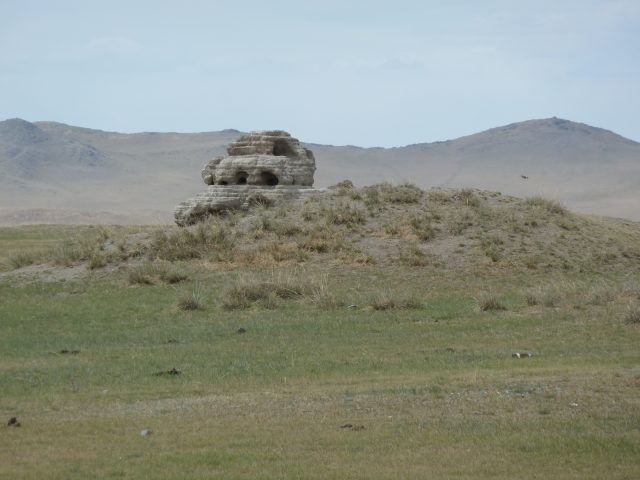
Karakorum is a place where time seems to stand still, preserving the echoes of an empire that once stretched across half of Eurasia. Today, only ruins remain, yet even these fragments tell the story of a city that was once the heart of the Mongol Empire, founded by Genghis Khan in the early thirteenth century. What was once the political and cultural center of a nomadic superpower now lies quietly in the steppes of central Mongolia, in the Orkhon Valley, surrounded by endless horizons and a silence broken only by the wind and the occasional voices of travelers.
The history of Karakorum begins in 1220, when Genghis Khan chose this spot for his encampment. But the city truly flourished under his son, Ögedei, who transformed a temporary settlement into a full-fledged capital. Palaces, temples, and markets rose from the earth, while its streets teemed with merchants, artisans, and diplomats from across the known world. Karakorum became a symbol of unity for an empire where nomadic traditions intertwined with settled civilizations, where Buddhism, Christianity, Islam, and shamanism coexisted. It was more than just an administrative hub—it represented a new era, when the steppe first spoke the language of global power.
Little remains of Karakorum’s architecture today, but even the ruins hint at the city’s former grandeur. The most famous relic is the so-called Genghis Khan Stone, a massive turtle that once served as the base for an inscribed stele. The turtle symbolized eternity and stability, though the empire itself did not last as long as its founders might have hoped. Nearby, the foundations of palaces and temples lie scattered, along with fragments of the city walls that once encircled Karakorum. One spot, said to be where Ögedei’s palace once stood, is particularly evocative—a vast structure with a golden roof, described by European travelers of the time.
One of the most striking reminders of Karakorum’s past is the Erdene Zuu Monastery, built in the late sixteenth century on the ruins of the old capital. Commissioned by the Mongol ruler Abtai Sain Khan, the monastery was an attempt to revive the spiritual traditions of the land that had once been the empire’s heart. Erdene Zuu became Mongolia’s first Buddhist monastery and remained one of its most important religious centers for centuries. Today, its walls, adorned with traditional Mongolian paintings and sculptures, preserve the memory of a time when Buddhism was just beginning to take root in the steppes.
Karakorum was not always a city of ruins. After the fall of the Mongol Empire, it remained an important trade and cultural hub for decades, until it was destroyed in the late fourteenth century by the forces of China’s Ming Dynasty. The city gradually faded into the steppe, its former glory buried beneath the earth. It wasn’t until the twentieth century that archaeologists began uncovering its secrets, allowing Karakorum to speak to the world again, though now only in the language of stone and dust. What visitors see today is just a fraction of what once was, but even that is enough to leave an impression on those willing to listen.
Visiting Karakorum is less about seeing landmarks and more about immersing yourself in the atmosphere of a place where past and present merge. The steppe around the city is much the same as it was hundreds of years ago—vast, quiet, filled with the scent of wormwood and dry grass. There are no crowds, no noise, just the wind, the sky, and the occasional silhouette of a yurt on the horizon. Time moves slowly here, allowing visitors to truly sense the spirit of a nomadic civilization for which the land was always a path, not a permanent home.
Karakorum is not just a historical site; it’s a symbol of impermanence. A city that once dictated its will to half the world now lies in ruins, a reminder of how quickly power can turn to oblivion. Yet even in this state, it remains a vital place for Mongolians, for it was here that their statehood took shape, where a culture emerged that blended nomadic and settled traditions. For travelers, Karakorum offers a chance to touch an era when the steppe was not just a landscape but the center of world history.
Today, Karakorum is an open-air museum, where every stone holds a memory of the past. There are no lavish palaces or grand cathedrals, and that’s what makes the place special. It doesn’t try to dazzle; instead, it invites reflection on how quickly the world changes and how fragile the memory of past greatness can be. For those who come here, Karakorum is more than just a dot on a map—it’s a place where the echoes of history can still be heard, where the breath of centuries lingers in the air.