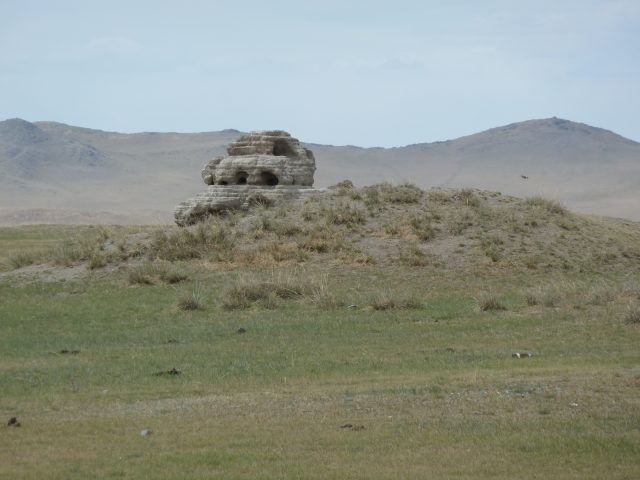
The Göktürk Museum in Karakorum is where the vast history of the Eurasian steppe takes tangible form. Nestled near the ruins of what was once the capital of the Mongol Empire under Ögedei Khan, Genghis Khan’s son, this small but significant institution bridges the gap between past and present. Karakorum itself was a crossroads of civilizations—a place where nomadic and settled peoples, traders from China and Persia, Buddhists and Christians all converged. The museum, established in the early 2000s, preserves the legacy of the Göktürks, a Turkic people whose influence shaped Central Asia for centuries.
The museum’s building is unassuming, blending quietly into the endless Mongolian landscape. Inside, its modest halls house artifacts uncovered from the ruins of the Uyghur Khaganate and other Turkic states. Stone steles inscribed with runic script, everyday objects of nomadic life, weapons, jewelry, and fragments of pottery offer glimpses into a world over a thousand years old. The exhibits include reconstructions of ancient burial sites and ritual complexes, helping visitors imagine the lives of those who once roamed these lands. There’s a sense of intimacy here, as if the past isn’t just displayed but gently invited into the present.
The Göktürks, or "Blue Turks," were one of the most enigmatic and powerful forces of the early medieval period. Their empire stretched from Manchuria to the Black Sea, leaving an indelible mark on the political and cultural landscape of Eurasia. The museum doesn’t just document their history; it reveals how Turkic traditions intertwined with others. Buddhist statuettes and Christian crosses found in Karakorum hint at the religious tolerance that defined Mongol rule. These artifacts remind us that the steppe was never isolated—it absorbed and reinterpreted outside influences while staying true to its own identity.
A highlight of the museum is its collection of runic inscriptions, some of the earliest examples of Turkic writing. Carved into stone, these texts recount tales of warfare, dynastic struggles, and the daily lives of nomadic peoples. Translations accompany some of the steles, and though the language is ancient, its Turkic roots remain recognizable. For many visitors, this is a revelation—proof that the steppe’s inhabitants had a written culture long before the spread of Islam or Buddhism, and that their history is far richer than the stereotype of warlike horsemen suggests.
The museum isn’t just a repository of artifacts; it’s an attempt to recreate the atmosphere of the Göktürk era. Traditional Mongolian music plays softly in the background, guiding visitors through the rise and fall of the Turkic khaganates. There’s no glorification of the past here—just a clear-eyed look at how fragile these empires were, dependent on the whims of rulers and the constant threat of external forces. In this way, the museum serves as both a historical record and a quiet meditation on the fleeting nature of power.
Karakorum itself is a place steeped in history. Though little remains of the once-great capital, the ruins still carry a sense of grandeur. Nearby stands the Erdene Zuu Monastery, built in the 16th century using stones from the destroyed city. The juxtaposition of Buddhist temples and Turkic steles creates a powerful sense of continuity, as if one era seamlessly flows into the next. The Göktürk Museum acts as a key to understanding this layered past, showing how the identities of Central Asia’s peoples were shaped by centuries of exchange and conflict.
Visiting the museum offers a chance to see Mongolia through the eyes of those who lived here long before modern borders were drawn. The exhibits don’t divide history into neat categories of nations or ethnic groups. Instead, Türks, Uyghurs, and Mongols appear as part of a shared cultural space, where alliances and wars came and went, but traditions endured. For many travelers, this is an eye-opening experience—history books often present the region’s past in fragments, but here, the pieces come together to form a cohesive narrative.
The museum is small enough to explore in a couple of hours, yet its impact lingers. There’s no attempt to dazzle with opulence or scale; instead, it tells a story with honesty and restraint. The absence of crowds and commercial distractions only deepens the sense of connection to the past. After leaving the museum, stepping outside into the vast steppe—where the wind carries echoes of ancient voices—makes it clear why Karakorum and its museum are more than just a tourist stop. They are places where history feels alive, where the land itself seems to whisper the stories of those who came before.