The Orkhon Inscriptions stand as silent witnesses to a time when the vast steppes of Central Asia were ruled by nomadic empires whose influence stretched across continents. Carved into two towering granite steles in the eighth century, these inscriptions are among the earliest known examples of written Turkic language, offering a rare glimpse into the world of the Second Turkic Khaganate. They were commissioned by Bilge Khagan and his brother Kul Tigin, rulers whose names echo through the centuries in these weathered stones. The texts are more than historical records—they reveal the values of a people who saw power, legacy, and memory as forces as enduring as the land itself.
The Orkhon Valley, where the steles now stand, has long been a crossroads of empires. For millennia, this fertile stretch of land along the Orkhon River served as a meeting point for trade, conquest, and cultural exchange. The valley witnessed the rise and fall of the Xiongnu, the Uyghur Khaganate, and later the Mongol Empire, each leaving behind traces of their presence. The inscriptions themselves remained hidden in plain sight for centuries, their meaning lost until the late 1800s, when Russian explorer Nikolai Yadrintsev stumbled upon them during an archaeological expedition. Even then, their significance wasn’t fully understood until Danish linguist Vilhelm Thomsen deciphered the runic script in the early 1900s, unlocking a direct line to the voices of the past.
What makes these inscriptions particularly striking is their personal tone. Unlike many ancient texts that speak in the detached language of chronicles, these were written in the first person, as if Bilge Khagan and Kul Tigin were addressing their descendants across the ages. The words recount military campaigns, internal struggles, and the khagans’ efforts to consolidate power, but they also convey a sense of urgency—a desire to be remembered, to leave behind something that would outlast their fleeting lives. The steles were not merely monuments; they were declarations of identity, carved into stone so that future generations would know who had shaped the destiny of the steppes.
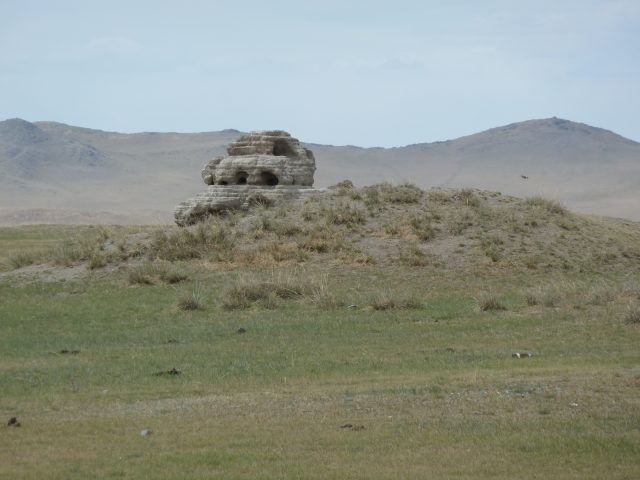
The setting of the inscriptions adds to their weight. Each stele rests on a stone base, surrounded by the remnants of what may have been ritual structures or ceremonial sites. Nearby, stone carvings of sheep and other animals lie scattered, remnants of Turkic burial traditions that linked the living with the dead. The landscape itself feels charged with history—rolling grasslands stretch toward distant mountains, while the Orkhon River winds through the valley, its waters reflecting the same sky that has watched over this place for centuries. The wind carries the scent of sagebrush and dry earth, a reminder that some things here have remained unchanged.
Reaching the Orkhon Inscriptions requires a journey through the heart of Mongolia. The nearest major settlement is Kharkhorin, once the capital of the Mongol Empire under Genghis Khan’s successors. The road from there cuts across open steppe, where the horizon blurs into the sky and the only signs of life are the occasional ger (yurt) of nomadic herders, their flocks of sheep and horses dotting the landscape. The drive itself is a transition from the modern world into one where time moves differently, where the past feels closer to the surface. By the time you arrive, the noise of cities has faded, replaced by the quiet rhythm of the land.
There are no crowds here, no tourist traps—just the wind rustling through the grass and the steles standing as they have for over a thousand years. It’s a place that invites reflection, not just on the history it preserves, but on the nature of legacy itself. The inscriptions remind us that even in an era of nomadic empires, where power was measured in horses and conquest, people sought permanence. They wanted their stories to endure, to be read by those who came after. In that sense, the Orkhon Inscriptions are more than relics; they are a conversation across time.
For anyone drawn to the history of Central Asia, this site is essential. It offers a window not only into the Turkic Khaganate but into the broader story of the Eurasian steppes—a region where cultures collided, religions spread, and empires rose and fell like the seasons. The inscriptions capture a moment when the nomadic world was at its height, when the steppes were not just a backdrop to history but its stage. Standing here, it’s easy to imagine the khagans who once ruled these lands, their voices carried on the wind.
Beyond the inscriptions, the Orkhon Valley itself is a place of quiet beauty. Recognized as a UNESCO World Heritage site, it encompasses sweeping grasslands, rugged mountains, and the meandering river that gives the valley its name. The landscape is alive with wildlife—eagles circling overhead, herds of wild horses galloping in the distance, and the occasional marmot darting between rocks. For those who venture here, the valley offers more than history; it offers a chance to step into a way of life that has persisted for centuries. Visitors can spend days exploring the area, staying with nomadic families, learning about their traditions, and experiencing the solitude of a land where the sky feels endless.
The Orkhon Inscriptions are not just stones with writing on them. They are a bridge between eras, a reminder that history is written not only in books but in the earth itself. Mongolia is often seen as a land of vast emptiness, of nomads and horses and endless steppe, but places like this reveal another side—a country with a deep and layered past, waiting to be discovered. To stand before these steles is to feel the weight of that past, to understand that even in a world of impermanence, some things endure.