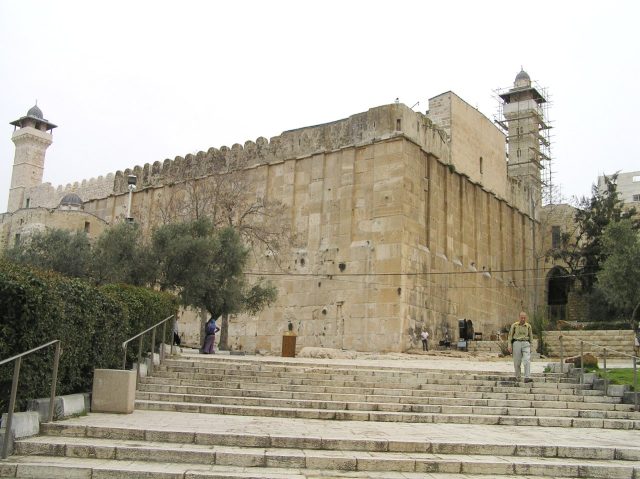
The Cave of the Patriarchs, known in Arabic as Al-Haram Al-Ibrahimi, stands in the heart of Hebron as one of the most ancient and revered sites in the Middle East. For millennia, it has been a place of pilgrimage, prayer, and reflection for Jews, Christians, and Muslims alike. According to tradition, this is the final resting place of the biblical patriarchs and matriarchs—Abraham and Sarah, Isaac and Rebekah, Jacob and Leah—figures whose stories form the foundation of three major world religions. The weight of history here is almost tangible, a quiet force that draws visitors not just to see, but to feel a connection to something far older than themselves.
The structure itself is imposing, a fortress-like edifice of massive stone walls and narrow slits that once served as arrow loops. Built in the 1st century BCE by Herod the Great, the same ruler behind Jerusalem’s Second Temple and Masada, the site was designed to endure. Over the centuries, it has absorbed layers of history: Crusader modifications, Mamluk additions like the towering minarets, and the slow accumulation of religious significance. Today, it remains one of the few places in the world where a synagogue and a mosque exist under the same roof, separated by partitions but sharing the same sacred ground. The building’s very architecture tells a story of conquest, faith, and adaptation, its stones bearing the marks of those who have come and gone.
Inside, the atmosphere is one of solemnity. The air feels cooler, the light softer, filtering through small windows to illuminate the marble tombs of the patriarchs. Each grave is marked with inscriptions in Hebrew and Arabic, their surfaces worn smooth by centuries of touch. The tomb of Abraham, the most prominent, draws the most visitors—some kneeling in prayer, others standing in silent contemplation. The interior is spare, almost austere, with little ornamentation beyond the occasional carved detail. Yet there is a quiet beauty in its simplicity, a sense that the space exists not for grandeur, but for reverence.
Hebron, the city that cradles the cave, is itself a place of contradictions. One of the oldest continuously inhabited cities in the world, it is mentioned in the Bible as the site where Abraham purchased land to bury Sarah. Today, it is divided, a microcosm of the broader tensions in the region, with Israeli and Palestinian sectors existing side by side. The Cave of the Patriarchs sits at the edge of this divide, a rare point of overlap where the past refuses to be overshadowed by the present. For many, visiting the site is as much about confronting the complexities of modern Hebron as it is about honoring its ancient significance.
The cave’s importance transcends religious boundaries. For Jews, it is the burial place of the forefathers, a tangible link to the origins of their faith. Muslims revere it as the Mosque of Abraham, where the prophet Ibrahim is said to be buried. Christians, too, find meaning here, seeing it as part of the biblical narrative that shapes their own traditions. Despite the differing interpretations, all three faiths share a common thread: the belief that this is holy ground, a place where the divine and the human have intersected for thousands of years. It is a rare point of convergence in a region often defined by division.
The architecture of the site reflects its layered past. The original Herodian walls, constructed from massive, precisely cut stones, still stand as a testament to the engineering prowess of the time. Later additions—the minarets, the vaulted ceilings, the intricate tilework—speak to the site’s evolution under different rulers. The main hall, where the tombs are located, is particularly striking. The arrangement of the graves, the play of light and shadow, even the way the space is divided between Jewish and Muslim worshippers, all carry symbolic weight. It is a place where every stone seems to whisper a story.
Beyond its religious and historical significance, the Cave of the Patriarchs is also a living part of Hebron’s daily rhythm. Outside its walls, the city bustles with life—vendors selling spices and textiles, children playing in the narrow streets, the hum of conversation in Arabic and Hebrew. Yet the moment you step inside, the noise fades, replaced by an almost palpable stillness. The contrast is striking: the chaos of the present giving way to the quiet of the eternal. It is a reminder that some places exist outside of time, where the weight of history is not just remembered, but felt.
For those who visit, the experience is often deeply personal. There is no rush here, no agenda beyond the act of being present. Some come seeking answers, others simply to pay their respects. The cave does not demand belief; it only offers space for reflection. Whether you arrive as a pilgrim or a curious traveler, the site has a way of lingering in the mind long after you leave. It is a place that challenges easy narratives, where the past and present coexist uneasily, and where the sacred is never far from the everyday. In a world that often feels fractured, the Cave of the Patriarchs endures as a quiet witness to the enduring power of faith, memory, and shared humanity.