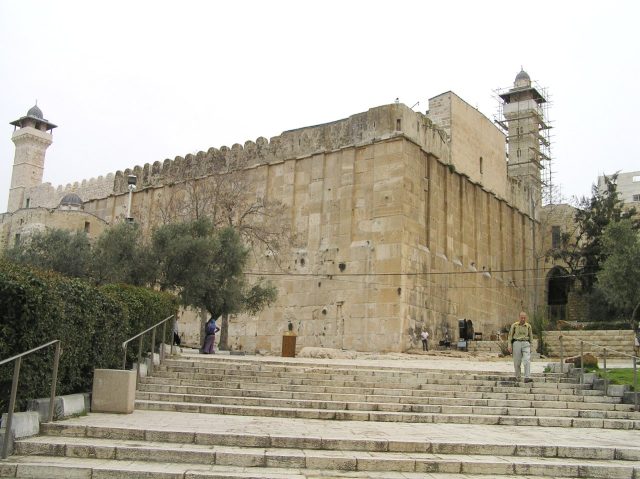
The Ibrahimi Mosque in Hebron is one of those rare places where history isn’t just remembered—it’s felt in the very ground beneath your feet. Built over the Cave of the Patriarchs, it holds within its walls the weight of ancient traditions, where, according to sacred texts, the biblical figures of Abraham and Sarah, Isaac and Rebekah, Jacob and Leah were laid to rest. For Muslims, it is the third holiest site after Mecca and Medina, believed to be the burial place of the Prophet Ibrahim, the shared patriarch of Islam, Christianity, and Judaism. The mosque itself, constructed in the 12th century atop earlier structures, rises like a fortress, its massive stone blocks stacked with a solemnity that transcends time.
The architecture tells a story of shifting faiths and empires. Originally a Crusader church, the building was transformed into a mosque after Saladin’s conquest of Hebron in 1187. Over the centuries, it absorbed new elements—minarets, domes, and courtyards—each layer reflecting the hands of those who came before. The marble mihrab, intricately carved to point toward Mecca, stands as a masterpiece of craftsmanship, while the interior, though spacious, feels intimate under the soft light filtering through narrow slits in the thick walls. There’s a quiet grandeur here, a sense of reverence that lingers in the air.
Beneath the mosque lies the Cave of the Patriarchs, the heart of this sacred site. Access is restricted, and even those permitted inside see only a fraction of the underground chambers. Tradition holds that the tombs of the patriarchs rest here, though the actual burial sites remain hidden from view. For Jews, this is the Cave of the Patriarchs, second only to the Western Wall in Jerusalem in its spiritual significance. Muslims know it as the Haram al-Ibrahimi, a place of prayer and reflection on the life of the Prophet Ibrahim. The shared veneration of this space speaks to a deeper, if often overlooked, connection between the three Abrahamic faiths.
Hebron has long been a city of intersecting histories, and the Ibrahimi Mosque sits at its core, surrounded by the narrow alleys of the Old City. The streets still echo with the footsteps of Ottoman-era merchants and pilgrims who once traveled from across the Middle East to pay their respects. Today, the atmosphere is more complicated. The city is divided, access to the mosque tightly controlled, and security measures shape the experience of visitors. Yet for many, the site remains a powerful symbol of unity, a reminder that these faiths, despite their differences, share a common origin.
Inside the mosque, time moves differently. The silence is broken only by the soft shuffle of feet on stone and the murmur of prayers. The high ceilings and sturdy columns create a sense of timelessness, as if the outside world has faded away. There’s no opulence here—no gilded domes or ornate mosaics—just the quiet dignity of worn carpets, antique lanterns, and the faint scent of incense. During religious festivals, the space comes alive with the voices of worshippers, their prayers resonating against the ancient walls.
The Ibrahimi Mosque is more than a monument; it’s a living testament to centuries of devotion. For the people of Hebron, it remains a spiritual anchor, a place to seek solace and reconnect with something greater than themselves. For travelers, it offers a rare glimpse into a history that isn’t just written in books but passed down through generations in stories and rituals. In a city where every stone carries the weight of the past, the mosque stands as a quiet witness to the enduring power of faith—and the hope that, even in the most divided of places, it might one day bring people together.