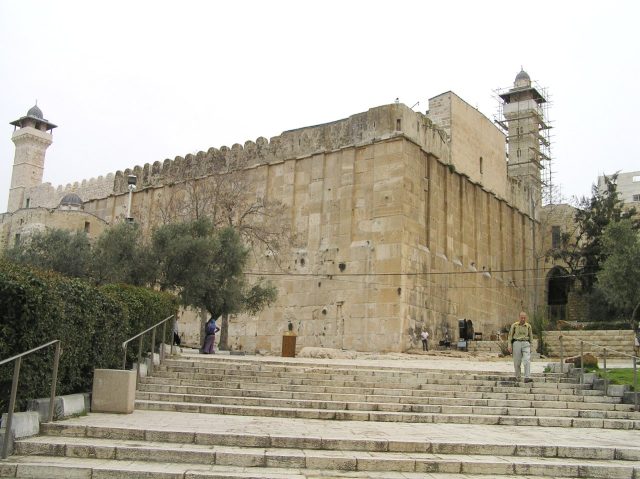
Hebron is one of the oldest continuously inhabited cities in the world, a place where layers of history unfold at every turn. Its narrow streets and ancient stone buildings carry the weight of millennia, and among them lies a site revered by three major faiths: the Tomb of Jesse and Ruth. For Jews, this is part of the Cave of the Patriarchs, where tradition holds that not only the forefathers and foremothers of the Jewish people are buried, but also the parents of King David. Christians see it as a sacred link in the lineage of Jesus, tracing back to Jesse, the father of David, from whom the Messiah descended. Muslims honor it as part of the Al-Haram al-Ibrahimi complex, where the prophets Ibrahim, Ishaq, and Yaqub rest.
The tomb is located within the ancient Cave of Machpelah, a site that has been a focal point of devotion and dispute for centuries. According to tradition, Abraham purchased this cave from the Hittites as a burial place for his wife Sarah, and it later became the resting place for several generations of biblical figures. Over time, a massive stone structure was built above the cave, now known as the Cave of the Patriarchs. Its walls, constructed from enormous blocks—some weighing dozens of tons—stand as a testament to ancient engineering. While historians debate the exact timeline of its construction, most agree that the core of the building dates back to the time of Herod the Great, around two thousand years ago.
Stepping inside the complex, the air feels thick with history. Dimly lit passageways lead to the tombs, where the scent of stone and incense lingers. The Tomb of Jesse and Ruth is housed in a separate chamber, accessible to pilgrims and visitors, though access can sometimes be restricted due to religious or political tensions. The site itself is marked by a modest tombstone, surrounded by notes left by the faithful—prayers and petitions scribbled on paper. For many, this is not just a historical monument but a living connection to faith, passed down through generations.
Hebron’s history is one of conflict and coexistence, with the city changing hands countless times—from Byzantines to Arabs, Crusaders to Mamluks, Ottomans to British. Each era left its mark on the architecture and culture, yet the Cave of the Patriarchs remained a constant center of reverence. In the Middle Ages, a mosque was built over the site, and later, when the city came under Israeli control, part of the complex was designated as a synagogue. Today, the site is divided into Muslim and Jewish sections, reflecting the complex realities of the region.
Visiting the Tomb of Jesse and Ruth is more than just a glimpse into ancient history—it’s an immersion into a city where past and present exist side by side. Hebron is a place where Roman columns are embedded in medieval walls, Ottoman fountains stand among modern buildings, and ancient synagogues neighbor mosques. The city moves at its own pace, and even in times of tension, daily life continues, with people of different faiths maintaining their traditions.
For those interested in biblical archaeology, Hebron offers a rare chance to walk in the footsteps of figures from sacred texts. The Tomb of Jesse and Ruth is just one of many sites where history comes alive. Nearby stands the Oak of Mamre, where Abraham is said to have welcomed angels, and the ruins of ancient settlements yield artifacts confirming the city’s existence as far back as the Bronze Age. Each of these places tells a piece of the story, weaving together a tapestry of millennia.
Yet Hebron is not just a relic of the past. The modern city is a vibrant mix of tradition and contemporary life. Markets overflow with spices from neighboring lands, while cafés serve dishes passed down through generations. Artisans still craft pottery and glass using age-old techniques, and in the evenings, the streets hum with conversation and laughter, a reminder that life endures despite everything.
A visit to the Tomb of Jesse and Ruth is more than a tour—it’s a journey through time. The site invites reflection on how fragile yet enduring memory can be, carried across centuries not just in books but in the hearts of those who visit. Even for the non-religious, the atmosphere here leaves an impression. Hebron is a city that can’t be fully described; it must be experienced.