
Elista
Russia · 10 places
Photo: Original uploader was Buzava at en.wikipedia, Public domain
Elista is a city that defies expectations. Tucked away in the vast steppes of southern Russia, it feels like a place where Europe and Asia quietly meet, where the rhythm of modern life blends with traditions that have endured for centuries. As the capital of Kalmykia, it’s the only city on the continent where Buddhism isn’t just practiced but woven into the very fabric of daily existence. The Kalmyks, descendants of Oirat tribes who migrated here from Dzungaria in the 17th century, carried their faith across thousands of kilometers, and today, their culture shapes the city in ways both subtle and striking. Walk down the streets, and you’ll hear Russian and Kalmyk spoken in the same breath; step into a café, and you might find buuz—steamed dumplings filled with meat—served alongside familiar pelmeni. It’s a place where the past isn’t preserved in museums but lives in the way people greet each other, in the prayers whispered at dawn, in the stories shared over tea.
The city itself is compact, but it doesn’t feel small. The center is clean and orderly, with wide boulevards lined by low-rise buildings painted in soft pastels, their facades reflecting the bright steppe sun. There’s no rush here, no relentless hum of traffic or crowds, yet it doesn’t feel like a sleepy backwater either. Life moves at its own pace, unhurried but not stagnant. The most striking example of this balance is the City-Chess district, built for the 1998 Chess Olympiad. It’s a surreal sight: giant chess pieces scattered across plazas, a museum dedicated to the game, and even a monument to the king. For chess enthusiasts, it’s a pilgrimage site; for everyone else, it’s a quirky landmark that somehow fits perfectly into the city’s unassuming charm.
What truly sets Elista apart, though, is its spiritual heart. The Golden Abode of Buddha Shakyamuni, perched on the edge of the city, isn’t just a temple—it’s a symbol of Kalmykia’s identity and one of the most important Buddhist sites in Russia. The complex is breathtaking in its simplicity: white walls gleaming under the sun, golden domes catching the light, and prayer wheels spinning gently in the wind. Inside, the air is thick with the scent of incense, and the murmur of monks chanting fills the space around the towering statue of Buddha. Visitors can wander through the halls, listen to the rhythmic prayers, or even receive a blessing. For many, this is the reason to come to Elista—a place where faith feels tangible, where the outside world fades into the background.
Beyond the city limits, the steppe stretches endlessly, a landscape that’s easy to dismiss as barren until you look closer. In spring, it bursts into color, wildflowers dotting the grass like scattered jewels; in summer, the air is thick with the scent of wormwood and thyme. This is the domain of the saiga antelope, a creature that once roamed across Eurasia but now survives in only a few places, Kalmykia among them. Spotting one in the wild is a rare treat—they’re skittish, vanishing into the distance at the slightest disturbance. But for those who take the time to explore the steppe’s quiet corners, the sight of a saiga herd moving across the horizon is unforgettable.
Elista doesn’t try to impress. There are no grand historical monuments, no bustling tourist traps, no dramatic landscapes that demand attention. Instead, it offers something quieter: a sense of place that seeps in slowly. It’s a city where time feels different, where the weight of tradition doesn’t clash with the present but coexists with it. You might spend a morning wandering through the temple complex, an afternoon sipping tea in a café while locals debate politics or share stories, and an evening watching the sun set over the steppe, the sky turning shades of gold and pink. It’s not a city that shouts for your attention, but those who visit often find themselves returning, drawn back by its understated pull—a place where the ordinary feels just a little extraordinary.
See & Do
10 places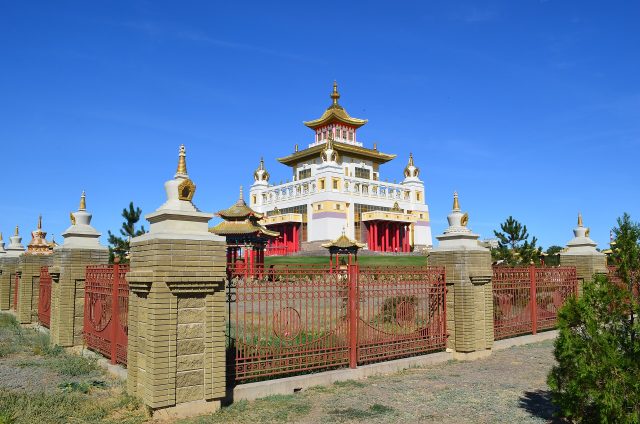


Places on the map
Marker colour follows the categoryClimate and weather
Detailed weather: Elista- Average temperature
- 11 °C
- Precipitation per year
- 389 mm
Average air temperature
°C
-2
-1
4
12
18
25
26
26
18
11
3
-1
Jan
Feb
Mar
Apr
May
Jun
Jul
Aug
Sep
Oct
Nov
Dec


