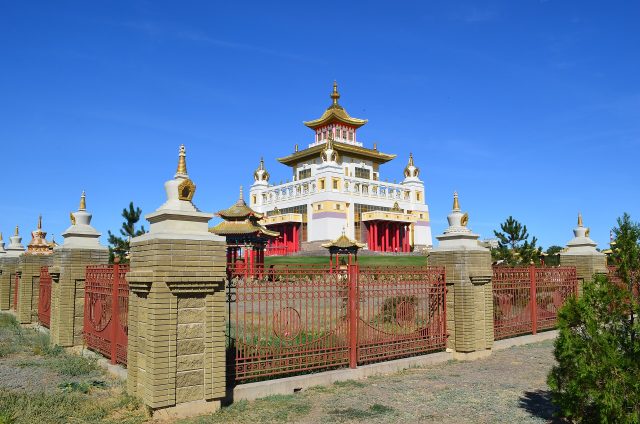
Elista’s City Chess is one of those rare places where a game transcends its rules and becomes something more—a living part of the city itself. Built in the late 1990s, the complex was conceived not just as a venue for tournaments, but as a symbol of renewal for the Kalmyk capital. Chess has deep roots in this region, where the game is more than pastime; it’s a tradition, a craft, and for some, a way of thinking. Today, City Chess stands as one of Russia’s most unusual landmarks, a place that doesn’t fit into any familiar category of architecture or culture.
The centerpiece of the complex is the Chess Palace, a building that looks like it belongs in a fairy tale rather than the flat, open steppes of Kalmykia. Its white walls and sharp, towering spires rise abruptly from the landscape, as if someone had dropped a fragment of a medieval castle into the middle of the city. Inside, the halls are vast and airy, designed to host everything from local club matches to international championships. The palace also houses a chess museum and a library, where visitors can trace the evolution of the game, learn about legendary players, and see rare artifacts—old boards, hand-carved pieces, and even letters from famous grandmasters.
But the Chess Palace is only the beginning. The surrounding area is a small town unto itself, where every detail ties back to the game. The main square features an enormous outdoor chessboard, its pieces tall enough to cast shadows over the players. In the evenings, people gather here—locals, visitors, those who know the rules and those who don’t—to watch matches or try their hand at a game. Nearby, cafes and small shops sell chess-themed souvenirs, from intricately carved wooden sets to books on strategy. The streets themselves are named after chess terms, and sculptures of knights, pawns, and kings dot the pathways, blending into the urban fabric as naturally as lampposts.
The story of City Chess is inseparable from the figure of Kirsan Ilyumzhinov, Kalmykia’s first president and a man whose passion for chess went far beyond politics. In the 1990s, when the region was still finding its footing after the Soviet collapse, Ilyumzhinov proposed an ambitious idea: to turn Elista into a global chess capital. The project received state backing, and within a few years, the city hosted the Chess Olympiad, drawing players from around the world. Since then, Elista has become a regular stop on the international chess circuit, and City Chess has grown into a pilgrimage site for enthusiasts.
For the people of Elista, the complex is more than just a tourist attraction—it’s woven into daily life. Schools hold tournaments here, children attend chess clubs after classes, and adults take beginner courses in the evenings. The palace’s courtyard often hosts open lectures and workshops, where anyone can learn, regardless of skill level. Even weddings have been photographed against the backdrop of the giant chessboard, as if the game itself were blessing the union. There’s a sense that chess here isn’t just a hobby; it’s a thread connecting generations, a skill passed down like a family heirloom.
What makes City Chess unusual is its atmosphere. Unlike most tourist spots, there’s no rush, no crowds jostling for the best photo. Instead, there’s a quiet focus, a rhythm that feels slower, more deliberate. Even if you’ve never played chess, the place has a calming effect. Maybe it’s the way the game demands patience, the way it forces you to think ahead, to see patterns where others see only chaos. Or maybe it’s simply the contrast—the stark, almost surreal architecture against the endless steppe, a reminder that beauty can emerge from the most unexpected places.
In recent years, City Chess has come to represent Elista itself. The city is often overlooked, dismissed as a remote outpost in the Russian south. But the complex gives it a distinct identity, one that doesn’t rely on grand historical monuments or flashy entertainment. Here, culture and sport merge in a way that’s rare anywhere in the world. For many visitors, City Chess is a revelation, a place where an abstract game takes on physical form, where strategy becomes architecture, and where a simple board can feel like the center of something much larger.
If you find yourself in Elista, set aside an hour to wander through the complex. You don’t need to know how to play. Just sit on one of the benches by the giant board and watch the pieces move, or step inside the palace to feel the weight of the game’s history. Maybe you’ll leave with a new appreciation for chess—or maybe you’ll just carry with you the quiet certainty that some places, like some games, are about more than what they appear to be.