Elista doesn’t announce itself. There are no tourist crowds, no busy streets—just quiet lanes, open steppe, and the feeling that time moves differently here.
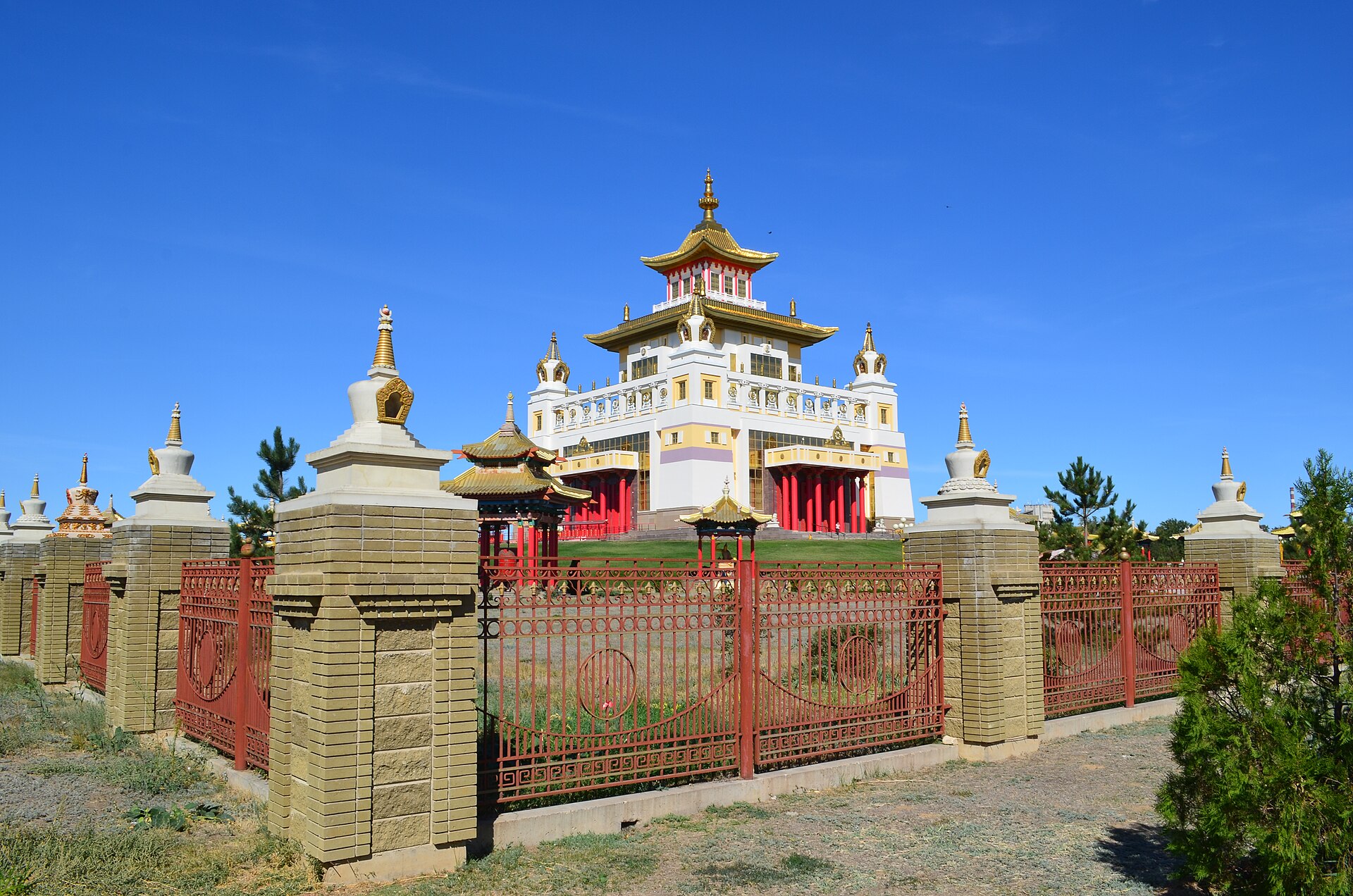
As the capital of Europe’s only Buddhist-majority region, the city carries a distinct identity. The Golden Abode of Buddha Shakyamuni stands at its center, not just as a temple but as a marker of Kalmyk history and belief.
The temple was built in the early 2000s, a period when Buddhism was regaining ground after decades of suppression. Construction started in 2004, and within a year, the complex was consecrated. Its opening mattered beyond Kalmykia—it was a moment for Buddhists across Russia. The design follows Tibetan monastic traditions but adapts them to local history and landscape.
The thirty-meter stupa is visible from a distance, its gilded dome reflecting sunlight. Inside, relics include fragments of the Buddha Shakyamuni’s remains, brought from India. Around the stupa, other structures form a single complex: the prayer hall, a library, classrooms, and the residence of Kalmykia’s Buddhist leader. The buildings share a consistent style, with colors, patterns, and symbols drawn from Buddhist art.
Inside the temple, the air is still. Frescoes cover the walls—scenes from the Buddha’s life, his teachings, and the spread of Buddhism in Kalmykia. A large statue of Buddha Shakyamuni dominates the hall, surrounded by bodhisattvas and other figures. People light butter lamps, leave offerings, and pray. The pace is unhurried. Even visitors unfamiliar with Buddhism notice the weight of the space, the way it feels older than its years.
The temple is also a place of learning. Monks train here, studying Tibetan language, philosophy, and medicine. Exhibitions and lectures preserve Kalmyk traditions. For many in Elista, it’s where they come to think, to find quiet, or to step away from daily noise.
During festivals like Tsagan Sar (the lunar New Year) or the Buddha’s birthday, the temple changes. Families arrive in traditional dress. Offerings of food are made. Gifts are exchanged. Processions circle the stupa, prayers rise, and incense lingers in the air. The celebrations draw even those who don’t practice Buddhism, as they represent a living culture that has survived for centuries.
The temple sits on a hill, overlooking the city and the steppe. In summer, the grounds are green. In winter, snow covers everything, making the golden dome stand out. Locals walk here, take photos, or sit on benches, looking toward the horizon. The place feels vast, like the steppe itself, and it’s easy to see why the Kalmyk people have always tied their identity to the land.
This isn’t a museum. Pilgrims arrive from across Russia and beyond. Monks move through their routines. Children play on the grounds. The temple isn’t separate from the city—it’s part of its rhythm. A visit here isn’t just about seeing a building. It’s about meeting a tradition, a faith, and a culture that has been kept alive through generations.