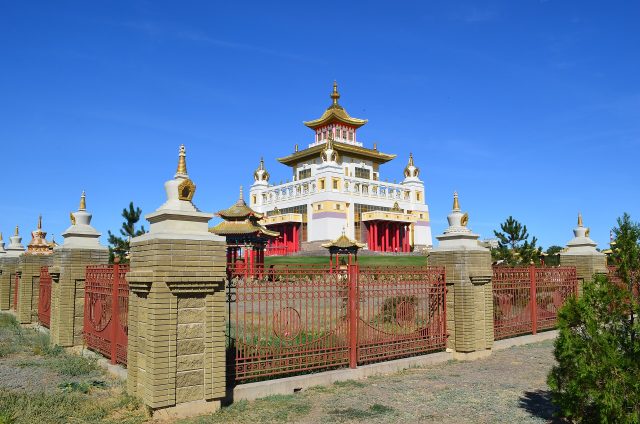
The Government House of the Republic of Kalmykia in Elista is one of those buildings that catches the eye immediately, even if you have no particular interest in politics or architecture. Standing in the heart of the city on Lenin Square, its unusual appearance sets it apart from the standard Soviet-era structures that dominate much of Elista. At first glance, it resembles a scaled-down Buddhist temple, with white walls, gilded domes, and traditional Kalmyk ornaments. This design is no accident—it reflects the cultural and religious identity of the republic, where Buddhism has long been woven into everyday life.
Construction began in the late 1980s and was completed in the 1990s, a time when Kalmykia gained its status as a republic within Russia. Local architects designed the building not just as an administrative center, but as a symbol of the revival of Kalmyk culture after decades of Soviet restrictions on religion and national traditions. Like many peoples of the USSR during that era, the Kalmyks were reconnecting with their roots, and here, in the southern reaches of Russia, Buddhism became more than a spiritual practice—it became a cornerstone of identity.
The architecture blends elements of traditional Kalmyk *khuruls* (Buddhist temples) with modern administrative design. The facades are adorned with stucco reliefs featuring Buddhist symbols—the Dharma wheel, lotuses, and dragons. Above the main entrance rises a large dome covered in gold leaf, flanked by two smaller domes. Inside, the Eastern influence is just as pronounced: high ceilings, marble-like columns, and even a small inner courtyard reminiscent of a monastic garden. It’s not a real temple, of course, but the atmosphere is undeniably unique—a place where politics and spirituality seem to intertwine.
For the people of Elista, the Government House is more than just an office building. It serves as a cultural hub, hosting exhibitions, concerts, and festivals. One of the most vibrant events is Tsagan Sar, the Kalmyk Lunar New Year, when the building is draped in national flags and the square fills with hundreds of people in traditional dress. On such days, the place comes alive with throat singing, the scent of milk tea and sweets, and an air of celebration. Even without a festival, the building and the square in front of it offer a glimpse into how deeply Kalmyk culture is cherished.
The Government House was one of the first major projects completed in Elista after the collapse of the Soviet Union. The 1990s were a difficult time for the city—economic crisis, population decline, crumbling infrastructure—but the construction of this building became a symbol of hope. It showed that even in hard times, identity could be preserved and celebrated. Today, Elista is a small but growing city where modernity and tradition coexist, and the Government House stands as a bridge between the past and the present.
If you find yourself in Elista, it’s worth walking around the building, especially in the evening when the lights come on. The golden domes glow under the streetlamps, giving the structure an almost ceremonial grandeur. The square in front is one of the liveliest spots in the city, always bustling with locals—some hurrying to work, others strolling with their families, and a few sitting on benches with cups of tea. On weekends, small markets often pop up, selling handmade souvenirs, baked goods, and traditional Kalmyk sweets.
This isn’t a tourist attraction in the usual sense. There are no guided tours, museum halls, or gift shops. But that’s precisely why it’s worth seeing. The Government House isn’t just an impressive building—it’s a living piece of the republic’s history. It tells the story of a people who endured deportation and repression yet managed to hold onto their culture and faith. Kalmykia may be one of Russia’s lesser-known regions, but places like this remind us that every culture has its own unique story, waiting to be discovered.