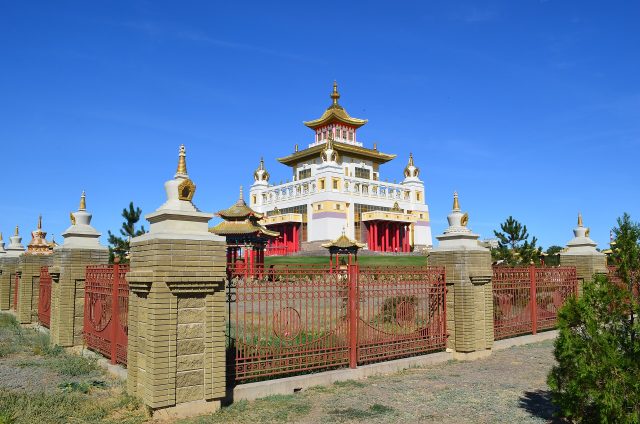
The Enlightenment Stupa in Elista is one of those places that reveals itself slowly. Perched on a low hill at the edge of the city, it doesn’t demand attention at first glance. From a distance, you can see its white dome crowned with a gilded spire, but the real stillness only settles in when you stand right before it. This isn’t just a monument—it’s a symbol of Buddhist tradition transplanted into the Kalmyk steppes, where faith and culture have intertwined with the history of a people who have long called this land home.
Built in the early 2000s, the stupa was part of a broader effort to revive Buddhism in Kalmykia after decades of religious suppression during the Soviet era. The republic, one of the few predominantly Buddhist regions in Europe, began reclaiming its spiritual heritage, and the Enlightenment Stupa became one of the first major structures of its kind. Constructed according to Tibetan traditions, it was crafted with the help of masters from Mongolia and Buryatia, ensuring every ritual detail was observed. Inside, the stupa holds Buddhist relics, sacred texts, and images of bodhisattvas, but its true purpose lies beyond its physical contents—it’s a place for quiet reflection and meditation.
The architecture is deceptively simple, yet rich in symbolism. The white dome represents purity, while the golden spire at the top signifies enlightenment. The eight sides of the base correspond to the Noble Eightfold Path of Buddhism, and the staircase leading to the entrance mirrors the ascent toward spiritual growth. Around the stupa, a small garden with stone paths invites visitors to walk slowly, leaving the noise of the city behind. There are no crowds here, even on weekends, just an atmosphere of quiet reverence.
For the people of Kalmykia, the stupa is more than a landmark—it’s a living place of power. Many Kalmyks, who practice Buddhism, come here to pray, leave offerings, or simply sit in silence. Religious festivals draw larger gatherings, with prayers and rituals held at the stupa, but even on ordinary days, you might encounter visitors from other parts of Russia or travelers curious about spiritual traditions. The stupa isn’t just a tourist stop; it’s a place where faith is quietly lived.
Elista itself is an unusual city, and the stupa fits seamlessly into its rhythm. Far from the hustle of big cities, Elista blends Soviet-era architecture with Buddhist motifs, creating a unique atmosphere. Nearby, you’ll find City Chess, a district known for its chess-themed buildings, and a little farther away, the Golden Abode of Buddha Shakyamuni, a grand Buddhist temple. Together, these places give Elista a sense of quiet purpose, where modernity and tradition coexist without tension.
Visiting the stupa doesn’t require any special preparation. You can come at any time, walk around it clockwise in the Buddhist tradition, or simply stand at the entrance, watching how the light plays on the white walls. Some choose to meditate outside on the benches under the trees rather than entering. There are no strict rules here, just an unspoken respect for the space and those who come with sincere intentions.
The stupa isn’t a place that overwhelms you with grandeur. Its beauty lies in how it harmonizes with the landscape—the vast steppes, the low sky, the sparse trees. On clear days, the golden spire catches the sunlight, while on overcast days, the white walls seem to merge with the clouds. There’s no ornate decoration, no bold colors, just a quiet elegance that makes it feel timeless.
For those who come to Elista not just for chess or local cuisine, the stupa offers something deeper—a chance to reflect on how faith and culture help preserve identity, even in the face of historical challenges. It’s a reminder that spiritual journeys don’t always require distant travels. Sometimes, all it takes is a visit to a city that, at first glance, seems unremarkable, yet holds profound meaning beneath its surface.