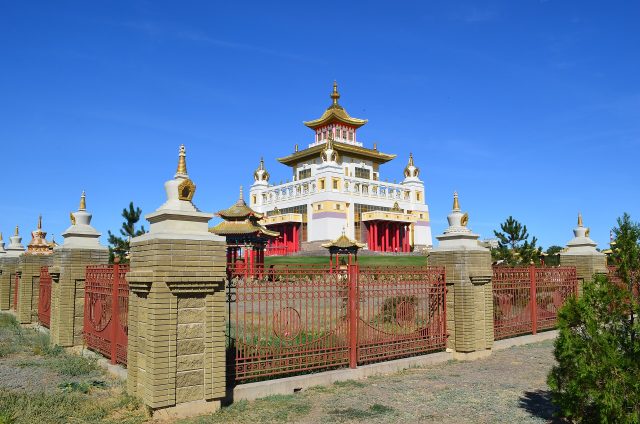
The Pagoda of Seven Days in Elista is one of those places that doesn’t immediately reveal itself to travelers, yet leaves behind a quiet sense of wonder. Perched on a gentle hill in the city center, it appears from a distance not as a building, but as something almost weightless—a structure so light it seems to merge with the sky. There’s no forced exoticism here, no theatrical grandeur that often accompanies Buddhist monuments elsewhere. Instead, it feels natural, as if it has always belonged: Buddhism in the Kalmyk steppe, among low-rise houses and wide streets where the wind carries dust and dry leaves.
The pagoda’s construction began in the 1990s, a time when Kalmykia—the only Buddhist republic in Europe—was reclaiming its cultural identity after decades of Soviet suppression. The idea of building a temple that would symbolize a return to traditional values wasn’t just symbolic; it was deeply personal. After years of exile and forced assimilation, the Kalmyk people sought to restore what had been lost: their language, customs, and faith. The Pagoda of Seven Days became one such symbol, not as a grand statement, but as a quiet invitation—meant for those who come not just out of curiosity, but for stillness.
Its architecture is simple and unadorned, free of unnecessary embellishment. Seven tiers, each dedicated to a day of the week, rise toward the sky, narrowing as they ascend. Inside, there are no elaborate murals or gilded statues like those found in more ornate Buddhist temples. Instead, light filters through narrow windows, filling a space that feels alive, almost breathable. The ground floor houses a prayer hall with traditional Buddhist elements—statues of the Buddha, prayer wheels, sacred texts—but the true essence of the place isn’t in its objects. It’s in the atmosphere: calm, focused, untouched by haste.
Unlike many tourist attractions that thrive on crowds, the pagoda rarely feels busy. This is one of its defining traits. Visitors arrive alone or in small groups, often just to sit in silence, reflect, or pray. In summer, the surrounding steppe stretches endlessly, and from the top tier, the city dissolves into the horizon. Winter brings a different kind of quiet—the snow muffles sound, and time seems to slow. There’s no rush here, no pressure to perform or document the moment.
It’s worth noting that the pagoda isn’t an active monastery or a major religious hub. Instead, it serves as a place for contemplation, gatherings, and meditation. Occasionally, small Buddhist festivals are held here, but they unfold without fanfare, woven into the fabric of daily life. Locals regard the pagoda with respect, though not reverence—it’s simply part of the cityscape, familiar and unassuming. That’s perhaps its greatest charm: it doesn’t seek to impress or astonish. It just exists, as if it has always been there.
So why visit? Not for dramatic photographs or guided tours. The Pagoda of Seven Days offers something else entirely—a chance to pause, step out of the usual rhythm, and feel the world expand around you. There are no crowds, no souvenir stalls, no insistent guides. Just the wind, the steppe, and a silence that sometimes speaks louder than words.
Nearby, a small park provides a place to wander after a visit. The trees are young and not yet towering, but they create a sense of shelter. In summer, their shade offers relief from the heat; in autumn, fallen leaves crunch underfoot. Locals often sit here—some reading, others simply watching the world go by. Like the pagoda, the park moves to its own unhurried pace.
The Pagoda of Seven Days won’t tell you grand stories of battles or famous figures. It won’t dazzle with scale or opulence. But that’s precisely its strength—its simplicity runs deeper than it first appears. Here, you can feel the pulse of the steppe, glimpse how people live in this corner of the world, and perhaps discover something meaningful within yourself. After all, travel isn’t always about loud experiences. Sometimes, it’s about the quiet that lingers long after you’ve left.