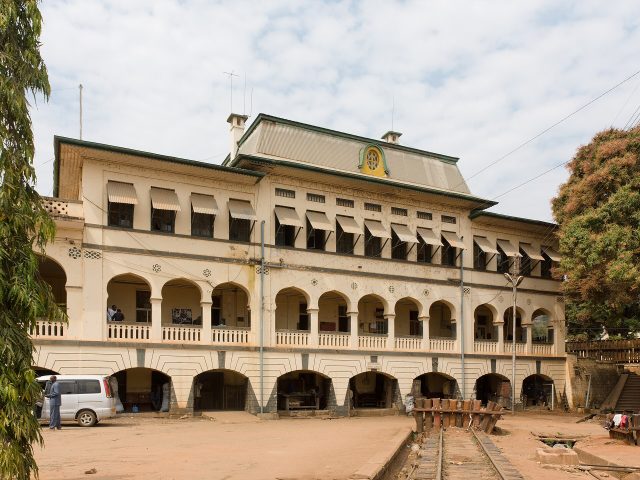
Kigoma’s railway station isn’t just a place where trains come and go. It’s one of those rare spots where the past lingers in the everyday, where the weight of history feels as tangible as the heat rising from the platform. Built in the early 1900s, when Tanzania was still German East Africa, the station was part of an ambitious railway line that stretched from the interior to the Indian Ocean. Back then, Kigoma was more than just a dot on the map—it was a vital link in a chain connecting Lake Tanganyika to the ports of Dar es Salaam, a place where goods, people, and ideas moved in and out with the rhythm of the trains.
The building itself is unassuming, built to last rather than to impress. Thick stone walls, high ceilings, and large windows give it a sturdy, no-nonsense look, the kind of architecture that was meant to endure the tropics without fuss. There’s nothing ornate about it, no grand flourishes or decorative details—just solid, practical design. It’s the sort of place that has seen generations pass through its doors, weathering storms, wars, and the slow march of time without losing its purpose.
Today, the station still plays a central role in Kigoma’s life. Trains here connect the town to the rest of Tanzania, as well as to neighboring countries like Burundi and the Democratic Republic of Congo. For locals, it’s more than just a transport hub—it’s a meeting point, a place where families reunite, where friends say goodbye, where parcels and supplies arrive from distant towns. The platform hums with stories: the farmer heading to market, the student returning home, the trader with goods to sell. You can hear snippets of conversations in Swahili, the occasional laughter, the quiet rustle of people waiting.
The area around the station is alive in its own way. Street vendors set up stalls selling fresh fruit, fried snacks, and cold drinks, while passengers while away the hours before their train arrives. The atmosphere is relaxed but never still—there’s always movement, always something happening. It’s not the kind of place that draws crowds of tourists, and that’s part of its charm. Here, you see Tanzania as it is, not as it’s packaged for visitors. The station doesn’t put on a show; it simply exists, as it has for over a century.
The railway line that runs through Kigoma was one of the most ambitious infrastructure projects of its time. When it was built, it opened up the interior of Africa in ways that had never been possible before, making trade and travel easier across vast distances. But it also bore witness to history’s darker moments. During World War I, the line was a strategic asset, a lifeline for supplies and troops. Later, it became a symbol of connection—between the coast and the interior, between colonies and the wider world. Even now, the railway carries that legacy, a thread running through the region’s past and present.
Trains don’t come as often as they do in bigger cities, but when they do, it’s an event. The platform fills with anticipation, with people checking schedules, greeting arrivals, or settling in for the wait. Some passengers chat, swapping news and stories, while others sit quietly, watching the world go by. Time here moves differently—slower than in the rush of Dar es Salaam, but faster than in the villages along the line. The station has its own rhythm, one that’s shaped by the comings and goings of the trains.
For visitors arriving in Kigoma, the station is often the first real taste of the town. It’s where you get a sense of how life here works, how people interact, how the railway still shapes the region. The station isn’t just a building; it’s a living piece of history, one that has adapted and endured even as the world around it has changed. There are no grand exhibits or polished displays, just the quiet presence of a place that has seen it all.
Kigoma isn’t a tourist hotspot, and the station isn’t a must-see attraction in the usual sense. But for those who appreciate history, or who are curious about the way places like this hold onto the past, it offers something rare. There’s no pretense here, no attempt to dress up the past for visitors. What you see is what you get—a working railway station, a piece of living history, a place where the echoes of the past are still part of the present. It’s not about grandeur or spectacle; it’s about the quiet, enduring presence of a place that has been, and still is, a part of people’s lives.