Farafenni’s old railway station sits quietly on the edge of town, a place where time seems to have paused. Once a vital link between Gambia’s interior and its coast, the station now stands as a relic of a different era. The tracks, overgrown in places, no longer carry trains, and the building itself bears the marks of decades gone by. Yet there’s something enduring about it—a sense of history that lingers in the weathered bricks and the empty platforms where passengers once waited.
The station’s architecture is simple and practical, much like other colonial-era railway buildings across West Africa. A low, single-story structure with wide windows and a sloping roof, it was built for function rather than grandeur. The red brick walls, though faded and cracked in places, still hold firm, their surfaces telling stories of rain, sun, and years of neglect. Inside, the rooms are bare, their peeling plaster and broken glass hinting at a time when ticket counters buzzed with activity. Outside, rusted rails and old signal posts remain, now more like props in a forgotten scene than part of a working railway.
The story of Gambia’s railway begins in the late 19th century, when British colonial authorities sought to connect the port of Bathurst (now Banjul) with the country’s inland regions. Construction was slow, hampered by harsh conditions, disease, and resistance from local communities. By the 1930s, the line reached Farafenni, turning the small settlement into a key transport hub. The town grew alongside the railway, with warehouses, hotels, and shops springing up to serve travelers and traders. For a while, life here revolved around the comings and goings of trains, but by the mid-20th century, the railway’s importance had begun to fade. Roads and trucks proved more efficient, and after Gambia gained independence in 1965, maintaining the railway became too costly. The last train left Farafenni in the 1980s, and since then, the tracks have slowly succumbed to nature.
Today, the station is less a working transport hub and more a monument to the past. For locals, it’s a familiar sight, one that evokes a mix of nostalgia and indifference. Tourists rarely make the trip—Gambia’s beaches, wildlife reserves, and bustling markets draw far more attention. But for those who appreciate history or enjoy exploring abandoned places, the station offers a quiet kind of fascination. There are no signs, no guides, no souvenir stalls, just the stillness of a place that time has mostly forgotten. Occasionally, children from the neighborhood come to play on the platforms or sit in the shade of the old building, adding a touch of life to the scene.
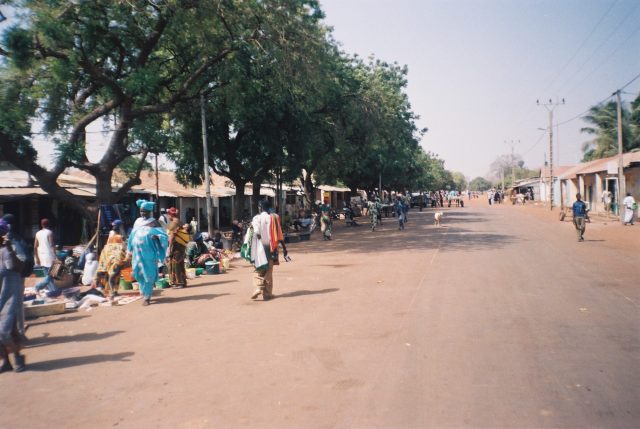
Farafenni itself is a typical Gambian town, where daily life centers around the market, mosques, and small shops. The station lies on its outskirts, a short walk or a quick ride in one of the shared taxis that serve as the main transport here. The surrounding streets are lined with clay houses and dusty lanes, where kids kick footballs and women balance baskets of fruit on their heads. During the rainy season, the area turns lush and green, but in the dry months, everything is coated in a fine layer of red dust that clings to walls and clothing. Despite its abandonment, the station doesn’t feel eerie or forlorn—it’s simply part of the town’s fabric, a quiet reminder of how things used to be.
In recent years, there’s been talk of reviving Gambia’s railway. The government has explored plans to restore transport links, potentially connecting the country with neighboring Senegal. If these projects move forward, Farafenni’s station could see a revival, with trains once again rolling through town. For now, though, it remains a silent witness to the past, a place where the echoes of history are still faintly audible. It’s a reminder of how priorities shift, how progress can turn once-essential infrastructure into ruins, and how quickly the world moves on.
Perhaps in a few years, the station will hum with activity again—new trains, busy platforms, the chatter of passengers. Or maybe it will stay as it is, slowly blending into the landscape, its stories fading with time. Either way, for now, it exists in a state of quiet dignity. There are no crowds, no hype, no commercialization, just the stillness of a place that has outlived its original purpose. For those who find themselves in Farafenni, it’s a chance to step back in time, to reflect on how much changes and how much of what once seemed permanent can disappear without a trace.