- Home
- The Gambia
- Banjul

Banjul
The Gambia · 5 places
Photo: Hannu Sääskilahti, CC BY-SA 4.0
Banjul is a city that defies expectations. Tucked away on a slender peninsula where the Gambia River meets the Atlantic, it feels almost too small to be a capital—just a few square kilometers of low-rise buildings and narrow streets, home to fewer than forty thousand people. Yet for all its modest size, it carries the weight of history in a way few places do. Founded by the British in the mid-1800s as a strategic outpost against the slave trade, its roots run deeper still. Long before colonial rule, this stretch of riverbank was a crossroads for trade, a place where local communities thrived along one of West Africa’s most vital waterways. Today, Banjul moves at its own unhurried pace, a quiet counterpoint to the region’s larger cities.
Wandering through the old quarter feels like stepping into another era. The streets are lined with weathered buildings, their peeling paint and carved wooden balconies hinting at stories untold. At the heart of it all is Albert Market, a maze of stalls where the day’s rhythm is set by the ebb and flow of commerce. Here, the air is thick with the scent of smoked fish, roasted peanuts, and spices piled high in woven baskets. Vendors sell fabrics, handmade jewelry, and fresh produce, while fishermen unload their morning catch straight from brightly painted pirogues. Nearby, the Arch 22 looms over the city, a stark monument to Gambia’s 1994 coup. From its heights, the view stretches across the river and the rooftops below—a rare vantage point where the past and present coexist without fanfare.
Life in Banjul is shaped by the water.
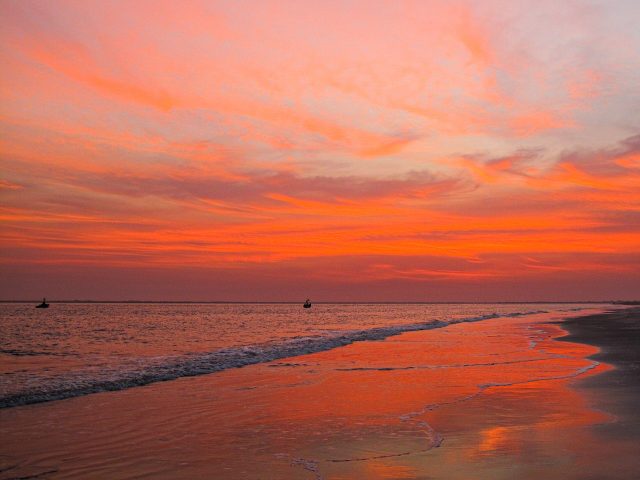
Each morning, fishermen set out in their wooden boats, their hulls painted in bold blues and reds, returning by midday with nets heavy with fish. By afternoon, the catch is sold along the shore, where the scent of grilling seafood mingles with the salt tang of the ocean. As evening falls, the waterfront comes alive. Locals gather to chat, listen to music, or simply watch the sun dip below the horizon. There are no glitzy resorts or crowded nightclubs here, just a handful of unassuming cafés serving dishes like benachin—a fragrant one-pot rice with fish and vegetables—or superkanja, a rich peanut stew. If you’re lucky, you might hear live mbalax music, its rhythms spilling out of a bar or a street corner, as much a part of the city as the river itself.
This isn’t a place for those seeking pristine beaches or grand museums. Banjul has neither the sweeping sands of Senegal’s tourist hubs nor the polished cultural institutions of larger capitals. What it offers instead is a sense of unfiltered reality. The city doesn’t try to impress. It simply exists—a humble capital in a small country, where time moves slower and strangers are met with easy smiles. Here, you might lose yourself in a tangle of backstreets, stumble upon a woodcarver’s workshop, or find yourself caught in an impromptu football match on a dusty pitch. These are the moments that linger.
The heat is relentless, the infrastructure basic. But the city doesn’t apologize for its rough edges. It exists on its own terms, unpolished and unpretentious. There’s no rush here, no pressure to perform or keep up. You could spend an afternoon sitting by the river, watching the water slip past, and realize that in this quiet place, there’s a kind of stillness. Banjul won’t rewrite your understanding of the world, but it might just remind you how little it takes to feel content.
See & Do
All of them
Places on the map
Marker colour follows the categoryClimate and weather
Detailed weather: Banjul- Average temperature
- 26 °C
- Precipitation per year
- 1216 mm
- Sunshine hours per day
- 7 h
Average air temperature
°C
25
25
25
26
26
28
27
27
27
28
27
25
Jan
Feb
Mar
Apr
May
Jun
Jul
Aug
Sep
Oct
Nov
Dec