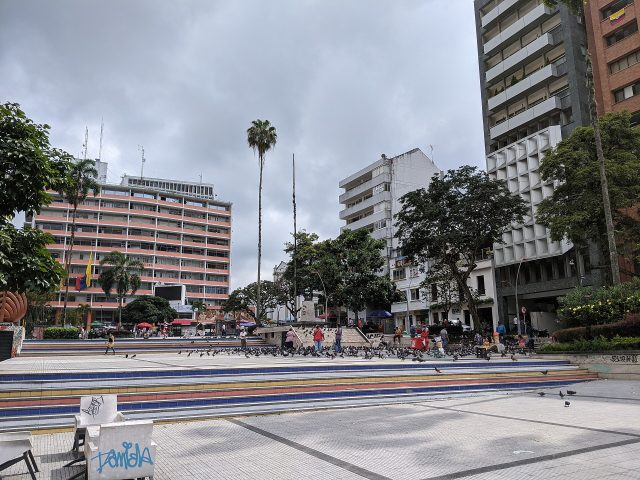
The Government Building of Tolima in Ibagué is one of those places that doesn’t immediately demand attention but slowly reveals its quiet importance. It stands at the heart of the city, on Murillo Toro Square, where life moves at an unhurried pace. There’s no rush here, no clamor of a capital’s streets—just a sense that time has softened, allowing you to notice the small details that usually slip by unnoticed.
The architecture is typical of mid-20th-century Colombian administrative buildings: clean lines, symmetrical facades, high ceilings, and large windows that give it an air of solidity and order. It’s not a structure that dazzles with opulence, but there’s a sense of respect for tradition and purpose in its design. Inside, if the rare photographs are any indication, the same restrained elegance continues—wooden panels, marble staircases, and spacious halls where decisions are made.
Ibagué may not be the most famous city in Colombia, but it plays a crucial role in the life of the Tolima region. As the administrative center, it’s where policies are shaped and decisions are made that affect thousands of lives. The government building isn’t just an office; it’s a symbol of authority and stability. Here, matters of economics, education, and infrastructure are discussed, and it’s where locals come when they need assistance or justice. In that way, the building is woven into the fabric of the city’s daily existence.
The history of the building is tied to Ibagué’s own story and that of the entire department. Founded in 1550 by Spanish conquistadors, the city remained a modest settlement for centuries before growing into an important commercial and administrative hub in the 19th century. As Tolima’s significance grew, so did the need for a permanent seat of government. The current structure reflects an era when Colombia was modernizing and strengthening its institutions, though its exact origins are likely more layered than a single moment in time.
Today, the Government Building of Tolima is more than just a workplace for officials. It’s a place where residents come for all sorts of reasons—some to submit paperwork, others to attend public hearings, and many simply passing through on their way elsewhere. The square outside is always alive with activity: vendors selling fruit and drinks, children playing, and elders sitting on benches, watching the world go by. It’s an ordinary scene, but one that captures the rhythm of the city.
The building’s architecture won’t impress tourists looking for grand monuments or intricate designs. There are no gilded domes, elaborate carvings, or towering columns. Instead, it stands unassumingly, fulfilling its role without fanfare. In that sense, it mirrors Ibagué itself—a city that doesn’t seek the spotlight but quietly serves its people, confident in its purpose.
For those interested in Colombia’s history and politics, the building offers a small but meaningful glimpse into regional life. It’s a place to feel the pulse of the country beyond Bogotá, to see how things work in a city that doesn’t often make headlines. You might not get the chance to step inside, but even sitting on the square, watching the everyday comings and goings, can be revealing.
Ibagué rarely appears on tourist itineraries, and that’s part of its charm. There are no crowds chasing the perfect photo, just the chance to see Colombia as it really is—not the version from travel brochures, but the one where people live, work, and go about their lives. The Government Building of Tolima is just one piece of that picture, but it’s the kind of place that helps you understand what a country is truly made of.