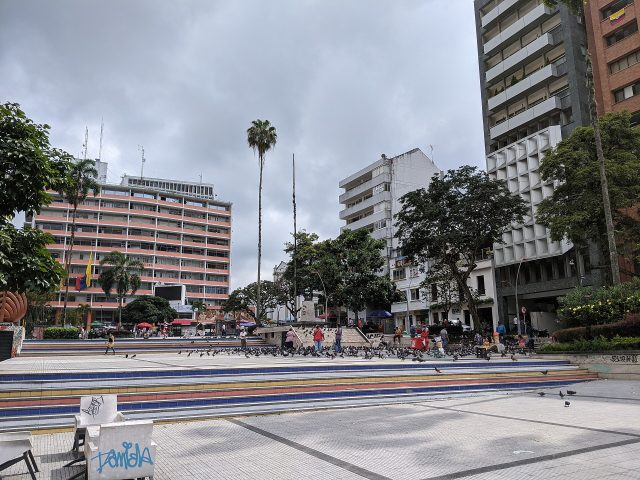
Bolívar Square in Ibagué is where the city’s story begins to unfold. Nestled in the heart of the town, it’s more than just a central landmark—it’s a living record of Colombia’s transformations. Under the shade of towering palms and old trees, layers of history come together: the colonial era, the struggle for independence, the rapid changes of the republic, and the quiet rhythm of modern life that flows past the cafés and small shops lining its edges.
Named after Simón Bolívar, the liberator of Latin America, the square carries the memory of a time when Ibagué was a key stop on the route between Bogotá and the country’s south. In the 19th century, revolutionaries gathered here to plan battles, and later, politicians and townspeople debated the region’s future. Today, echoes of that past remain in the architecture—the wooden balconies, wrought-iron grilles, and heavy doors that seem to pull you into another era.
At the center of the square stands the Bolívar monument, a bronze figure on a tall pedestal, always surrounded by people. Some take photos, others sit on benches watching pigeons, and a few come out of habit, as if meeting an old friend. The statue doesn’t feel grand or imposing; it’s part of everyday life, just like the square itself. Nearby, street musicians often play guitars or accordions, their melodies blending with the city’s hum to create something unmistakably local.
The buildings around the square reflect Ibagué’s architectural evolution. Colonial structures with whitewashed walls and tiled roofs stand beside later constructions, where modernist and contemporary influences peek through. The city hall, with its clean lines and columns, serves as a reminder that this space has always been more than just a place to relax—it’s been a seat of power. Around it, small shops sell local crafts, coffee, and traditional sweets, while cafés offer arepas or hot chocolate with cheese, a simple pleasure that feels like a taste of the city’s soul.
Ibagué is known as Colombia’s musical capital, and Bolívar Square is at the heart of that reputation. Festivals, concerts, and dance nights regularly spill into its open space, especially during local celebrations. On those days, the square becomes a stage where cumbia, salsa, and other rhythms fill the air, and people of all ages join in. Even on ordinary days, the sound of a guitar or the shake of maracas drifts through the air—music is never far away here.
But the square isn’t just about history or festivities. It’s alive, shifting with the city’s pulse. In the mornings, retirees gather to read newspapers or chat, while students with backpacks pass through by afternoon. By evening, families arrive, children running between trees or riding bikes. On weekends, vendors set up stalls selling everything from fresh fruit to handmade jewelry. It’s a place where everyone finds something: solitude, conversation, or just the chance to feel the city’s heartbeat.
Ibagué sits in a valley between the Central and Eastern Cordilleras, where the climate is mild year-round, almost like perpetual spring. Bolívar Square captures that feeling perfectly. Even at midday, the shade keeps things cool, and in the evenings, when the streetlights flicker on, the air fills with the scent of flowers and freshly brewed coffee. Locals say time moves differently here—unhurried, without the rush of bigger cities.
For visitors, the square is often the first stop in discovering Ibagué. From here, it’s easy to explore the historic center, visit small museums, or head to the market for local goods. But even if you just sit on a bench and watch life unfold, you’ll catch glimpses of what makes Colombia special: its warmth, its love of music, its respect for history, and its joy in simple moments. Bolívar Square isn’t just a landmark—it’s where the city reveals itself in all its complexity.