Perched on a gentle hill in Viña del Mar, Castillo Wulff feels like a fragment of another era that somehow drifted into the present. Its silhouette—turrets, battlements, and arched windows—evokes a medieval fortress, though the building is barely a century old. The architecture blends Gothic flourishes with romantic whimsy: pointed towers rise against the sky, stone walls are crowned with crenellations, and a shallow moat traces the perimeter, more decorative than defensive. The effect is less like a historical relic and more like a daydream given form, as if the castle had always belonged here, rather than being the vision of a wealthy Chilean businessman with a taste for European grandeur.
The story of Castillo Wulff begins in the 1910s, when Gustavo Wulff, the son of English immigrants, decided to build a home that would echo the estates of his parents’ homeland. Wulff had made his fortune in nitrate mining, a lucrative industry in early 20th-century Chile, and his ambitions extended beyond mere wealth. He wanted something that would impress not just his peers but the wider public. The design was entrusted to Italian architect Arnaldo Barucci, who had already left his mark on Chile’s landscape with similar projects. Construction took years, but the result was a building that still turns heads today, its stone façade weathered just enough to feel authentic without losing its charm.
Inside, the castle is as intriguing as its exterior. The interiors were designed to resemble a European manor, with high ceilings, dark wood paneling, and stained-glass windows that cast colored light across the floors. Fireplaces, ornate moldings, and a grand staircase leading to the upper floors all contribute to the sense of stepping into another time. Today, the castle houses a museum, though even without exhibits, the space itself tells a story. The furniture, much of it original, the paintings, and the tableware all feel preserved in amber, as if the Wulff family might return at any moment.
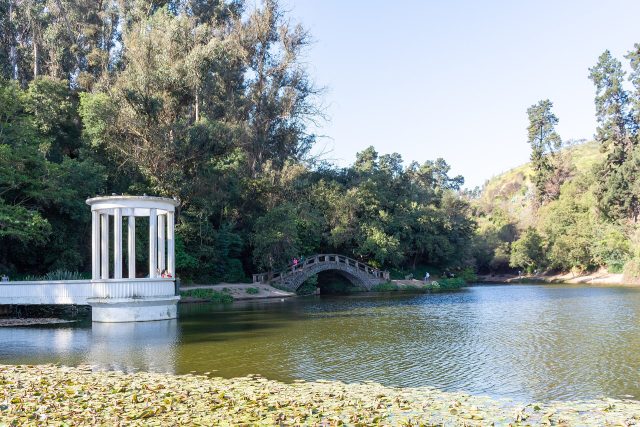
Surrounding the castle is a park that feels like an extension of the building’s character. Spanning roughly ten hectares, it was laid out in the English style, with manicured lawns, winding paths, and quiet ponds. A small waterfall adds a touch of movement to the scene, while exotic trees—some imported from distant continents—stand alongside native Chilean flora. Peacocks roam freely, their iridescent feathers catching the sunlight as they strut across the grass. The park is a perfect place to wander, especially in the warmer months when the air is thick with the scent of blooming flowers.
Though Castillo Wulff was originally a private residence, it has always had a public dimension. After Gustavo Wulff’s death in the 1930s, the castle passed to his heirs before eventually being turned over to the city. Now, it hosts tours, exhibitions, and cultural events, though its role in the community goes beyond tourism. Locals often choose the castle as a venue for weddings and celebrations, drawn to its fairy-tale atmosphere. While it may not be as famous as other Chilean landmarks, it has become a quiet icon of Viña del Mar, appearing on postcards and in travel guides as a symbol of the city’s refined charm.
Viña del Mar itself is often called the jewel of Chile’s Pacific coast, and Castillo Wulff fits neatly into that image. Unlike the bustle of Santiago or the crowded beaches of more tourist-heavy destinations, Viña del Mar offers a slower pace, a sense of order, and a touch of elegance. The castle, with its European echoes, feels right at home here, as if it were always meant to stand on this hill, overlooking the ocean. It’s a place that doesn’t shout for attention but rewards those who take the time to notice it.
Visiting Castillo Wulff is less about ticking off a sightseeing box and more about stepping into a different rhythm. The building carries the weight of its history lightly—there are no grand narratives of battles or revolutions here, just the quiet story of a family and their vision. The stone walls, the creaking floors, even the old clocks in the sitting rooms all feel like silent witnesses to a bygone era. You don’t need to know the backstory to feel its pull; the castle has a way of making the past feel tangible, if only for an afternoon.
Chile has a handful of other European-style castles and estates, but Castillo Wulff stands out for its setting and upkeep. Unlike some of its counterparts, which can feel neglected or out of place, this one seems perfectly at ease in its surroundings. That may be because Viña del Mar itself is a city that values its heritage. The castle isn’t just a relic; it’s part of the fabric of the place, as much a landmark as the palm-lined streets or the flower clock in the city center.
If you find yourself in Viña del Mar, the castle is worth a visit, preferably in the morning when the light is soft and the park is at its most peaceful. You could spend an hour wandering the grounds, watching the peacocks or listening to the waterfall, or join one of the guided tours to learn more about the Wulff family and the building’s history. Either way, Castillo Wulff leaves an impression—not through spectacle, but through its quiet, enduring presence. It’s the kind of place that lingers in your memory long after you’ve left.