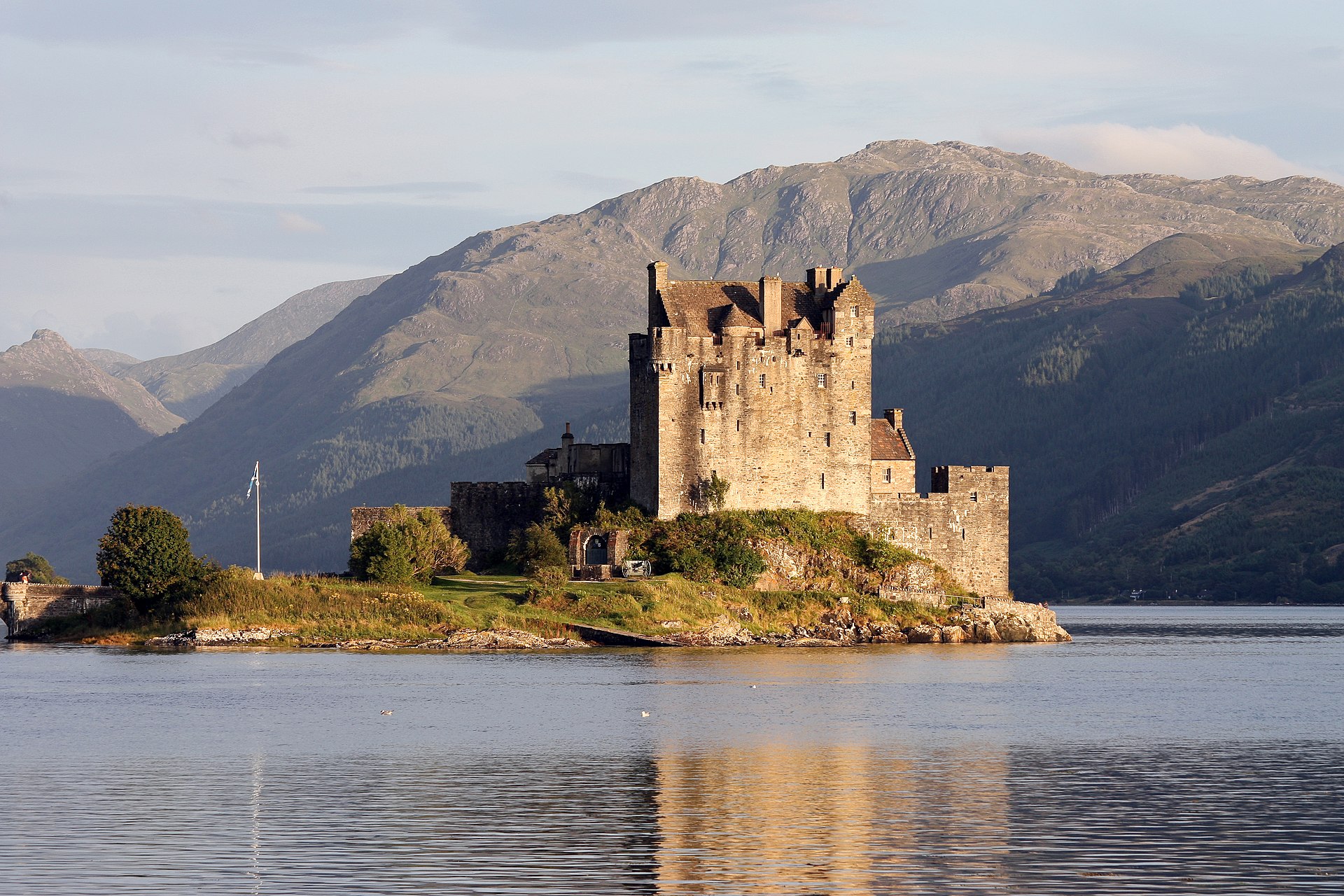
Eilean Donan Castle is one of those rare places that feels plucked from the pages of an old legend. Perched on a small island where three lochs—Duich, Long, and Alsh—converge, it rises from the water like a vision of medieval Scotland, where mist clings to the hills and the line between land and sea blurs. This isn’t just a castle; it’s a living piece of history, shaped by centuries of conflict, abandonment, and revival. Today, it draws visitors who come not just to admire its beauty but to step into a story that still lingers in the salt air and the echo of waves against stone.
The castle’s origins stretch back to the 13th century, when the first fortress was built to defend against Viking raids that plagued Scotland’s western coast. Its location was no accident—here, at the crossroads of waterways, it controlled trade and movement between the islands and the mainland. Over time, Eilean Donan became a stronghold of the Mackenzie clan, later passing into the care of the MacRaes, a family whose name is woven into Scotland’s turbulent past. By the 17th century, the castle had expanded into a formidable stronghold, its walls thickened and its towers raised to withstand sieges. Yet for all its strength, it couldn’t escape the tides of history.
The 18th century brought destruction. During the Jacobite uprisings, the castle became a rallying point for supporters of the exiled Stuart kings. In 1719, a Spanish garrison occupied it, only to face the wrath of British forces. Cannon fire from warships reduced Eilean Donan to ruins, and for nearly two centuries, it lay abandoned, its stones slowly surrendering to the elements. It wasn’t until the early 1900s that restoration began, a painstaking effort that took over twenty years. When the castle finally reopened in 1932, it stood once more as a symbol of resilience, its towers and battlements restored to their former grandeur, though now softened by time.
The architecture of Eilean Donan reflects its layered history. The central keep, a three-story tower with thick walls and narrow slit windows, is a classic example of Scottish fortification, built to repel invaders rather than impress them. Inside, the past is tangible—vaulted ceilings, massive fireplaces, and spiral staircases winding up to the battlements. Later additions, like the residential wings and the arched stone bridge leading to the entrance, bring a touch of elegance to the fortress’s stern lines. That bridge, especially at dusk when the water mirrors its silhouette, has become one of the castle’s most iconic features, a quiet reminder of how beauty and function once went hand in hand.
Visitors can explore rooms filled with relics of the past: suits of armor, faded tapestries, and a collection of swords and daggers that tell of battles fought and lives lived in these halls. The heraldry room, with its shields bearing the crests of the Mackenzies and MacRaes, offers a glimpse into the world of clan loyalty and rivalry. Below ground, the dungeons remain, their low ceilings and rough walls a stark contrast to the grandeur above. These spaces don’t just display history—they preserve the weight of it, the sense of lives interrupted by war and politics, of a fortress that was never just a home but a statement of power.
Beyond the castle walls, the landscape is just as compelling. The island is connected to the mainland by a narrow causeway, a path that invites slow walks and lingering glances at the water. The surrounding hills, covered in heather and bracken, roll toward the distant peaks of the Cuillin range, their slopes often shrouded in mist. On clear days, the lochs shift from silver to deep blue, while in stormy weather, they darken almost to black, reflecting the mood of the sky. Wildlife thrives here—deer move through the glens, eagles circle overhead, and seals sometimes venture into the shallows, adding to the sense that this is a place where nature and history exist side by side.
Eilean Donan has long since outgrown its role as a fortress. It’s now a cultural landmark, its image reproduced on everything from postcards to whisky labels, a shorthand for Scotland itself. Filmmakers have used it as a backdrop for everything from historical dramas to fantasy epics, each time finding something new in its weathered stones. Weddings are held here, couples posing on the bridge or in the castle’s shadow, as if the very air promises a love as enduring as the castle’s walls. In summer, the sound of bagpipes drifts across the water, a tradition that feels both ancient and alive. In winter, when frost dusts the battlements, the castle takes on a fairy-tale quality, as if it might vanish with the next thaw.
What makes Eilean Donan special isn’t just its beauty or its history, but the way it makes the past feel present. You can stand in the courtyard and imagine the clatter of hooves during a medieval tournament, or the hushed conversations of clansmen plotting rebellion. On windy days, the stones seem to whisper, carrying stories of sieges and betrayals, of loyalty and loss. When fog rolls in, the castle appears to float above the water, untethered from time. It’s easy to lose yourself here, not just in the grandeur of the place, but in the quiet moments—the way the light slants through a narrow window, or the echo of footsteps on a spiral staircase.
More than a monument, Eilean Donan is a piece of Scotland’s soul. It doesn’t just tell a story; it embodies one, a tale of survival and reinvention. For nearly eight hundred years, it has stood here, bearing witness to wars and peace, to the rise and fall of clans, to the slow march of time. It’s a place that refuses to be forgotten, not because it’s perfect, but because it’s real—flawed, resilient, and deeply human. That’s why people return, why the castle lingers in the mind long after the visit ends. It doesn’t just show you history; it makes you feel it, in the chill of the wind, the weight of the stones, and the quiet certainty that some places are meant to be remembered.