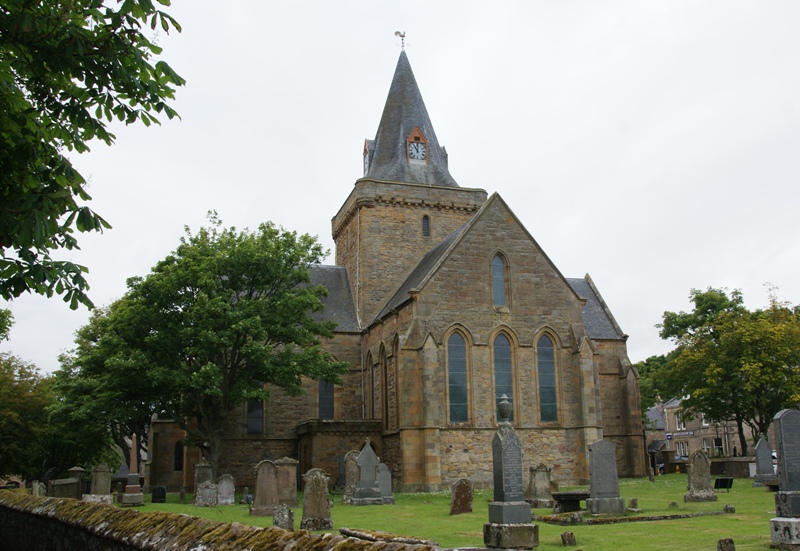
Dornoch Cathedral sits quietly in the small Highland town of Dornie, a place where time seems to have settled into a slower rhythm. The streets here are narrow, lined with stone houses that have stood for generations, and the cathedral itself has watched over the town for more than eight hundred years. It isn’t grand like the great cathedrals of England or even the more famous ones in Edinburgh or Glasgow. Instead, it has a quiet presence, the kind that invites you to linger rather than simply admire from a distance.
The cathedral’s origins trace back to the thirteenth century, when these lands were part of the Diocese of Caithness. Dornie was then an important religious center, and the cathedral was meant to be a symbol of the Church’s influence in the region. But its history wasn’t smooth. Medieval Scotland was often caught in conflict, and Dornie, like much of the Highlands, saw its share of turmoil. The cathedral suffered from raids, fires, and the upheavals of war. The Reformation in the sixteenth century brought further change, with many churches across Scotland being looted or repurposed. Somehow, Dornch Cathedral endured, though it lost some of its original character along the way.
What makes the cathedral particularly interesting is how its architecture tells the story of these changes. It began in the Romanesque style, with thick walls and rounded arches, but over time, Gothic elements were added. The nave still carries the solid, almost fortress-like feel of early medieval design, while the windows and vaulting in some parts have the more delicate lines of Gothic architecture. Inside, the wooden pews are carved with simple but careful craftsmanship, and the stained glass, though not as vivid as in continental cathedrals, casts a soft light that shifts with the day. The altar is unadorned but dignified, a fitting center for a place where generations have come to pray.
For centuries, the cathedral wasn’t a major pilgrimage site or a national landmark, but it was always deeply important to the people of Dornie. It was where children were baptized, couples married, and the dead were remembered. More than just a building, it was a part of daily life, a place where the community gathered not only for services but also for quiet reflection. Even when the Church’s influence waned, the cathedral remained a constant, a place where people could step away from the noise of the world. That sense of calm still lingers today. Visitors often remark on how peaceful it feels inside, as if time moves differently here.
The cathedral is also tied to the history of the Sutherland clan, one of Scotland’s most powerful families. In the Middle Ages, this was their territory, and the cathedral served as both a religious and social hub. Clan members were buried here, and important gatherings took place within its walls. In one of the side chapels, you can still see memorial plaques and coats of arms that speak to this connection. Even now, descendants of the Sutherlands occasionally visit to honor their ancestors. This link to the past gives the cathedral a deeper resonance—it’s not just an old building, but a living piece of Scotland’s history.
Outside, the cathedral is surrounded by a small but well-tended garden, where roses and lavender bloom in the summer. It’s a favorite spot for locals, who come here to walk, have picnics, or just sit on the benches and enjoy the quiet. The garden feels like an extension of the cathedral itself, offering the same sense of tranquility. In the winter, when the days grow short, the cathedral is lit with soft lights, making it look even more striking against the darkening sky.
Today, Dornch Cathedral is both an active place of worship and a point of interest for visitors. People come here for different reasons—some are drawn by Scotland’s history, others by architecture, and some simply by the desire to experience a place where the past feels close. Guided tours are available, offering insights into the cathedral’s story, the people who shaped it, and the events it has witnessed. But even without a guide, the building speaks for itself. The stones, the light through the stained glass, the stillness—all of it tells a story if you’re willing to listen.
Dornoch and its cathedral aren’t the kind of place that dazzles you at first sight. There are no towering spires, no golden decorations, no crowds of tourists. But that’s part of their charm. This is a place for those who appreciate quiet beauty, who find meaning in the small details rather than the grand gestures. Coming here, you realize that Scotland isn’t just about castles and Viking legends. It’s also about these unassuming corners where history and the present blend so seamlessly that it’s hard to tell where one ends and the other begins.