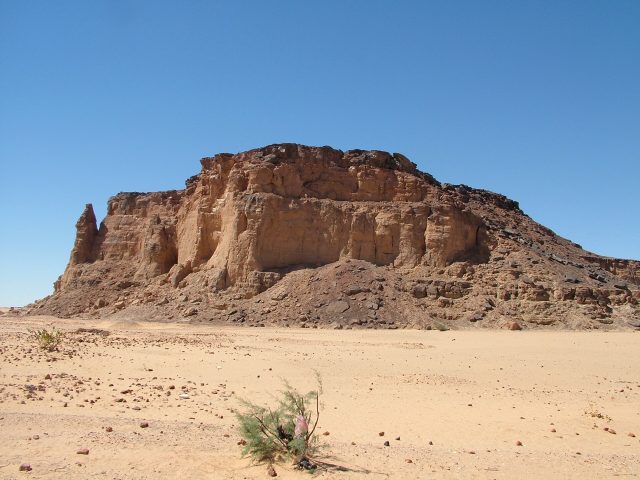
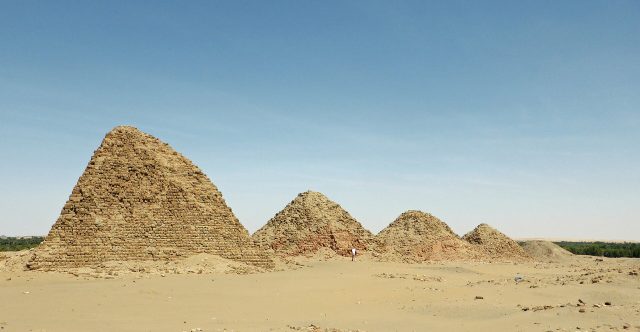
The Temple of Sanam is one of those places in Sudan that feels suspended in time, a quiet witness to the grandeur of ancient kingdoms that once ruled these lands long before the modern era. Tucked away near the modern town of Meroë, on the eastern bank of the Nile, this temple was once part of the powerful Kingdom of Kush, a civilization deeply intertwined with Egypt yet fiercely independent in its own right. Unlike the more famous pyramids of Meroë or the temples of Luxor, Sanam remains relatively unknown, and that’s precisely what makes it special. Here, the past isn’t just preserved—it’s palpable, unfiltered by crowds or the noise of tourism.
Built in the 7th century BCE during the reign of the Kushite pharaohs, Sanam was more than a religious site; it was a statement of power. For a brief but significant period, these rulers extended their influence into Egypt itself, establishing the 25th Dynasty. The temple’s architecture reflects this dual identity, blending the imposing columns typical of Egyptian sanctuaries with the stark, almost austere lines of Kushite design. It lacks the opulence of the Nile Valley’s grandest temples, but its simplicity only heightens its sense of solemnity. The ruins that remain today—fragments of walls, the bases of columns, and traces of reliefs—hint at a structure that was once both a spiritual center and a symbol of a kingdom straddling two worlds.
What survives of Sanam is enough to stir the imagination. The entrance, flanked by two massive pylons, would have been adorned with vibrant paintings, though time and the harsh Sudanese climate have long since erased them. The remnants of carvings depict gods and pharaohs, offering glimpses into the religious life of Kush. Archaeologists believe the temple was dedicated to Amun, a deity central to the Kushite pantheon, whose worship played a pivotal role in the kingdom’s identity. Even in its current state, the site feels charged with history, as if the rituals performed here centuries ago still linger in the air.
Visiting Sanam is an experience unlike most others in Sudan. There are no tourist facilities, no guides rushing visitors from one spot to the next, no souvenir stalls breaking the silence. Instead, there’s the vastness of the desert, the whisper of sand underfoot, and the distant silhouettes of Meroë’s pyramids on the horizon. The isolation is part of the appeal—this is a place for those who seek authenticity over spectacle, where the weight of history isn’t overshadowed by modern distractions. The temple sits at the edge of the desert, a solitary reminder of a civilization that once thrived here, its ruins now blending into the landscape as if they’ve always been part of it.
Sanam’s significance lies in its role as a cultural crossroads. The Kingdom of Kush wasn’t merely an imitator of Egypt; it was a civilization that absorbed, adapted, and redefined foreign influences to create something uniquely its own. Here, African and Mediterranean traditions converged, producing a culture that was both deeply rooted in its surroundings and remarkably cosmopolitan. The temple stands as a physical testament to this synthesis, a reminder that Sudan’s history is far richer and more complex than many realize. It’s a place where the past feels alive, not because of careful restoration, but because the land itself seems to resist letting go of it.
Reaching Sanam isn’t easy. The journey from Khartoum or Atbara takes hours, and the region’s infrastructure is minimal. But those who make the trip are rewarded with something rare: the chance to stand in a place where time moves differently. There’s no rush here, no itinerary to follow. You can spend hours wandering the ruins, tracing the outlines of what once was, and pondering the lives of the people who built and worshipped here. Occasionally, a local herder might pass by with their livestock, or a family might head toward the river, their presence a subtle reminder that life in this remote corner of Sudan continues, even as the past lingers all around.
What makes Sanam truly compelling is its ability to evoke the fragility of civilizations. The Kingdom of Kush, once a dominant force in the ancient world, eventually faded, leaving behind only ruins and stories. Yet even in decay, the temple speaks. It’s a place that invites reflection—not just on the rise and fall of empires, but on the enduring human impulse to build, to worship, and to leave a mark. Walking among its stones, you’re not just observing history; you’re stepping into it, if only for a moment. The silence, the vastness of the desert, and the weight of the past combine to create an experience that feels both humbling and deeply personal.
Sanam isn’t just a monument; it’s a conversation with time. It doesn’t offer easy answers or grand narratives, but it doesn’t need to. The ruins themselves tell a story—of power, faith, and the relentless march of history. For those willing to listen, it’s a reminder that the past isn’t as distant as it seems, and that some places have a way of making you feel both insignificant and profoundly connected at the same time. In a world that often prioritizes the new and the immediate, Sanam offers something far more precious: the chance to pause, to reflect, and to remember.