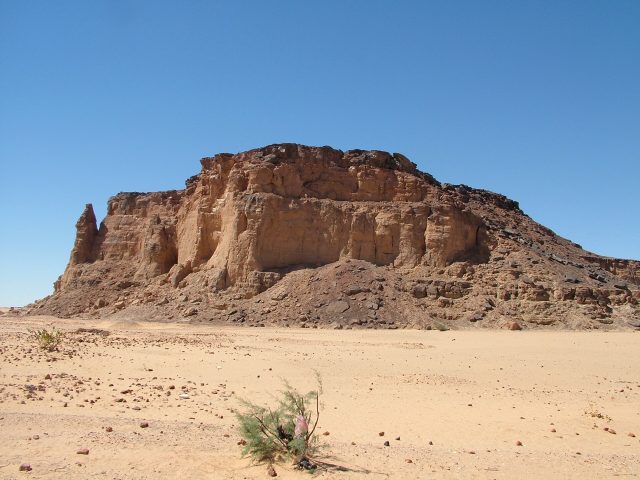
Jebel Barkal isn’t just a mountain rising from the sands of northern Sudan—it’s a place where time feels suspended between earth and myth. From a distance, its silhouette resembles a recumbent sphinx, an unmistakable landmark that has watched over the Nile for millennia. At its base lies the Temple of Amun, a sanctuary that has stood as both a spiritual heart and a political statement since the days when Napata was the capital of a powerful Kushite kingdom. For the Nubian people, this mountain was never just stone and sand; it was the dwelling place of Amun, the god who shaped the world and crowned pharaohs. Even now, the temple carries the echoes of an era when Sudan was not just connected to ancient Egypt but was a rival, an equal, and at times, its ruler.
The Temple of Amun at Jebel Barkal is more than an archaeological site—it’s a testament to the shifting power dynamics between Egypt and Nubia. Over centuries, it was expanded, defaced, and rebuilt, each phase reflecting the ebb and flow of influence in the region. The earliest structures date back to the 15th century BCE, when Pharaoh Thutmose III absorbed Nubia into the Egyptian empire. But when the Kushite kingdom rose to prominence, its rulers—who saw themselves as the true heirs of Egypt’s pharaohs—restored the temple, turning it into a center of religious and political authority. The columns inscribed with hieroglyphs, the statues of gods and kings, the reliefs depicting rituals—all of them tell a story of how Nubia absorbed Egyptian traditions and then made them its own.
The architecture of the temple is striking in its grandeur and precision. The main entrance opens into a vast courtyard, its perimeter lined with columns topped by lotus-shaped capitals, a motif borrowed from Egyptian design. Beyond the courtyard lies a hypostyle hall, where massive columns support a ceiling adorned with astronomical symbols. The most compelling details are the reliefs, which show Kushite pharaohs performing sacred rites before Amun. Among them is Taharqa, one of the most famous Kushite rulers, who later became pharaoh of Egypt’s 25th Dynasty. His carved figure, still commanding even in ruin, serves as a reminder that Nubia once held sway over Egypt itself.
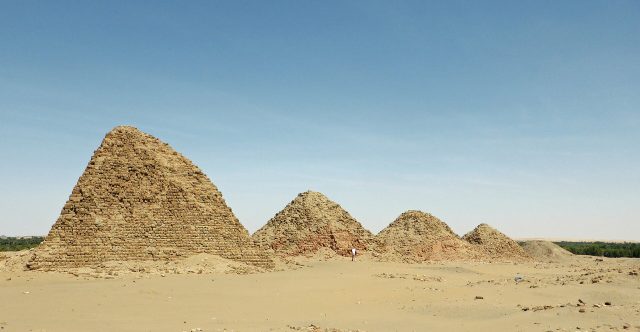
Jebel Barkal is more than just the Temple of Amun. The surrounding area is dotted with the remains of palaces, smaller temples, and royal necropolises, forming an archaeological landscape unlike any other. Nearby, the pyramids of Nubian kings stand in stark contrast to their Egyptian counterparts—smaller, steeper, and built with a distinct technique. These pyramids were the final resting places of Napata’s rulers, who, like the pharaohs before them, prepared for the afterlife with meticulous care. The site feels almost untouched, as if the past is still present in the quiet rustle of the wind through the ruins.
Visiting Jebel Barkal is like stepping into a world where history and legend blur. There are no crowds here, no tourist traps—just the vastness of the desert, the weight of the stones, and the sense that the past is still alive. The temple’s walls, worn by time, bear the marks of ancient ceremonies, while its columns, now open to the sky, seem to reach upward as if trying to reclaim their former glory. The silence is profound, broken only by the occasional call of a bird or the crunch of sand underfoot. It’s easy to imagine the processions that once filled these spaces, the chants of priests, the murmur of crowds gathered for a coronation or a festival.
The light here changes everything. At midday, the sun bleaches the stones to a pale gold, making the hieroglyphs harder to read but no less mysterious. As the day wanes, the shadows lengthen, and the mountain takes on a warmer hue, as if the earth itself is remembering the rituals performed in its honor. Sunset is the most magical time, when the rocks glow like embers and the temple’s ruins seem to breathe. It’s a reminder of how fleeting time is—and how some places refuse to let it erase them completely.
For Sudan, Jebel Barkal is more than a historical site; it’s a symbol of a past that predates modern borders and conflicts. In a country that has seen its share of upheaval, these ruins stand as proof that Sudan was once home to one of Africa’s greatest civilizations. The temple and its surroundings are now a UNESCO World Heritage site, recognized for their global significance. Yet despite this status, the place doesn’t feel like a museum exhibit. It feels lived-in, as if the spirits of the past are still keeping watch.
There are no guided tours here, no set paths to follow. Visitors are left to explore at their own pace, to sit on the temple steps and listen to the stories of locals who still speak of Amun as if he might return. Or to wander among the pyramids, tracing the edges of the stones with their fingers, wondering about the lives of the kings buried beneath them. The lack of crowds makes the experience deeply personal. You’re not just observing history—you’re touching it, feeling the weight of centuries in the rough surface of a column or the cool shade of a half-collapsed chamber.
Jebel Barkal leaves an impression that lingers long after you’ve left. It’s a place where the past isn’t just remembered—it’s still felt. The wind carries the scent of dust and dry grass, the same scents that would have filled the air thousands of years ago. The silence isn’t empty; it’s full of voices, of prayers and proclamations, of the footsteps of priests and kings. Standing in the shadow of the mountain, it’s impossible not to feel the presence of something greater than yourself. This is a place where history isn’t just written in books—it’s written in the land itself.