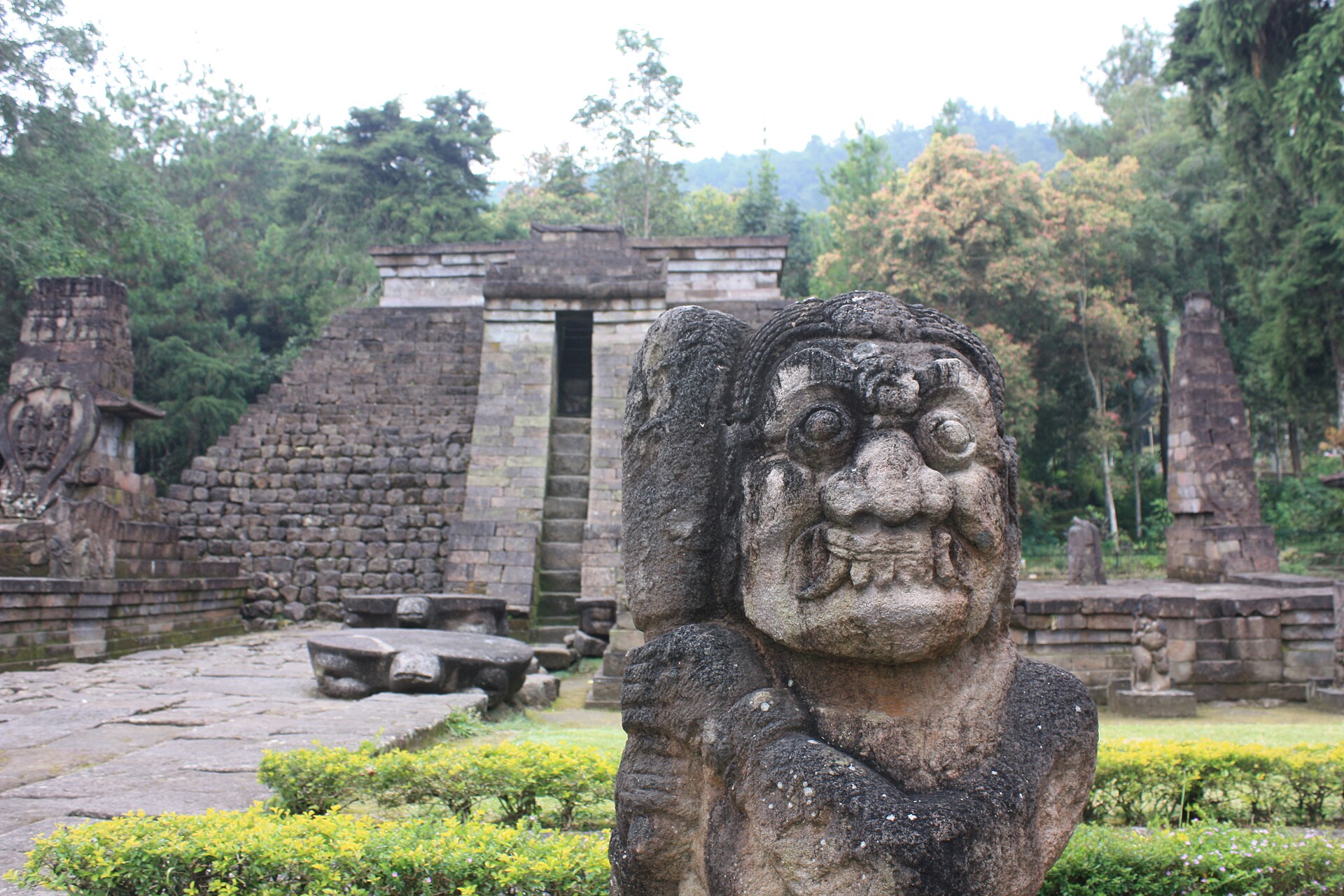
Perched on the slopes of Mount Lawu, far from the well-trodden paths of Java, Candi Sukuh stands as one of Indonesia’s most enigmatic ruins. Unlike the grand temples of Borobudur or Prambanan, with their intricate carvings and towering spires, this sanctuary feels almost unfinished—its rough-hewn stones and stark pyramid shape defy the conventions of Javanese architecture. There’s a raw, almost primal quality to it, as if the builders deliberately rejected the polished elegance of earlier monuments in favor of something more elemental.
The temple’s origins are shrouded in uncertainty. Historians debate its purpose, with theories ranging from a fertility cult to a site of warrior initiation or even a place of death rituals. What is clear is that Candi Sukuh doesn’t fit neatly into the religious or artistic traditions of the Majapahit Empire, which was already in decline when the temple was constructed in the 15th century. The empire’s golden age had passed, and with it, perhaps, the strict adherence to classical forms. Some scholars suggest the temple’s design may hark back to older, pre-Hindu Javanese beliefs, though any direct connection remains speculative.
The carvings here are unlike anything else on the island. Where other temples depict scenes from the Ramayana or the lives of the Buddha, Candi Sukuh’s bas-reliefs are cryptic, even unsettling. One panel shows a figure with an exaggerated phallus, another appears to depict childbirth, while others feature hybrid creatures—part human, part animal—or symbols that resemble ancient runes. Some interpret these as remnants of indigenous animist traditions, while others see the influence of Tantric practices, which were present in Java but rarely expressed so openly. Whatever their meaning, the carvings feel deliberately provocative, as if challenging the viewer to look beyond the familiar.
The temple’s location adds to its mystique. At nearly 900 meters above sea level, the air is cooler and crisper than in the lowlands, and the journey here is part of the experience. The road winds through villages, rice terraces, and tea plantations, offering glimpses of rural life that has changed little over the centuries. When the temple finally comes into view, it feels like stepping into another time. There are no crowds, no vendors hawking souvenirs—just the quiet hum of the forest and the occasional visitor wandering the grounds.
Candi Sukuh is small, and an hour is enough to explore its terraces and platforms. The main structure is a stepped pyramid, its ascent leading to a now-empty pedestal where a statue once stood. From the top, the view stretches across rolling hills and valleys, with Mount Merapi visible on clear days. Scattered around the site are fragments of columns and slabs inscribed with weathered, indecipherable script. The stones themselves seem to whisper of a past that is both distant and strangely immediate.
For the people who live in the surrounding villages, the temple is less a place of reverence than a quiet landmark, a remnant of their ancestors’ world. Occasionally, small ceremonies are held here, but there are no grand pilgrimages, no throngs of devotees. It remains a place apart, untouched by the commercialism that has transformed other historic sites into tourist attractions.
The lack of fanfare is part of what makes Candi Sukuh special. There are no guided tours, no audio guides, no gift shops—just the temple and the landscape around it. The nearest settlements are home to farmers and plantation workers, many of whom are descendants of the people who might have built or worshipped here centuries ago. Life moves slowly in these parts, and visitors often find themselves slowing down as well, drawn into the rhythm of the place.
A walk through the surrounding countryside reveals coffee and rubber plantations, their neat rows of trees stretching up the hillsides. In a small roadside stall, you might find locally grown coffee, its rich aroma a reminder of the land’s fertility. But the real draw is the sense of stillness—the kind that invites reflection rather than snapshots. There’s no pressure to document the experience, no need to perform for an audience. The temple exists as it always has, indifferent to the passage of time.
Candi Sukuh won’t reveal all its secrets, and perhaps that’s the point. Too much about it remains unknown, its purpose and symbolism open to interpretation. But in that ambiguity lies its power. This isn’t a monument frozen in a museum; it’s a living fragment of history, one that refuses to be neatly categorized. Those who make the journey here won’t find grand revelations or dramatic stories. Instead, they’ll find something rarer: a place where the past feels tangible, where the weight of centuries settles like the mountain mist, and where the silence speaks louder than any guidebook.