Dvin is one of those rare places where history isn’t just something you read about—it’s something you can almost touch. What remains today is little more than a grassy mound rising gently from the plains, but once, this was the beating heart of ancient Armenia. Founded in the 4th century, the city became the capital after the royal court moved here from Artashat, shifting the center of power to a place that would soon grow into one of the most important hubs of the Silk Road. Caravans laden with Chinese silk, Indian spices, and Syrian glass passed through its gates, while Armenian merchants sent their own goods—wine, carpets, and metalwork—far beyond the region’s borders. For centuries, Dvin thrived as a crossroads of trade, culture, and politics, until the Mongols sacked it in the 13th century, and an earthquake later erased what little was left.
Now, the site is a quiet expanse of ruins, but even in their fragmented state, they tell a story. Archaeologists have uncovered the foundations of palaces, basilicas, workshops, and residential quarters, offering glimpses of what the city must have looked like in its prime. The most striking remnant is the massive 5th-century basilica, once one of the largest in the Caucasus. Its scale speaks to Dvin’s role not just as a political capital but as a religious center—here, the Catholicos of the Armenian Apostolic Church held court, and the cathedral could accommodate thousands of worshippers. Nearby, the remains of the royal palace hint at the diplomatic intrigue that once played out within its walls, where envoys from Byzantium and Persia negotiated alliances and settled disputes.
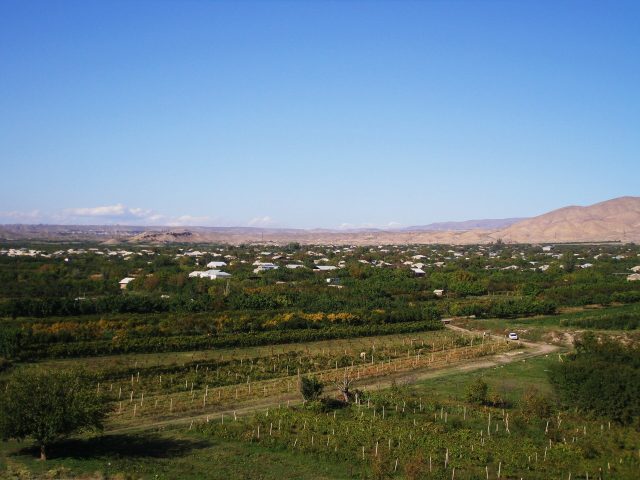
The hill sits in the Ararat Valley, a short drive from Yerevan, surrounded by endless fields and vineyards. From the top, the view stretches toward the distant mountains, with the twin peaks of Mount Ararat dominating the horizon. On clear days, the mountain feels almost close enough to touch. This valley is where Armenian civilization took root, where, according to legend, Noah’s ark came to rest, and where some of the earliest settlements in the region emerged. The land here is layered with history—beneath Dvin lie traces of even older cultures, from Urartian fortresses to Bronze Age villages. It’s a place where the past isn’t buried; it’s right beneath your feet.
Visiting Dvin isn’t like touring a reconstructed ancient city or a museum under the open sky. There are no restored walls or carefully arranged exhibits, just the quiet persistence of stone and earth. The ruins lie as they have for centuries—weathered blocks of basalt and tuff, moss-covered steps, and scattered fragments of columns. Walking among them, you can try to imagine where the main streets once ran, where the marketplace buzzed with activity, or where people lived their daily lives. Occasionally, you might spot a shard of pottery or a piece of glass, small reminders of the bustling city that once stood here.
For historians, Dvin is a treasure trove, but its significance goes beyond academic interest. The city was a cornerstone of Armenian identity, especially after Christianity became the state religion in the early 4th century. It was here that the first Armenian schools were established, where sacred texts were translated, and where a distinct architectural style began to take shape. The basilica of Dvin served as a model for churches across the country, its use of local stone and innovative design influencing generations of builders. Even after the city fell, its legacy endured—scholars, artisans, and clergy carried its traditions to other parts of Armenia, ensuring that Dvin’s influence lived on.
Today, Dvin is a place for quiet reflection rather than grand spectacle. There are no crowds, no souvenir stalls, no guides competing for attention. Just the hill, the ruins, and the vast sky above. Occasionally, locals pass through—shepherds grazing their flocks or families picnicking on the grass. For them, Dvin is simply part of the landscape, a place they’ve known since childhood. For visitors, it offers a different kind of Armenia, one that isn’t polished for tourists but exists as it always has, where history isn’t confined to museums but is woven into the land itself.
If you come here, the best times are early morning or late afternoon, when the light softens and the stones take on a golden hue. In those moments, it’s easier to picture the city as it once was—people moving through the streets, the hum of the marketplace, the distant tolling of church bells. You can sit on one of the scattered boulders and look out over the valley, thinking about the countless lives that passed through this place. Dvin doesn’t demand awe or excitement; it simply exists, as timeless as the wind, the mountains, and the sky. And perhaps that’s what makes it so compelling—the sense that here, more than anywhere else, the past isn’t really gone. It’s just waiting.