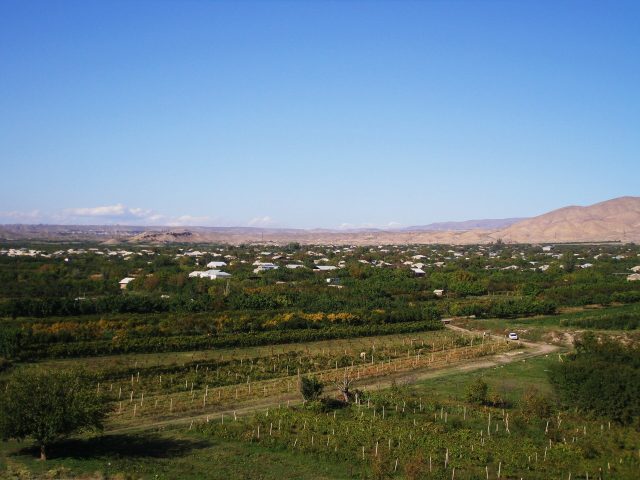
Dvin is one of those rare places where history isn’t just something you read about—it’s something you can almost touch. A short drive south of Yerevan, this ancient city was once the beating heart of Armenia, a political and cultural powerhouse that connected East and West. Today, little remains of its former grandeur beyond scattered ruins, but even those fragments tell a story of a city that shaped an entire nation. Here, kings ruled, merchants traded, and scholars debated in an era when Dvin was one of the most important cities in the Near East.
Founded in the 4th century on the site of an even older Urartian settlement, Dvin became Armenia’s first true capital as the country emerged as an independent state. It was here that the Armenian kings established their royal residence, and later, after the adoption of Christianity in the early 4th century, the seat of the Catholicos—the head of the Armenian Apostolic Church. The city flourished, drawing artisans, traders, and intellectuals from across the region. By the 7th century, Dvin had grown into a metropolis of nearly 100,000 people, its markets overflowing with goods from distant lands: Chinese silk, Indian spices, Syrian glass, and Persian ceramics. It was a crossroads of civilizations, where ideas and cultures intertwined.
The architecture of Dvin reflected this diversity. Armenian building traditions blended with influences from Byzantium, Persia, and even Rome, creating a unique urban landscape. The city was encircled by massive walls with watchtowers, enclosing palaces, temples, public baths, and residential quarters. At its heart stood the Catholicos’s residence—a sprawling complex that included a cathedral, a library, and administrative buildings. Today, only foundations and fragments of walls remain, but they offer a glimpse into the scale of what once was. The ruins hint at a city that was not just grand, but sophisticated, with advanced infrastructure and a thriving public life.
Dvin’s history was far from peaceful. Over the centuries, it endured wave after wave of invasions—by Arabs, Seljuks, and Mongols—each leaving its mark on the city. In the 9th century, Dvin became part of the Arab Caliphate, and though Armenian nobility retained some influence, the city’s prominence began to fade. The devastating earthquake of 893 dealt a final blow, destroying much of the city and reducing its population. Though Dvin never fully recovered, it remained an important religious and commercial center for several more centuries, a shadow of its former self.
Today, Dvin is primarily an archaeological site, its layers of history slowly uncovered by excavations that have been ongoing since the 19th century. Each season brings new discoveries: fragments of mosaics, pottery, coins, and everyday objects that offer clues about life in the city. Among the most significant finds are the remains of early Christian churches, adorned with intricate frescoes and Armenian inscriptions. These artifacts don’t just reveal the city’s physical layout—they provide a window into the daily lives of its inhabitants, from the bureaucrats who stamped official documents to the craftsmen who shaped its streets.
Visiting Dvin is less about seeing a reconstructed past and more about stepping into it. Unlike some ancient sites where ruins are carefully preserved or rebuilt, Dvin remains largely as it was found—a vast, open field dotted with stones and the occasional outline of a wall. There are no grand reconstructions here, no museum displays under the sky. Instead, the landscape itself tells the story. A low mound might once have been a palace; a depression in the earth could mark the site of a marketplace. The silence, broken only by the wind or the distant murmur of visitors, makes it easy to imagine the city as it once was: the clatter of workshops, the hum of a crowded bazaar, the chanting of priests in the cathedral.
The best time to experience Dvin is at sunset, when the fading light bathes the ruins in gold. The site is often quiet then, with few visitors, allowing for a solitary walk through the remnants of the past. It’s a place that invites reflection, where the weight of centuries feels almost tangible. Archaeologists believe that much of the city still lies buried beneath the surface—perhaps entire neighborhoods, streets lined with houses and workshops, waiting to be uncovered. Who knows what secrets Dvin still holds?
For anyone interested in Armenia’s history, Dvin is a must-visit. It may not have the fame of Garni or Etchmiadzin, but it offers something those places cannot: a direct connection to the early Middle Ages, when Armenia was forging its identity. This was the city where Christianity became the state religion, where Armenian culture flourished, and where the first struggles for independence were waged. Chronicles were written here, masterpieces of art were created, and decisions that shaped the nation’s future were made.
Dvin is more than just a monument to the past—it’s a reminder of how fragile civilization can be. A city that was once the center of the world for thousands now lies in ruins, its former glory preserved only in memory. Yet that very fragility is what makes it so compelling. When you walk among its stones, you’re not just observing history—you’re touching it, feeling the echoes of a time when this quiet field was alive with the hopes, dreams, and struggles of an entire people.