Dvin is one of those Armenian cities you’re more likely to read about in history books than find on a modern map. Once the capital of the ancient Armenian kingdom, it was a hub where caravan routes intersected. Today, little remains of its former grandeur—just scattered ruins that still carry the echoes of a time when this place was central to a nation. Among the few surviving structures, the Basilica of Saint Grigoris stands out, not only as a monument of early Christian architecture but as a witness to the era when Armenia first embraced Christianity.
The basilica sits on the outskirts of what is now the village of Dvin, a short drive from Yerevan. Its ruins don’t immediately catch the eye—low walls of dark tuff, grass-covered foundations, the remnants of an apse sinking into the earth. This modesty gives it a quiet power. There are no gilded domes or ornate facades. Instead, the basilica reflects the simplicity of early Christian design, a time when faith was still shaping its architectural language. Built in the 5th century, shortly after Christianity became Armenia’s state religion, its form shows classical influences alongside features that would later define Armenian church building.
Saint Grigoris, the basilica’s namesake, was the grandson of Gregory the Illuminator, who baptized Armenia in the early 4th century. Tradition says he preached among pagan tribes in what is now Azerbaijan and was martyred. His relics were brought to Dvin, and this basilica was built over his burial site. Historians debate whether it was originally dedicated to him, but the site remains tied to early Christian martyrs and the Armenian Church’s first steps.
The basilica’s architecture is typical of Armenia’s early Christian period. A three-aisled structure with a rectangular plan, its central nave is wider and taller than the side aisles. The eastern end has a semicircular apse where the altar once stood. The walls are built from large blocks of tuff, a volcanic stone long used in Armenian construction—easy to carve, durable. Inside, fragments of frescoes remain, hinting at stone-paved floors and a likely wooden roof.
In the 5th century, Dvin was the heart of a kingdom. The royal residence stood here, church councils convened, and the nation’s fate was decided within its walls. The Basilica of Saint Grigoris, though not the city’s main cathedral, played a role in Dvin’s religious life. It was where theological debates unfolded and church canons were established. The city endured repeated destruction—plundered by Persians, Arabs, and Mongols—but the basilica, though reduced to ruins, survived. Its unassuming appearance may have spared it from conquerors’ attention.
What remains today is modest.
A closer look reveals the outlines of a narthex, remnants of columns that once divided the naves, and traces of later renovations. Excavations in the 20th century uncovered older structures, burials, and everyday artifacts beneath the surface. Each stone seems saturated with time, and if you press your palm against the wall, you can almost feel the past.
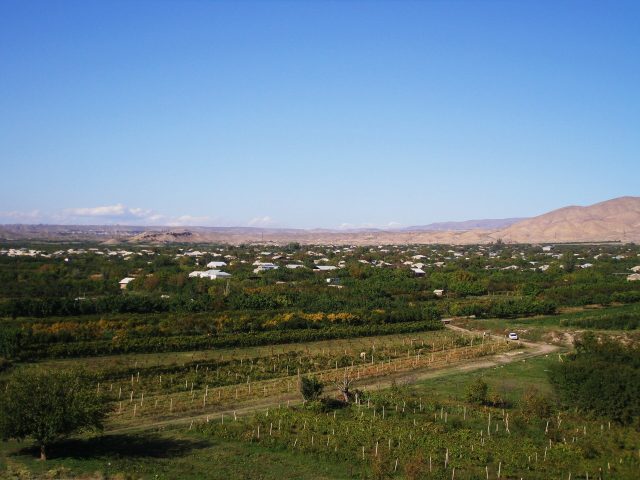
Visiting isn’t like a typical tour. There are no crowds, no souvenir stalls—just the wind through the grass and the occasional visitor. The surrounding fields stretch out, and in the distance, Mount Ararat looms. Here, it’s easy to forget the modern world and picture the basilica as it once was: a place where people gathered, prayers were spoken, and history unfolded.
The Basilica of Saint Grigoris is a living page from Armenia’s past. It reminds us that Christianity here is more than a religion—it’s a cornerstone of national identity, shaped at the crossroads of cultures and centuries. Its walls reflect classical traditions, early Christian influences, and the spirit of Armenia. Today, it stands as a silent witness, inviting visitors to touch the roots of one of the world’s oldest Christian civilizations. The ruins don’t try to impress. They simply endure, as history does.