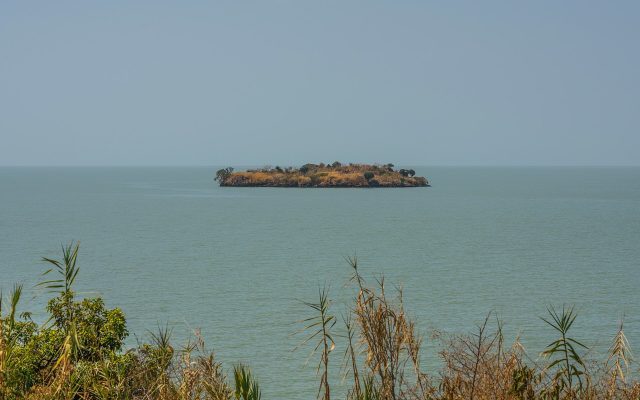
Lake Tana is Ethiopia’s largest lake, a vast expanse of water stretching across the highlands, its surface dotted with islands and fringed by papyrus reeds. Among these islands, some of the most intriguing are those that hold ancient monasteries, places where time seems to move differently. Ura Kidane Mehret is one of them—a small but deeply significant monastery perched on a sliver of land surrounded by the lake’s calm waters. To reach it, you must take a boat, gliding across the water as the shoreline fades into the distance. The journey itself feels like a transition, leaving behind the noise of the world and stepping into a quieter, older rhythm.
The monastery is modest in size, but its presence is anything but small. For centuries, it has been a spiritual anchor for the region, a place where monks live, pray, and preserve the relics of Ethiopia’s Orthodox Christian heritage. Inside its circular walls, the air is thick with the scent of incense and old parchment. The walls themselves are alive with color—frescoes depicting biblical scenes and the lives of saints, painted in the vivid, almost dreamlike style that defines Ethiopian religious art. The figures are expressive, their faces full of emotion, their gestures telling stories that have been passed down through generations. The iconostasis, a screen separating the altar from the rest of the church, is a masterpiece of craftsmanship, adorned with intricate carvings and gilded details that catch the light in a way that feels almost sacred.
Ura Kidane Mehret was founded in the 14th century, a time when Ethiopia’s Christian traditions were taking deep root in the highlands. According to local lore, it was established by one of the disciples of Saint Takla Haymanot, a revered figure in the Ethiopian Orthodox Church. The monastery has since become a repository of history, not just in its art but in its manuscripts. These ancient texts, written in Ge’ez—the liturgical language of the church—are more than religious documents. They are chronicles of a nation, recording the lives of kings, the outcomes of battles, and the daily rhythms of a society that has long since faded into the past. To hold one of these manuscripts is to touch a piece of Ethiopia’s soul, a connection to a time when faith and history were inseparable.
The island itself feels like a world apart. The only sounds are the lapping of water against the shore, the calls of birds—pelicans gliding low over the lake, cormorants drying their wings on the rocks—and the occasional rustle of leaves in the breeze. The lake is home to a rich ecosystem, its waters teeming with fish, its reeds sheltering crocodiles that slip silently beneath the surface. The monastery is nestled among trees, their branches casting dappled shadows on the ground. There’s a sense of stillness here, as if the island exists outside the rush of modern life, a place where the hours pass more slowly, measured by the tolling of church bells rather than the ticking of a clock.
Visitors are welcome, but the monastery is not a museum. It remains a living place of worship, and those who come are asked to respect its traditions. Women are not permitted inside the main church building, a rule that reflects long-held customs rather than any modern imposition. Men must dress modestly, covering their shoulders and legs. These are not strict prohibitions but rather acknowledgments of the monastery’s role as a sanctuary, a place where the sacred is preserved in its purest form. The monks who live here go about their daily routines—praying, tending to the gardens, caring for the manuscripts—unfazed by the occasional arrival of outsiders. Their quiet dedication is a reminder that some things endure, unchanged by the passage of time.
Beyond the monastery, Lake Tana holds other secrets. It is the source of the Blue Nile, the river that merges with the White Nile in Sudan to form one of the most famous waterways in the world. The lake’s islands and peninsulas are home to other monasteries, each with its own story. Some, like Debre Maryam, are known for their ancient frescoes, while others, such as Kebran Gabriel, are revered for their libraries of rare texts. To visit them is to take a journey through Ethiopia’s spiritual landscape, a chance to see how faith has shaped the land and its people. The boat rides between these islands are part of the experience, offering glimpses of birds taking flight, fishermen casting their nets, and the ever-changing play of light on the water.
A trip to Ura Kidane Mehret is more than just a visit to a historical site. It’s an immersion in the natural beauty of Lake Tana, a place where the boundaries between the sacred and the everyday blur. The lake’s waters are clear, reflecting the sky and the surrounding greenery, while the air carries the scent of damp earth and wildflowers. There are no crowds here, no hurried tourists snapping photos before moving on. Instead, there’s a sense of space and time, an invitation to slow down and observe. The boatmen who ferry visitors to the island often pause to point out a heron standing motionless in the shallows or a kingfisher diving for fish, their knowledge of the lake as deep as the water itself.
What lingers after a visit to Ura Kidane Mehret is not just the memory of its art or its history, but the feeling of having stepped into a different kind of existence. The monastery is a place where the past is not just remembered but lived, where the rituals of daily life have remained largely unchanged for centuries. The monks’ chants, the flicker of candlelight on ancient walls, the way the island seems to float between water and sky—all of it creates an atmosphere that is both grounding and transcendent. For those who come here, it’s a rare opportunity to disconnect from the noise of the modern world and reconnect with something older, something that feels timeless. In the end, Ura Kidane Mehret is not just a destination; it’s a reminder of how history, nature, and faith can come together to create a place that feels both deeply human and profoundly sacred.