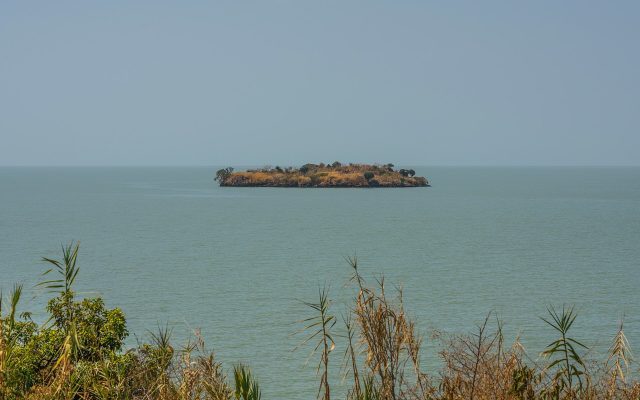
Perched on a small island in the southeastern corner of Lake Tana, the monastery of Meharaf feels like a world apart from the bustle of Bahir Dar, just a short boat ride away. The journey there is part of the experience—gliding across the lake’s calm waters, past papyrus reeds swaying in the breeze and fishermen casting their nets from traditional tankwas, the slender wooden boats that have plied these waters for centuries. The island itself is unassuming, covered in dense greenery that gives way only when the monastery’s whitewashed walls and thatched roofs come into view. There’s no grand entrance, no crowds, just a quiet sense of arrival, as if stepping into a place that has long existed outside of time.
Meharaf is one of the oldest monasteries on Lake Tana, though its exact origins are lost to history. Local tradition holds that it was founded in the 14th century, during the reign of Emperor Amda Seyon, a period when Christianity was taking deeper root in Ethiopia and monasticism flourished along the lake’s shores. The monasteries here were not just places of worship but centers of learning, where monks preserved ancient manuscripts, chronicled the country’s history, and developed the distinctive Ethiopian Orthodox traditions that endure today. Meharaf, like many of its counterparts, was built to be self-sufficient, with its own farmland, water sources, and even a small community of monks who still live there, though their numbers have dwindled over the years.
The architecture of Meharaf is modest but striking in its simplicity. The main church, a circular structure with a conical thatched roof, follows the classic design of Ethiopian Orthodox churches, where the shape symbolizes the Holy Trinity and the circular layout encourages a sense of unity among worshippers. The walls are made of mud and wood, plastered smooth and painted white, a style that blends seamlessly with the natural surroundings. Inside, the air is cool and dim, lit only by the soft glow of oil lamps and the occasional shaft of sunlight filtering through small windows. The walls are adorned with faded frescoes depicting saints, biblical scenes, and the lives of Ethiopian kings, their colors muted by time but still vivid enough to tell their stories.
What makes Meharaf particularly special is its collection of religious artifacts, some of which are said to date back to the monastery’s earliest days. Among them are ancient parchment manuscripts, their pages filled with Ge’ez script, the liturgical language of the Ethiopian Orthodox Church. These texts include gospels, psalms, and theological writings, many of them illuminated with intricate designs and miniature paintings. The monks here have long been the guardians of this knowledge, passing it down through generations, though the fragility of the manuscripts means they are rarely displayed to visitors. Nearby, a small treasury holds processional crosses, ceremonial robes, and other relics, each piece a testament to the monastery’s enduring role in Ethiopia’s spiritual life.
The island itself is a place of quiet beauty, with paths winding through groves of fig and acacia trees, their branches heavy with fruit in season. The monks cultivate small gardens where they grow vegetables and herbs, and the air is often filled with the scent of eucalyptus and wildflowers. In the early morning, the mist rises off the lake, shrouding the island in a soft haze, while in the evening, the setting sun turns the water to gold. It’s a place where the rhythms of life are dictated by the natural world—by the changing seasons, the rise and fall of the lake’s waters, and the slow, deliberate pace of monastic routine.
Visiting Meharaf is not like visiting a museum or a tourist attraction. There are no guided tours, no gift shops, no signs pointing the way. Instead, it’s an experience that unfolds at its own pace, shaped by the people you meet and the moments you stumble upon. If you’re lucky, you might be invited to sit with one of the monks, who will offer you strong coffee brewed in the traditional Ethiopian way, roasted over an open fire and served in small cups with a pinch of salt or sugar. Conversations are slow, punctuated by long pauses, and often conducted in a mix of Amharic and broken English, but the warmth is unmistakable. The monks here are not relics of the past; they are living links to a tradition that has survived wars, political upheavals, and the relentless march of modernity.
For many travelers, Meharaf is a place of reflection. The isolation of the island, the simplicity of the surroundings, and the deep sense of history all combine to create an atmosphere that feels almost meditative. It’s easy to imagine the monks who have lived here over the centuries, waking before dawn to pray, tending their gardens, and copying manuscripts by the light of a single lamp. Their lives were not easy—Ethiopia’s history is one of hardship and resilience—but there is a sense of peace here that transcends the struggles of the outside world. Even the lake itself, with its vast expanse of water stretching to the horizon, seems to invite contemplation, its surface mirroring the sky and the passing clouds.
Meharaf is not a place you come to for grand spectacles or dramatic landscapes. It’s a place you come to for something quieter, something more intangible. It’s a reminder that some of the most meaningful experiences in travel are not about seeing the biggest or the most famous, but about stepping into a world that operates on a different rhythm, where time moves more slowly and the past feels very much alive. The monastery has survived for centuries not because it was the most powerful or the most wealthy, but because it has remained true to its purpose—a sanctuary for faith, learning, and the simple, enduring act of being present.
If you do visit, go with an open mind and a willingness to let the place reveal itself to you. The boat ride from Bahir Dar takes about an hour, depending on the wind and the currents, and the journey itself is a chance to disconnect from the noise of everyday life. Once on the island, you might spend an hour wandering the paths, or you might stay longer, drawn in by the quiet conversations with the monks or the chance to sit by the water’s edge and watch the light change over the lake. There’s no agenda here, no must-see checklist. Just the slow unfolding of a place that has been waiting, patiently, for centuries.