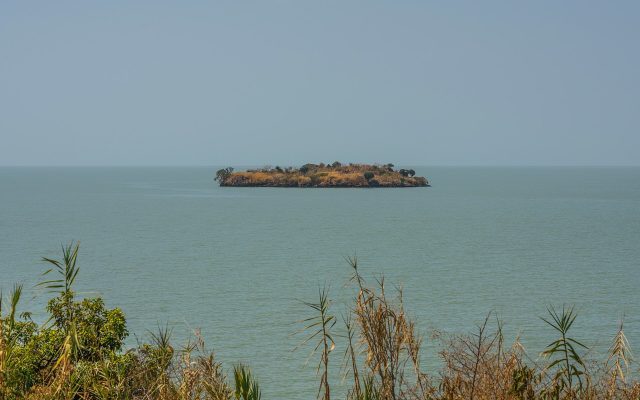
Narga Selassie sits on Dek Island, a quiet speck of land in the vastness of Lake Tana, Ethiopia’s largest lake. The monastery rises gently from a low hill, its round walls softened by the surrounding greenery. From the water, it looks almost like a mirage—something timeless, untouched by the rush of the world beyond the lake. The island itself is small, its paths winding through dense forest, and the only sounds are the rustle of leaves and the occasional call of a bird. There’s no grand entrance, no fanfare; just a place that has stood here for centuries, as if waiting for those who seek something beyond the ordinary.
The monastery was founded in the 18th century, though its origins are tied to an earlier time. Emperor Iyasu I, who ruled in the early 1700s, is said to have chosen this spot, envisioning a spiritual refuge at the heart of his empire. He never saw its completion, but his influence lingers in the quiet determination of the place. Over the years, Narga Selassie became more than a religious site—it was a keeper of history, where monks preserved ancient manuscripts and chronicled the events of a nation. The walls here have absorbed centuries of prayers, and the air still carries the weight of those who came before.
The architecture is unassuming, built to endure rather than impress. The main church is circular, its thatched roof curving like the shell of a tortoise, a design common to many Ethiopian monasteries of the era. The walls are made of local stone and clay, their rough texture weathered by time. Inside, the space is intimate, the walls covered in faded frescoes depicting biblical scenes and the lives of saints. The altar, carved from wood and painted in bold colors, stands as the focal point, its details worn smooth by generations of hands. Around the church, the monks’ quarters and small gardens blend into the landscape, as if the buildings grew from the earth itself.
Reaching Dek Island is part of the experience. There are no bridges, no roads—only the lake, stretching endlessly toward the horizon. Boats leave from Bahir Dar, the nearest town, their wooden hulls cutting through water that seems too still to be real. Along the way, papyrus reeds sway in the shallows, and fishermen in traditional tankwas—boats woven from the same reeds—cast their nets into the depths. The lake is home to countless birds, their nests clinging to floating islands of vegetation. When the boat finally pulls up to the island’s shore, the silence is immediate, broken only by the lapping of water against the rocks.
Narga Selassie is not a place for crowds. There are no souvenir stalls, no guided tours with microphones, no signs pointing the way. The monastery moves at its own pace, and visitors are expected to do the same. The monks are welcoming but reserved, their lives governed by routines that have changed little over the centuries. If you’re lucky, you might hear their voices during a service, the chants rising and falling in the dim light of the church. Photography inside is forbidden, a rule that’s taken seriously—this is a living place of worship, not a museum exhibit.
The island itself feels like a world apart. Dense forests cover much of Dek, their paths leading to hidden clearings and rocky outcrops with views of the lake. The air is thick with the scent of earth and vegetation, and if you’re quiet, you might spot monkeys swinging through the trees or rare birds flitting between the branches. The water near the shore is clear and cool, tempting on a hot day, though swimming is discouraged near the monastery. At night, the darkness is profound, the stars reflected in the stillness of the lake.
For those interested in Ethiopia’s history, Narga Selassie offers a glimpse into a past that predates much of the modern world. Christianity took root here long before it spread across Europe, and the monastery stands as a testament to a time when Ethiopia was a powerful empire, its rulers tracing their lineage back to King Solomon and the Queen of Sheba. The stories aren’t just told—they’re felt in the cool stone of the church walls, in the scent of incense lingering in the air, in the way the light filters through the narrow windows.
A visit here requires patience. There’s no rushing, no checklist of sights to see. The boat back to Bahir Dar doesn’t run on a strict schedule—it leaves when enough passengers have gathered, so it’s wise to arrange a return time in advance. Some choose to stay longer, spending the night in one of the simple guest huts, waking to the sound of the lake lapping against the shore. The island doesn’t demand attention; it simply exists, as it has for centuries, offering a rare kind of stillness in a world that rarely stops moving.
Ethiopia is a land of contrasts—where ancient traditions brush against the edges of modernity, where bustling cities give way to vast, silent landscapes. Narga Selassie is one of those places where the noise of the world fades away, leaving only the quiet rhythm of life as it’s been lived for generations. There’s no need to perform, no need to explain. Just the island, the monastery, and the lake, carrying on as they always have. And perhaps that’s the point.