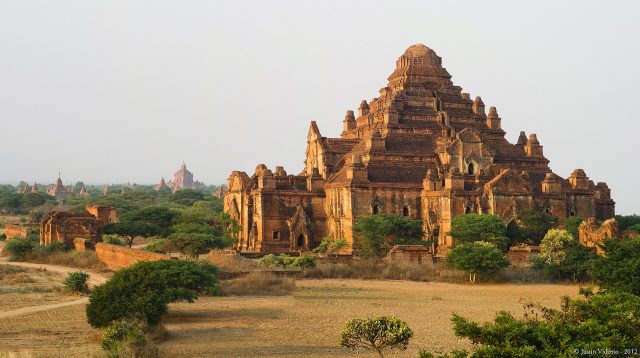
ThatbyinnyuThatbyinnyu stands apart from other temples in Bagan. Its towering silhouette dominates the plains, marking it as one of Myanmar’s most revered landmarks. Commissioned in the 11th century by King Anawrahta, the founder of the Bagan Kingdom, the temple has endured for nearly a millennium. Pilgrims and locals still gather here, climbing its terraces for panoramic views of the ancient capital.
The temple’s design is a stepped pyramid, its gilded stupa catching the sunlight. Five terraces ascend toward the summit, each lined with Buddha images in niches. Steep staircases lead upward, while inside, narrow windows cast slivers of light through dim corridors. The interplay of shadow and light creates a sense of stillness, as if the temple itself is holding its breath.
The name *Thatbyinnyu* means *Four Sacred Relics*. Legend claims the temple was built over an older stupa and houses strands of the Buddha’s hair, brought from India. Whether the relics exist or not, the temple remains a place of devotion. During festivals, worshippers fill the grounds, offering flowers, candles, and prayers. The air thickens with chanting and incense, lingering long after the crowds leave.
From the top terrace, Bagan unfolds in every direction. Hundreds of temples and pagodas dot the plain, their spires rising like ancient sentinels. The Irrawaddy River winds through the landscape, its banks lined with villages and fields. At sunset, the light turns golden, gilding the stupas and stretching shadows across the plains. This is why visitors return—when the past feels almost within reach.
Thatbyinnyu is tied to Bagan’s golden age, when the city thrived as the heart of a powerful empire between the 11th and 13th centuries. Rulers competed to build grand temples, each hoping to leave a lasting legacy. Anawrahta, who commissioned Thatbyinnyu, united scattered kingdoms and established Bagan as Myanmar’s first unified capital. The temple was more than a religious site—it was a declaration of power and ambition.
Today, Thatbyinnyu draws visitors seeking more than just photographs. Unlike crowded temples, it offers quiet corners where you can watch light shift across ancient stone. Guides recount its survival through earthquakes and wars, its structure still standing despite centuries of upheaval. There’s resilience here, a reminder that some things endure.
Beyond the temple, life moves slowly. Rice and vegetable fields stretch toward the horizon, tended by farmers following generations-old routines. In the mornings, monks in saffron robes pass with alms bowls, a scene unchanged for a thousand years. This contrast—between the grandeur of temples and the simplicity of daily life—makes Bagan feel alive, not frozen in time.
Visiting Thatbyinnyu isn’t just about checking off a landmark. It’s about stepping into a place where stones whisper stories of devotion and empire. Whether you come for the views, the history, or a moment of quiet, the temple lingers in memory. Standing here, you wonder about the people who built it, the kings who ruled, and the countless others who have gazed across these same plains. The wind carries echoes of prayers offered centuries ago.