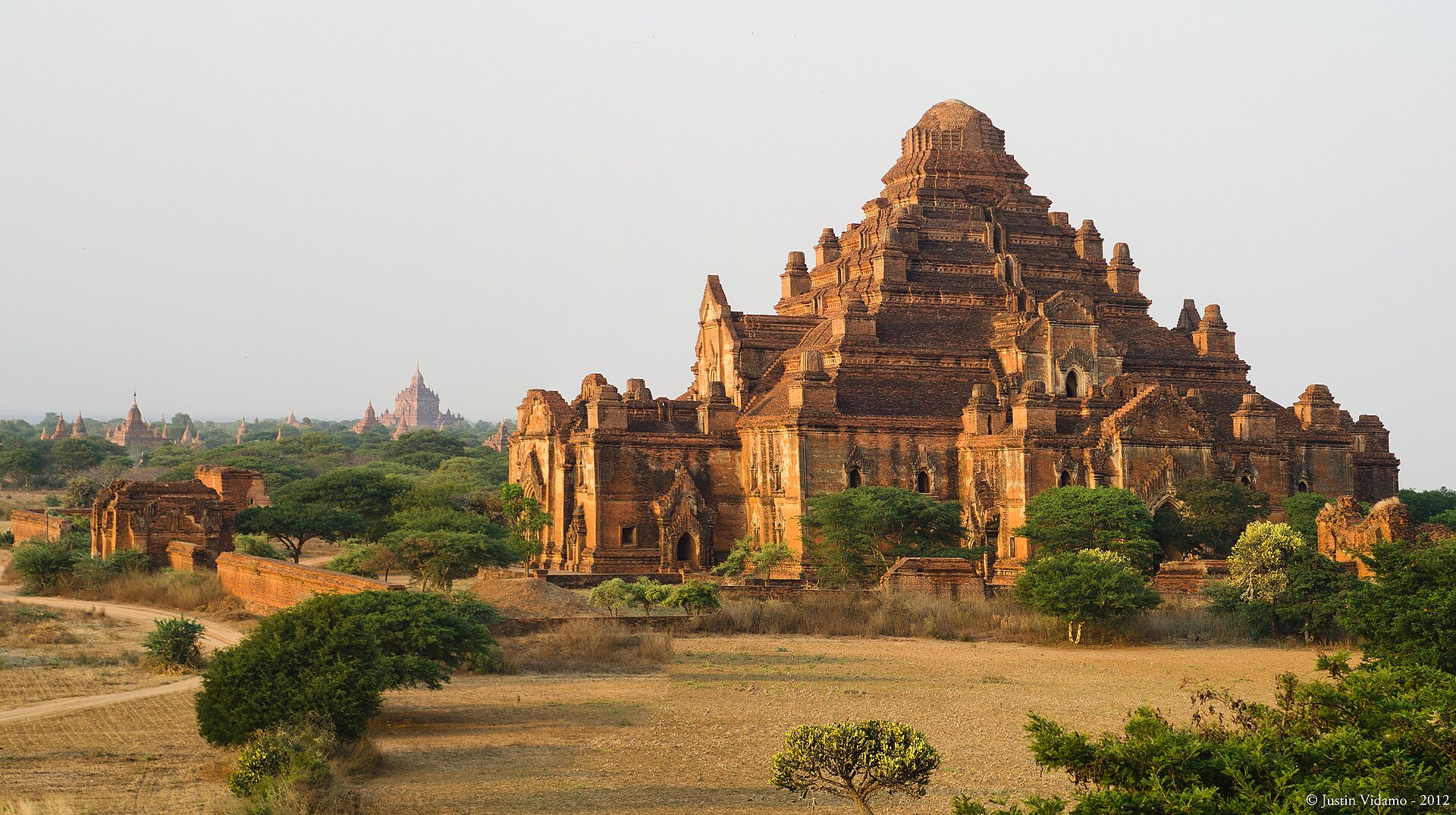
Bagan is a place where time feels suspended, and Dhammayangyi stands as one of its most enigmatic temples. Built in the mid-12th century, it rises alone among the hundreds of pagodas and stupas scattered across the plain. Its massive walls, constructed from reddish brick, tower over the landscape like a silent guardian of a long-gone era. Unlike many of Bagan’s other temples, Dhammayangyi lacks the vibrant murals or gilded decorations that draw crowds elsewhere. Instead, its stark simplicity gives it a quiet power, a sense of something unfinished yet deeply intentional.
The temple’s history is woven with legends, the most persistent of which ties it to King Narathu. According to local stories, he ordered the temple’s construction as penance for the brutal acts that secured his throne—including the murders of his father and brother. Some say the temple was never completed because of his sudden death, while others suggest political upheaval cut the work short. Whatever the reason, the temple remains frozen in time, its corridors half-built, its passages sealed as if to preserve the secrets of the past. Walking through its interior, you can still see the rough edges of history, the places where laborers left off, their work abandoned mid-task.
Architecturally, Dhammayangyi is imposing in its scale. The temple is a square structure with four entrances leading toward a central stupa, though the layout feels more like a maze than a straightforward path. The walls are so thick that the corridors narrow into dim tunnels, where light filters through only a few openings. The stone floors are uneven, worn smooth in some places by centuries of footsteps, while the air carries the scent of dry earth and old wood. Inside, there are no elaborate Buddha statues or colorful frescoes, just empty spaces where silence lingers. The absence of decoration makes the temple feel even more haunting, as if the builders intended it to be a place of contemplation rather than display.
Dhammayangyi is often called Bagan’s most mysterious temple, and the stories surrounding it only deepen its allure. Locals whisper that if you listen closely, you can still hear echoes of the past—voices of monks chanting, the rustle of robes, or even the footsteps of King Narathu himself. While these tales are likely just folklore, there’s something undeniably atmospheric about the temple. In some chambers, the walls still bear the soot of ancient oil lamps, a reminder of the people who once gathered here in prayer. The temple doesn’t just stand as a monument; it feels like a vessel of memory, holding onto fragments of lives long gone.
Visiting Dhammayangyi is less about ticking off a tourist attraction and more about stepping into another time. Unlike the more famous temples like Shwezigon or Ananda, it doesn’t draw large crowds, so you can explore its corridors at your own pace. Running your fingers along the brick walls, you might wonder what this place looked like in its prime—how the light fell through the windows, how the air smelled when the temple was alive with activity. The best time to visit is at sunset, when the fading light turns the bricks golden and stretches the shadows into long, shifting shapes. It’s then that the temple feels most alive, as if the past is just beneath the surface, waiting to be glimpsed.
Despite its unfinished state, Dhammayangyi remains one of Bagan’s most significant landmarks. It serves as a quiet reminder of impermanence, of how even the grandest empires fade and leave behind only fragments of their glory. Many of Bagan’s temples have been restored or altered over the centuries, but Dhammayangyi has been left largely untouched, its raw edges still visible. In a way, its incompleteness makes it more compelling—it’s a temple that never got the chance to fulfill its purpose, yet still stands as a testament to ambition, regret, and the passage of time.
If you find yourself in Bagan, don’t rush straight to the most famous temples. Take the time to seek out Dhammayangyi, where the absence of crowds and the weight of history create a different kind of experience. It may not be as ornate or as celebrated as others, but that’s precisely what makes it special. Here, you can walk through corridors that have remained unchanged for centuries, where the silence feels thick with stories waiting to be uncovered. It’s the kind of place that lingers in your memory long after you’ve left, a quiet corner of the world where the past still breathes.