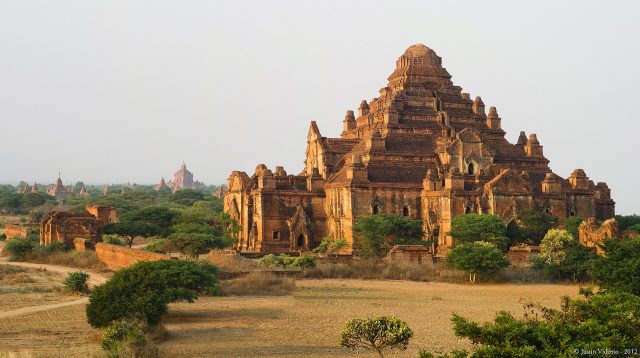
Shwezigon Pagoda stands as one of Bagan’s most enduring landmarks, a place where the weight of centuries settles gently over the landscape. Rising from the dusty plains, its gilded stupa catches the sunlight like a beacon, not just as a monument of stone and gold, but as a living thread connecting Myanmar’s past to its present. Built in the 11th century under King Anawrahta, it marked a turning point in the country’s history—when Bagan was more than a city, it was the heart of a kingdom that shaped the spiritual and political identity of an entire region.
The pagoda was conceived as a sacred repository, housing relics believed to be fragments of the Buddha himself—teeth, bones, and strands of hair brought from India. Local stories say Anawrahta chose its location after receiving signs from the spirits, ensuring the site would become more than a place of worship. It was meant to unify a people under Theravada Buddhism, transforming faith into a cornerstone of national identity. Even now, standing before its gleaming domes, it’s impossible not to feel the same reverence that has drawn pilgrims for a thousand years.
Architecturally, Shwezigon blends the simplicity and symbolism of early Bagan design. Its square base ascends into circular terraces, each step representing the path toward enlightenment. Four stairways lead upward, flanked by small pavilions where stone nagas—mythical serpent guardians—stand watch. Unlike the ornate temples that would follow, Shwezigon’s beauty lies in its restraint. There are no sprawling murals or grand halls, just the quiet dignity of a structure built to inspire devotion rather than awe.
Inside, the space is intimate, almost austere. Narrow corridors guide visitors past small niches where Buddha statues sit in silent vigil, their faces worn smooth by time and touch. At the center lies the holiest chamber, said to contain the sacred relics. People come here not for architectural spectacle, but for the sense of connection—to something ancient, something enduring. The late afternoon is the busiest time, when the setting sun turns the stupa’s gold into liquid fire, and the air hums with the murmur of prayers and the soft chime of bells.
Beyond its religious significance, Shwezigon played a pivotal role in Bagan’s cultural evolution. It was here that sacred texts were first transcribed into the Burmese language, making Buddhist teachings accessible to ordinary people rather than just the learned elite. The pagoda also served as a coronation site for kings, reinforcing their divine right to rule. Even after Bagan’s decline in the 13th century, Shwezigon remained a spiritual anchor, drawing devotees from across Southeast Asia.
Today, the area around the stupa feels like an open-air museum, dotted with smaller shrines and pagodas from different eras. Some bear ancient inscriptions or weathered carvings that hint at the daily life of medieval Bagan. The best time to explore is early morning, when mist still clings to the ground and the first light spills over the stupa’s curves. Monks move quietly in their rounds, while locals arrive with offerings of flowers and incense, their footsteps echoing on the worn stone.
Shwezigon is deeply woven into the rhythm of modern Bagan. Each year, it becomes the focal point of major Buddhist festivals, the most famous being the Shwezigon Festival itself. For days, the area buzzes with activity—processions, music, and traditional dances fill the air, while vendors line the paths selling everything from handmade crafts to steaming bowls of mohinga. The pagoda, usually a place of quiet reflection, transforms into the heart of a communal celebration.
Despite its age, Shwezigon is far from frozen in time. Restoration work occasionally refreshes its surfaces, ensuring it endures for future generations. Yet its true magic lies not in perfection, but in how seamlessly it fits into the present. There are no crowds jostling for space, no aggressive touts—just the rustle of palm leaves, the distant call of birds, and the soft murmur of prayers blending with the shuffle of feet on ancient stone.
Visiting Shwezigon is less about ticking off a landmark and more about stepping into a space where time feels fluid. You can sit on a sun-warmed bench for hours, watching the light shift across the gold, or join the slow procession of pilgrims circling the stupa. Either way, the experience lingers—not as a memory of something seen, but as a quiet understanding of how faith and art once shaped a world, and how their echoes still resonate today.