Bagan is a place where time seems to stand still, dissolving into the vast plains of Myanmar. Stretching along the banks of the Irrawaddy River, this ancient city is home to one of the world’s most extraordinary archaeological landscapes. Thousands of temples and pagodas rise from the earth, their weathered forms a testament to the vanished empire that once ruled these lands. Bagan is not just a city—it is an open-air museum, where every structure carries the weight of centuries, a reminder of the time when this was the heart of Buddhist culture and power in Southeast Asia.
The story of Bagan begins in the 9th century, when the first rulers established a dynasty that would shape Myanmar’s history. Over the next few hundred years, the city grew into a political and religious center, reaching its golden age between the 11th and 13th centuries under kings like Anawrahta and Kyanzittha. During this period, hundreds of temples, monasteries, and stupas were built, many of which still stand today. Bagan became the spiritual core of Theravada Buddhism, its influence stretching far beyond modern Myanmar’s borders, drawing pilgrims and scholars from across the region.
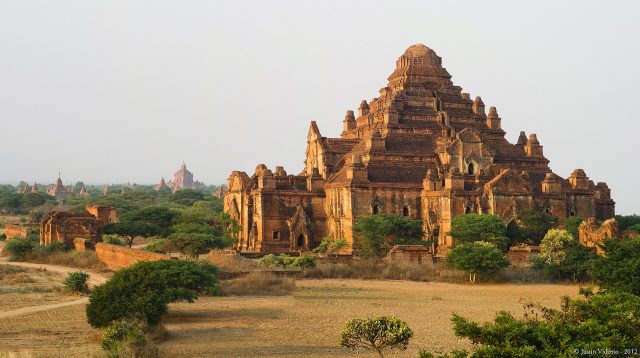
The architecture of Bagan is as diverse as it is breathtaking, reflecting the evolution of religious thought and construction techniques over centuries. Some structures are fortress-like, with thick walls and narrow windows, while others are delicate stupas reaching toward the sky. Among the most famous is the Ananda Temple, built in the 11th century and considered a masterpiece of Myanmar’s architectural heritage. Its whitewashed walls and gilded spires dominate the landscape, and inside, four towering Buddha statues face the cardinal directions. Another notable site is the Dhammayangyi Temple, commissioned by King Kyanzittha in the 13th century. Its massive brick walls and terraces convey a sense of grandeur, while the interior houses faded murals depicting scenes from the Buddha’s life.
Yet Bagan’s magic lies not only in its most celebrated temples but in the quieter, lesser-known ones that dot the plains. The Sulamani Temple, constructed in the 12th century, is renowned for its intricate frescoes and carvings, while the Htilominlo Temple, built a century later, stands out for its unusual design, with countless niches and statues embedded in its walls. Many of these structures have been restored after earthquakes that have repeatedly shaken the region, yet even in their partially ruined state, they retain a sense of majesty. Walking among them, it’s impossible not to wonder about the generations of people who once gathered here, leaving their mark on the stone and in the stories passed down through time.
Bagan is more than just an archaeological site—it remains a living center of Buddhist tradition. Early in the morning, monks in saffron robes move through the streets with alms bowls, while locals visit the temples to pray and honor their ancestors. Some shrines still host religious ceremonies, and if you’re lucky, you might witness one of these rituals, a quiet reminder of the faith that has endured here for centuries. The atmosphere is one of serenity, a rare quality in today’s fast-paced world, where the past feels tangible and the present moves at a slower rhythm.
One of the most unforgettable experiences in Bagan is watching the sunrise or sunset, when the sky turns gold and pink, casting long shadows across the plains. From vantage points like the Shwesandaw Pagoda, the entire landscape unfolds below—a sea of temples stretching to the horizon. From above, the structures seem to merge with the earth, as if they’ve grown from it rather than been built upon it. Many travelers come to Bagan specifically for these moments, when nature and architecture come together in a way that feels almost sacred, making the rest of the world fade away.
Despite its ancient roots, Bagan is far from a relic of the past. It’s a place where history and modern life intersect. Alongside tourists, you’ll find local artisans selling handmade crafts, farmers tending to fields that surround the temples, and villagers going about their daily routines. The Irrawaddy River, flowing nearby, remains a lifeline for the people here, providing water, fish, and a connection to the outside world. Bagan isn’t a museum frozen in time—it’s a living community where people continue to work, worship, and preserve their heritage.
For those who want to delve deeper into Bagan’s history, the local museums offer a glimpse into the past through artifacts unearthed from the ruins. Ancient manuscripts, Buddha statues, and pottery tell the stories of the people who once called this place home. But the real treasure of Bagan lies in its temples, each one a silent witness to the passage of time. Walking among them, you can’t help but feel a connection to something larger than yourself—a sense that you’re not just visiting a place, but stepping into a story that began long before you arrived and will continue long after you leave.
Bagan leaves an indelible mark on everyone who visits. There’s no other place quite like it, and no words can fully capture what it feels like to stand among these ancient ruins. You have to experience it for yourself—to wander through the temples, watch the light change over the plains, and listen to the quiet hum of life that still thrives here. Bagan isn’t just a destination; it’s a world where the past and present coexist in a fragile, beautiful balance, a reminder of how fleeting and enduring human history can be.