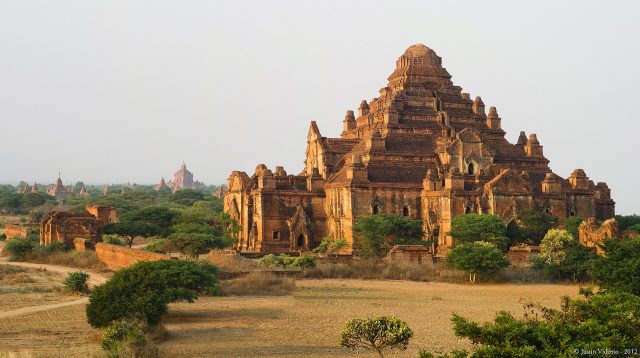
Ananda Temple stands as one of Bagan’s most revered landmarks, a silent witness to the city’s golden age when it was the heart of a powerful kingdom in what is now Myanmar. Built in the early 12th century, it remains a masterpiece of Bagan’s architectural legacy, a time when hundreds of Buddhist sanctuaries transformed the Irrawaddy Valley into one of Asia’s great spiritual centers. Unlike many ruins that feel frozen in time, Ananda is still very much alive—a place where pilgrims and travelers come to pay respects, drawn by the quiet reverence that lingers in its stone corridors.
The temple’s design is a study in balance and symbolism. Its cruciform structure centers around a soaring spire that dominates the surrounding plains, while its whitewashed brick walls give it an airy presence against the darker, weathered tones of other Bagan temples. Inside, four towering Buddha statues face the cardinal directions, their gilded surfaces catching the light in a way that softens the space. Each statue carries its own expression—one serene, another contemplative, a third almost welcoming—inviting visitors to pause and reflect.
Legends surround Ananda’s origins, as they do with many of Bagan’s monuments. It’s said that King Kyansittha commissioned the temple after dreaming of a perfect sanctuary, one that would rival the grandeur of India’s Buddhist sites. Construction took years, with artisans brought from across Southeast Asia to shape its intricate details. While the exact methods are lost to time, the temple itself embodies the ambition and devotion of its creators, a physical manifestation of faith that has endured for centuries.
Stepping inside Ananda is like entering another world. Sunlight filters through narrow windows, casting shifting patterns across the walls and illuminating faded murals that depict scenes from the Buddha’s life. The air is still, broken only by the occasional murmur of prayers or the soft footsteps of monks moving through the halls. There’s a sense of timelessness here, as if the temple itself slows the rush of the outside world, allowing visitors to linger in its quiet embrace.
Ananda is deeply tied to Bagan’s history, a city that once rivaled the great metropolises of its time. Between the 11th and 13th centuries, Bagan was home to over ten thousand temples, monasteries, and pagodas, though many have since succumbed to earthquakes and the passage of time. The city was more than a religious hub—it was a crossroads of trade, where caravans laden with silk, spices, and gems passed through, connecting India, China, and Southeast Asia. Temples like Ananda were not just places of worship but symbols of the kingdom’s wealth and influence, their grandeur reflecting the power of Bagan’s rulers.
Today, Ananda remains one of Bagan’s most visited sites, not just for its historical significance but for the sense of peace it offers. It’s a place where people come to escape the noise of modern life, to sit in the shade of its galleries or trace the delicate carvings that adorn its walls. The best times to visit are at dawn or dusk, when the rising or setting sun bathes the temple in warm hues, stretching shadows across the ancient stone. The light seems to breathe life into the structure, making it feel less like a relic and more like a living part of the landscape.
Despite its age, Ananda doesn’t feel abandoned. Locals continue to care for the temple, restoring its surfaces and maintaining its grounds. Religious festivals draw crowds of devotees each year, while daily visitors are welcomed with quiet hospitality. Unlike some of Bagan’s other temples, where tourists might feel like outsiders, Ananda has a way of making everyone feel at ease. Perhaps it’s because the temple has never lost its spiritual purpose—it remains a place where history and faith intertwine so seamlessly that they become one.
Bagan itself is a city caught between past and present. Ancient temples rise from the plains alongside small villages where life moves at its own unhurried pace. Ananda, like the rest of Bagan, is a reminder that great civilizations don’t simply vanish—they leave behind traces that continue to inspire. Visiting the temple isn’t just about seeing an old building; it’s about stepping into a story that’s still unfolding, told in the language of stone, light, and silence. And maybe that’s why Ananda lingers in the memory long after the visit is over.