
Bagan
Myanmar · 8 places
Photo: Vyacheslav Argenberg, CC BY 4.0
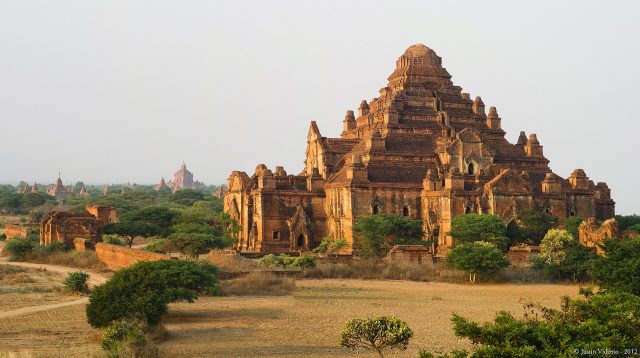
Bagan unfolds along the banks of the Irrawaddy, a place where time seems to have paused beneath the relentless Myanmar sun. There are no skyscrapers here, no honking traffic or crowded streets, though visitors still arrive in steady numbers each year. Instead, the air carries the quiet rustle of palm fronds and the occasional murmur of locals going about their day, much as they have for centuries. The city is best known for its temples—once over ten thousand, now around two thousand—scattered across the plains like silent sentinels of a long-lost empire. Their weathered spires and crumbling walls tell stories of a kingdom that once ruled these lands, its legacy etched into every brick and stone.
Walking through Bagan is like stepping through layers of history. Some temples rise in grand, imposing forms, their massive structures still commanding attention, while others are delicate, almost fragile, their intricate carvings resembling lace woven from sandstone. A few remain remarkably intact, their interiors glowing with the soft light filtering through narrow windows, while others have surrendered to time, their ruins no less captivating. The best moments come at dawn or dusk, when the sun casts a golden hue over the ancient walls, stretching shadows across the dusty ground. In that light, the past feels almost tangible, as if the centuries between then and now have dissolved into the warm, still air.
Beyond the temples, Bagan is shaped by the people who call it home. Most are Buddhist, their lives woven into the rhythms of tradition and faith. They welcome visitors with quiet warmth, offering handmade crafts, guiding tours, or simply sharing a smile—never pushy, only eager to connect. In the surrounding villages, artisans keep old skills alive: weaving vibrant textiles, shaping clay into pottery, or coating bamboo with layers of lacquer to create objects that are both beautiful and enduring. These crafts are more than souvenirs; they carry the stories of generations, passed down through hands that have shaped them for centuries.
Life here moves at its own unhurried pace. Mornings begin early, with monks in saffron robes walking barefoot through the streets, their alms bowls held out in silent offering. Women tend to open fires, stirring pots of rice and curry, while children hurry to school in crisp uniforms. By midday, the heat forces a pause—even tourists retreat into the shade of a temple or a roadside teahouse, waiting for the sun to soften. As evening falls, the city stirs again. Food vendors set up their stalls, music drifts from hidden speakers, and families gather along the riverbank, watching the Irrawaddy flow past. The river is more than water here; it’s a lifeline, a witness to the centuries that have shaped Bagan, binding its past to its present.
Bagan isn’t a place for luxury resorts or flashy entertainment. What it offers instead is something rarer: a chance to step outside the rush of modern life and into a world where history isn’t just remembered—it’s lived. You could spend days wandering among the temples, tracing the outlines of ancient murals or climbing to a high terrace to watch the sun dip below the horizon. Or you could linger longer, letting the slow rhythm of the place seep into your bones, watching as the stars emerge over the Irrawaddy and the temples fade into silhouettes against the darkening sky. Either way, Bagan leaves its mark—not with fanfare, but with a quiet, lasting impression, as deep and enduring as the land itself.
See & Do
All of them


Places on the map
Marker colour follows the categoryClimate and weather
Detailed weather: Bagan- Average temperature
- 27 °C
- Precipitation per year
- 1066 mm
Average air temperature
°C
22
25
29
32
30
28
28
27
27
27
26
24
Jan
Feb
Mar
Apr
May
Jun
Jul
Aug
Sep
Oct
Nov
Dec


