The Roman baths of Lugo are one of those rare places where history isn’t just preserved—it lingers, quietly woven into the fabric of everyday life. Tucked beneath a restaurant in the heart of the city, their entrance is unassuming, easy to miss if you don’t know what lies below. But descend the narrow staircase, and you step into the remains of a bathhouse built nearly two thousand years ago, when Lugo was known as Lucus Augusti, a Roman outpost on the empire’s northwestern frontier.
These ruins are more than just fragments of the past; they’re a testament to how the Romans shaped life even in distant provinces. Lugo stood along a vital trade route, and its baths were far more than a place to wash. They were a social hub where merchants struck deals, travelers unwound after long journeys, and locals gathered to gossip or debate. The surviving chambers, with their mosaic floors and traces of the hypocaust system—an ingenious network of underground channels that circulated hot air to warm the floors and walls—reveal just how advanced Roman engineering was. Even in their partial state, the baths offer a glimpse into a world where public life revolved around these communal spaces.
What makes the baths particularly striking today is how seamlessly they coexist with the modern city. The restaurant above incorporates the ancient walls into its dining area, with tables set just meters away from the weathered stone. It’s an odd but strangely fitting juxtaposition, as if the past and present occupy the same space without conflict. The effect is subtle, almost dreamlike—like stumbling upon a layer of history that refuses to fade.
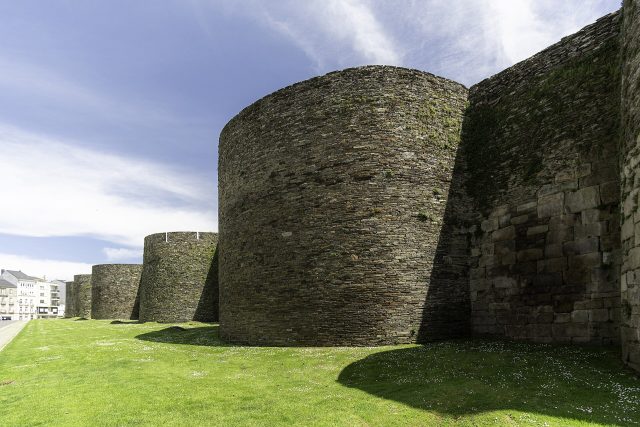
Lugo itself is a city shaped by its Roman roots. Founded in the 1st century BCE as a fortified settlement, it was a key stronghold on the road to the northern provinces. While traces of that era are scattered throughout the city, the baths are perhaps the most tangible reminder of its origins. They’ve endured the fall of empires, the chaos of the Middle Ages, and the relentless march of urban development. For centuries, they lay buried beneath the ground, forgotten until construction work in the mid-20th century uncovered them once again.
Visiting the baths doesn’t take long, but the experience lingers. There are no flashy reconstructions or interactive displays here—just the quiet weight of ancient stone, the dim light filtering through small windows, and the faint echo of footsteps on worn steps. It’s the kind of place that feels alive precisely because it doesn’t try to impress. The absence of modern embellishments leaves room for imagination, allowing visitors to fill the silence with their own sense of connection to the people who once gathered here.
Lugo isn’t a city that draws crowds, and that’s part of its charm. It’s a place where you can wander cobblestone streets, pause in a café on Plaza Mayor, and then slip underground to stand where Romans once stood. The baths serve as a quiet reminder that some human needs—rest, conversation, community—are timeless. The setting may have changed, but the essence remains. If you find yourself in this corner of Galicia, it’s worth taking a short detour to step into the past, if only for a little while. The city moves at its own unhurried pace, and the baths are one of its most understated treasures.