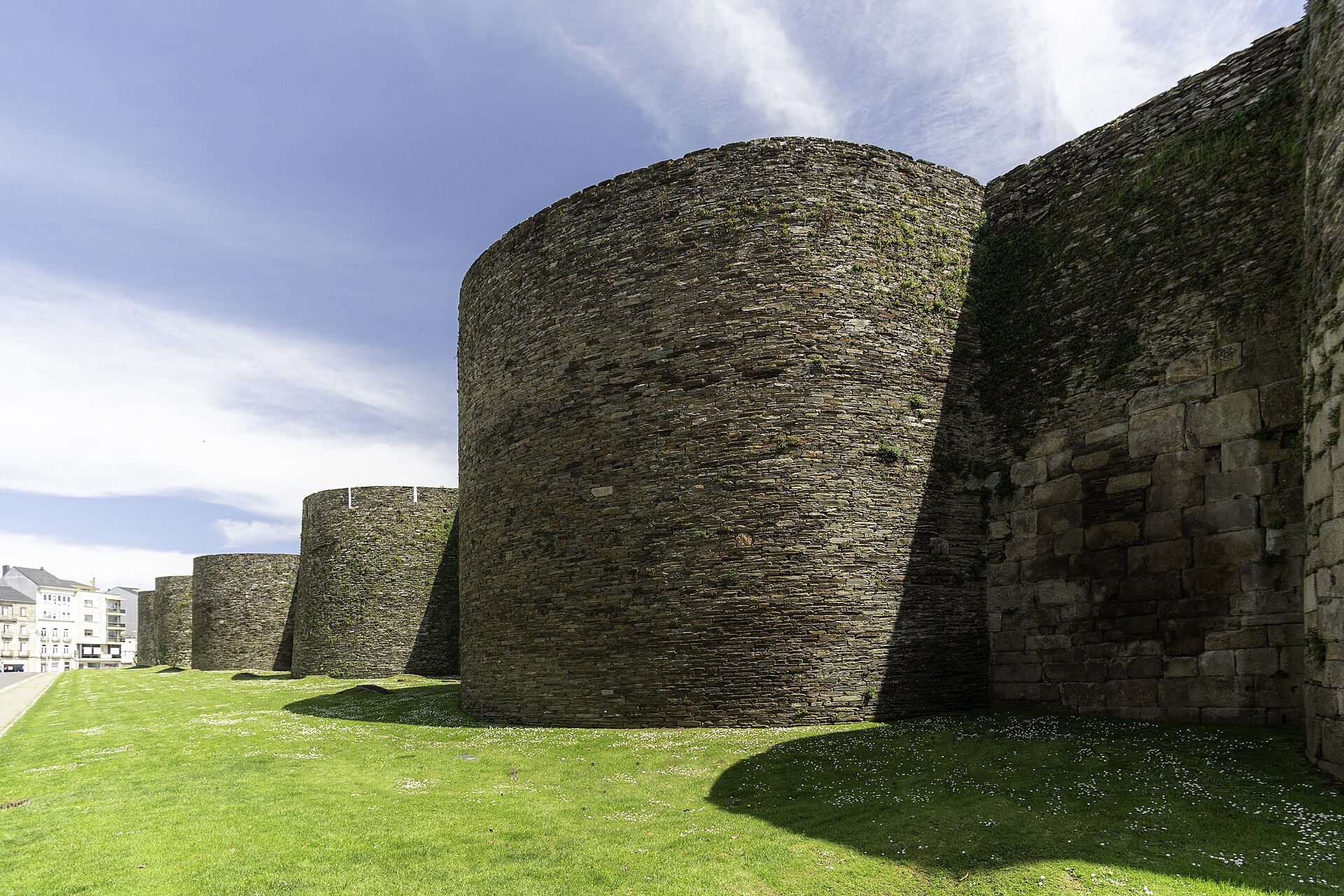
Lugo’s Roman walls are one of those places where time feels close enough to touch. They have stood here for over two thousand years, enduring wars, shifting borders, and the slow march of centuries. Built in the late third century to defend Lucus Augusti, these walls were fortifications first. Later, they became something else—a boundary that still defines the city’s shape.
The walls stretch nearly two and a half kilometers in a near-perfect circle around Lugo’s old town. In some places, they rise ten meters high, their thickness reaching over four meters. Originally taller, they have settled over time—stones have crumbled, and houses have grown into the walls, their facades merging with the granite. Yet the walls still dominate the skyline. The granite blocks were fitted without mortar, so precisely that a knife blade couldn’t slip between them. That precision speaks to the skill of the builders.
Ten gates once pierced the walls. Seven remain. Porta de San Pedro was the main entrance, where the road to Braga began. Now, it marks the threshold into the old city. Miñá and Nova, once guarded by watchtowers, frame the streets of modern Lugo. Their arches connect the past to the present.
The best way to understand the walls is to walk along their top. A wide promenade runs the entire length, offering shifting views. On one side, the rooftops of old houses, narrow cobblestone streets, and the medieval cathedral appear. On the other, the gentle hills of Galicia stretch toward the Miño River. The light at dusk turns the granite golden, casting long shadows.
Lugo’s walls are the only Roman walls in the world that remain entirely intact. Other fortifications were dismantled or rebuilt, but these walls stayed largely unchanged. Perhaps because Lugo was always on the edge of the empire, where history moved more slowly.
Inside the walls, the old town moves at its own pace. Narrow streets lead to Praza Maior, where the 13th-century cathedral stands. Small cafés and taverns serve pulpo á feira, empanadas filled with seafood, and tetilla cheese. The rhythm here feels different—slower, as if time itself has settled.
For locals, the walls are part of daily life. People walk along the promenade, meet friends, or sit on benches watching the sky. For visitors, the walls offer a way to touch history. For those who live here, they are as familiar as the river or the hills. That familiarity keeps them from feeling like a museum. They are alive because they are still part of the city.
The walls were designated a UNESCO World Heritage Site in 2000. Yet they have not become a tourist spectacle. There are no crowds, no souvenir stalls. Instead, there is quiet and the faint salt tang of the Atlantic breeze. That unspoiled quality draws those who want to feel the past without the noise of the present.
To walk Lugo’s walls is to walk between eras. They remind us that cities, like people, carry their history in their bones. Sometimes, all it takes is placing a hand on the stone. The same surface was touched by Roman soldiers, medieval merchants, and generations of locals. That’s the quiet power of this place—it doesn’t just tell stories. It lets you step into them.