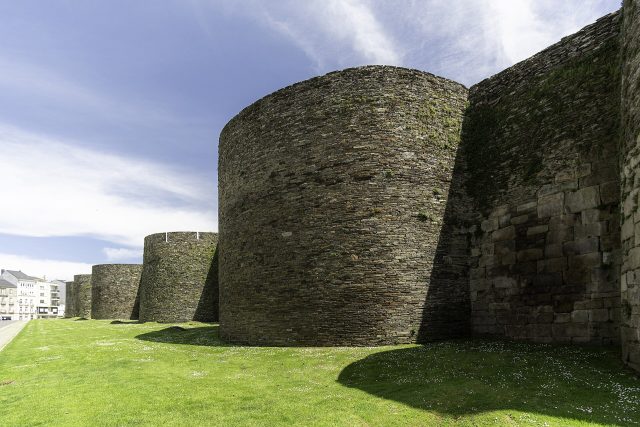
Lugo’s Parque de Rosalía de Castro is one of those rare urban spaces where the city’s hustle fades into quiet, where time seems to slow just enough to let you breathe. Tucked along the edge of town, where the ancient Roman walls gradually give way to rolling green slopes, the park stretches down toward the Miño River. There are no amusement rides or tourist crowds here—just wide, tree-lined paths, shaded corners, and a view of the water that makes you forget the city center is only a short walk away.
The park takes its name from Rosalía de Castro, one of Galicia’s most beloved poets, whose spirit feels woven into the place. Born nearby in Santiago de Compostela, her work was deeply tied to this landscape—its mists, its rivers, its quiet melancholy. A bronze statue of her sits on a bench near the riverbank, as if listening to the rustle of leaves or the distant murmur of the water. Some visitors come just to sit beside her, as though hoping to catch an echo of her verses in the breeze.
The park itself came to life in the mid-20th century, when Lugo began expanding beyond its medieval walls. That’s when the riverside promenade was built, paths were laid, and trees were planted—many of which now tower overhead. Spring is especially lovely here, when magnolias and chestnuts bloom and the air is thick with the scent of damp earth. In summer, locals escape the heat under the shade of the trees or picnic by the water. Come autumn, the park transforms: leaves turn gold and crimson, and the mists Rosalía loved so much drift in, softening the edges of everything.
The park’s design is simple, almost unassuming, but it has a quiet charm. Small stone bridges cross narrow streams, wooden benches line the paths, and old-fashioned lampposts cast a warm glow as dusk falls. The promenade is the heart of the place—a broad, paved walkway running alongside the river, inviting slow strolls. Benches along the way offer views of the water and the green hills on the opposite bank. Sometimes you’ll see fishermen with their rods or locals just taking in the fresh air.
Lugo is a city steeped in history, its Roman walls a reminder of its ancient past. The park, just beyond those walls, feels like an extension of that history—a place where the city’s modern life meets its older rhythms. There are no grand monuments or museums here, just the sense of time moving differently. The old trees, the steady flow of the river, even the names of the paths all carry a whisper of the past.
For locals, Parque de Rosalía de Castro isn’t just a green space; it’s part of daily life. In the mornings, joggers weave along the paths. By afternoon, families with children wander through, and in the evenings, teenagers gather or older couples sit with coffee from a nearby café. On weekends, the park comes alive—picnics, guitar music, people sprawled on the grass with books. There are no strict rules, just an unspoken respect for the quiet and the natural world.
In recent years, the park has become a venue for small cultural events. Open-air concerts, poetry readings, and local art exhibitions occasionally take over the space. Some of the most memorable evenings are those when live music drifts along the promenade, and the lamplight reflects off the river. These gatherings draw not just locals but visitors too, people who come to Lugo looking for a taste of Galicia’s unhurried, lyrical atmosphere.
What makes the park special isn’t anything grand or dramatic. It’s the way it lets you simply exist—no need to rush, no pressure to document every moment. You can sit on a bench, listen to the water, and think. It’s a patch of nature within the city, a reminder that even in a fast-moving world, there are still places for stillness. That might be why it means so much to the people of Lugo. It’s not just a park; it’s part of their lives, their memories, their sense of home.