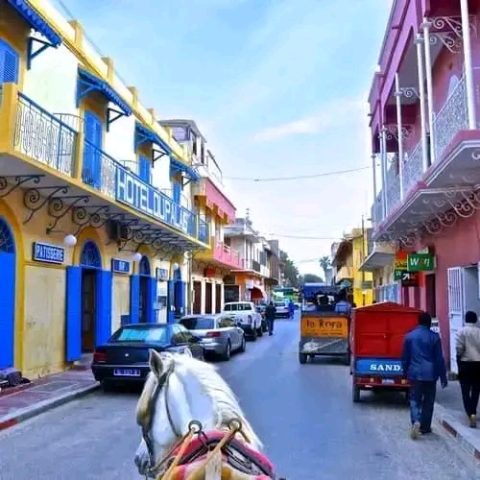
Saint-Louis Island carries the weight of history in its quiet streets, and nowhere is that more evident than at the Théâtre de Saint-Louis. Tucked along the banks of the Senegal River, the building doesn’t immediately demand attention—its facade is modest, blending into the worn charm of the old city. Yet stepping inside feels like crossing into another era. The air is thick with the scent of aged wood and polished stone, and the walls seem to hum with the echoes of performances past. This is a place where the colonial legacy of Senegal and its own cultural renaissance intertwine, where every crack in the plaster tells a story.
Built in the late 19th century, the theater was conceived as a piece of Paris transplanted to West Africa. At the time, Saint-Louis was the capital of French West Africa, and the city’s elite sought to recreate the sophistication of European salons. The auditorium, with its soaring ceilings and wooden balconies, mirrors the grand opera houses of France, though the details betray a local touch—carvings and motifs that nod to Senegalese craftsmanship. Molière and Racine were performed here, but so too were the oral traditions of the region, with griots recounting epics to the rhythms of the kora and balafon. The theater became a rare space where two worlds met, not as colonizer and colonized, but as collaborators in art.
The 20th century brought both triumph and neglect. After Senegal gained independence in the 1960s, the theater became a hub for experimentation, where African rhythms fused with European forms. Musicians like Youssou N’Dour once filled the hall with songs of love and resistance, their voices bouncing off the vaulted ceilings. But there were also years of decay, when the building stood empty, its stage gathering dust. A restoration in the early 2000s brought it back to life, though not without compromise—some original details were lost, replaced by modern materials that don’t quite match the patina of age. Still, the soul of the place remains intact, a testament to its resilience.
Today, the theater is more than a performance space; it’s a living archive. The foyer is lined with yellowed playbills and faded photographs of actors long gone, their faces frozen in moments of applause. Occasionally, you’ll find relics like an old piano, its keys worn smooth by generations of musicians. The auditorium seats around three hundred, and when it’s full, the energy is electric—laughter, murmurs, and the rustle of programs blending into a symphony of anticipation. Even when empty, the space feels alive, as if the ghosts of past audiences linger in the shadows.
The theater’s location adds to its magic. Saint-Louis is a city of contrasts, where narrow alleys twist through the old quarter and wide boulevards recall its colonial past. The river, once a bustling trade route, now laps gently against the shore, its waters reflecting the fading light of sunset. The theater sits at the intersection of these worlds, a bridge between the city’s layered histories. In the evenings, the building glows softly, its facade illuminated by warm lights that cast long shadows from the surrounding palms. Locals often gather outside, chatting or simply enjoying the breeze, as if the theater were a natural extension of their daily lives.
Visiting the Théâtre de Saint-Louis isn’t just about catching a show—it’s about stepping into a story. Even without a performance, the building invites exploration. Guided tours sometimes offer a glimpse behind the scenes: the balcony overlooking the stage, the dressing rooms where old costumes still hang, the backstage corridors lined with props from decades past. There’s a sense of timelessness here, as if the building exists outside the rush of modern life, preserving moments that might otherwise be forgotten.
Saint-Louis has long been Senegal’s cultural heart, and the theater is one of its most enduring symbols. It doesn’t try to be cutting-edge or trendy; it simply endures, bearing the marks of its past with quiet dignity. That’s what makes it special. The walls remember the laughter and the music, the air carries the weight of countless performances, and every visitor leaves with the sense of having touched something real. In a world that often prioritizes the new, the Théâtre de Saint-Louis reminds us that some things are worth holding onto.