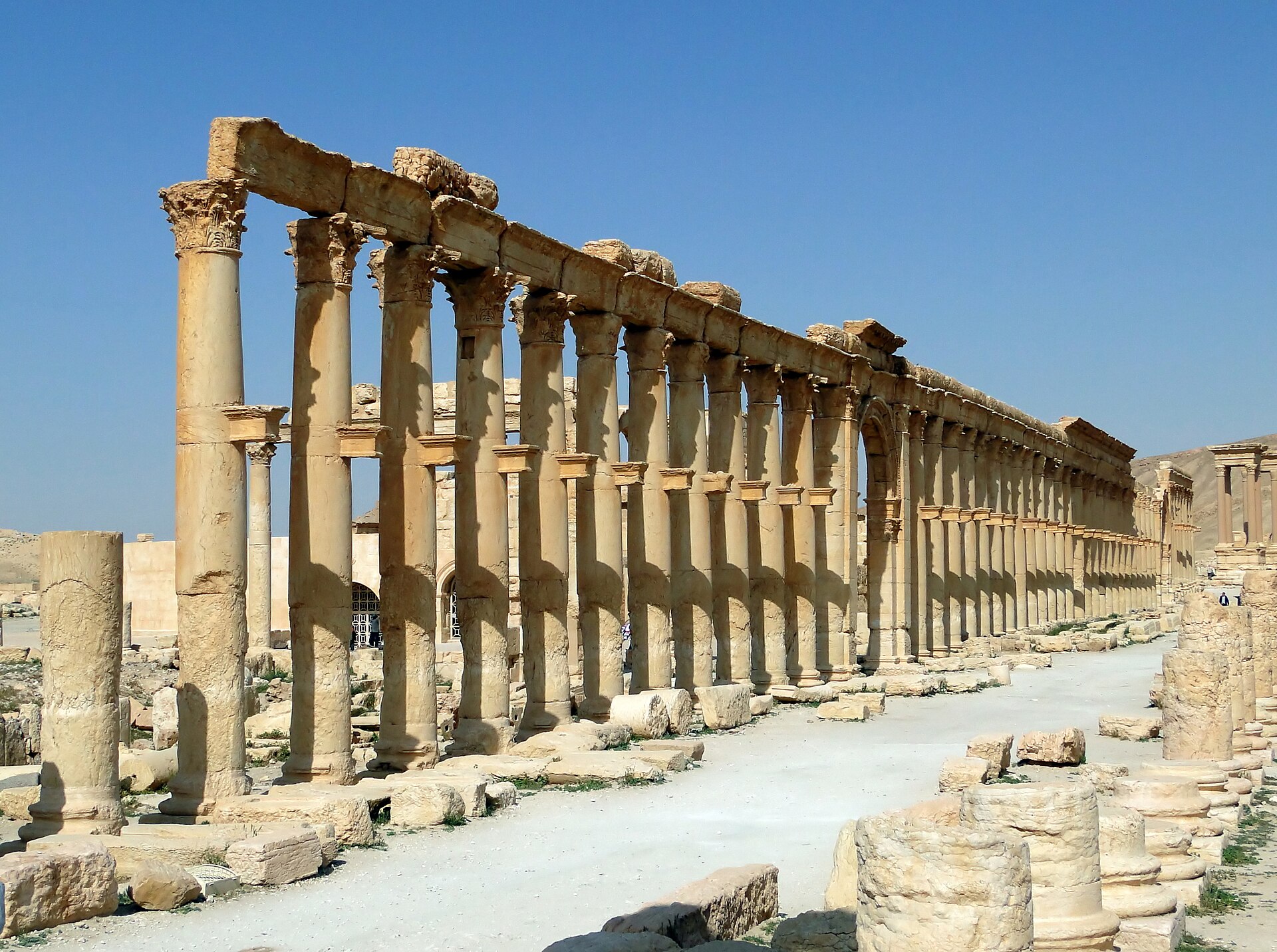
Palmyra’s ancient theatre is one of those rare places where time feels suspended, where the weight of history lingers in the stillness of stone. Built in the heart of the once-thriving city of Palmyra—known to the Romans as a jewel of the desert—this structure is more than just a relic of the past. It stands as a quiet witness to an era when caravans laden with silk, spices, and precious metals crossed vast stretches of sand, and when the cultures of East and West converged in this remote oasis. Though now partially ruined, the theatre retains a grandeur that defies its age, its weathered columns and tiered seating still commanding attention against the backdrop of the Syrian desert.
The story of the theatre is inseparable from that of Palmyra itself. In the first three centuries of the Common Era, the city transformed from a modest desert settlement into a vital hub of trade linking the Roman Empire with Persia, India, and beyond. Its prosperity was built on its strategic position along the Silk Road, and the theatre became a symbol of that wealth, a stage not just for performances but for the ambitions of Palmyra’s elite. Constructed in the second century, during the height of the city’s influence under Roman rule, the theatre reflects the architectural traditions of Rome while incorporating local elements. The limestone used in its construction, for instance, was typical of the region, giving the structure a distinctly Syrian character.
Architecturally, the theatre follows the classic Roman design, though with subtle adaptations to its desert environment. Built to accommodate around ten thousand spectators, its semicircular seating rises from the orchestra—the central performance space—up toward the upper tiers, where the vast expanse of the desert once stretched beyond. The stage, or *scaenae frons*, was once adorned with intricate carvings and columns, though today only fragments remain. What makes the theatre particularly striking is its integration with the natural landscape. Rather than being built on flat ground, it was constructed into the slope of a hill, a practical choice that also gave the structure an organic feel, as if it had grown from the earth itself.
In its prime, the theatre served multiple purposes beyond entertainment. It was a gathering place for civic life, where political speeches were delivered, legal disputes settled, and public announcements made. During festivals, it hosted gladiatorial combats and animal hunts, drawing crowds from across the Mediterranean. Palmyra’s position as a crossroads of trade meant that its theatre was a melting pot of languages, customs, and ideas. But with the city’s decline in the third century, following its destruction by Roman forces after Queen Zenobia’s rebellion, the theatre fell into disuse. Over the centuries, sand drifted over its stones, earthquakes weakened its walls, and locals repurposed its materials for their own buildings.
Today, the theatre exists in a state of elegant decay, its ruins more evocative than any reconstruction could be. Standing in the orchestra, it’s easy to imagine the echoes of ancient performances—the murmur of the crowd, the clash of cymbals, the dramatic declamations of actors. The silence of the desert only amplifies this sense of time travel, the wind whispering across the stone seats as if carrying voices from the past. In recent decades, archaeologists have worked to uncover and preserve the site, though their efforts have been hampered by the region’s instability. Yet even in its current state, the theatre remains a powerful reminder of Palmyra’s former glory.
Visiting the theatre is less about ticking off a tourist attraction and more about stepping into a living history. The stones here bear the marks of different eras—Roman columns stand alongside Byzantine inscriptions, while faint Arabic graffiti hints at medieval travelers who passed through. The play of light at dawn or dusk is particularly striking, casting long shadows that reveal details hidden in the glare of midday. The surrounding desert adds to the sense of isolation, creating a space where the modern world feels distant, and the past seems almost within reach.
Beyond its architectural significance, the theatre is a testament to the resilience of human culture. Despite centuries of conflict, neglect, and natural decay, it endures, a silent monument to the desire for beauty and meaning that transcends time. As Palmyra slowly recovers from the devastation of recent years, the theatre stands as a bridge between eras, a place where the achievements of the past are still palpable. It doesn’t need to be restored to its former splendor to leave an impression—its power lies in its authenticity, in the way it preserves the spirit of a city that was once the beating heart of the desert.