Palmyra’s Agora is one of those rare places where the past doesn’t just linger—it feels alive, even in silence. Tucked within the ruins of the ancient city once known as Tadmor, this open square was never just a marketplace. It was the pulse of a civilization that thrived where few others could, a crossroads where the ambitions of empires, the fortunes of merchants, and the whispers of travelers from distant lands all converged. Today, the stones here are worn smooth by time, but they still hold the echoes of a city that once stood at the heart of the world.
Palmyra’s rise was written in the sand. Nestled in an oasis amid the Syrian Desert, it began as a humble rest stop for caravans moving along the Silk Road. But its location between the Mediterranean and Mesopotamia turned it into something far greater—a place where goods, ideas, and people flowed in from every direction. By the second and third centuries, when the Agora was built, Palmyra had become a city of consequence. Here, Roman officials rubbed shoulders with Persian traders, Indian spice merchants haggled with Chinese silk dealers, and Arab nomads shared stories with Greek settlers. The Agora wasn’t just where deals were struck; it was where the world met.
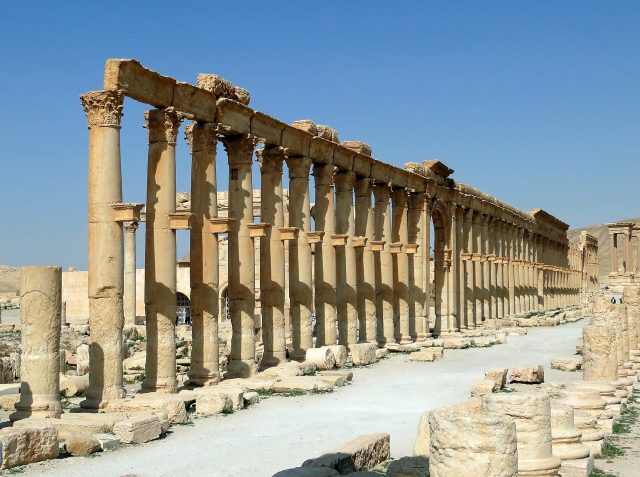
The architecture of the Agora, even in its ruined state, speaks to the city’s wealth and sophistication. The square itself stretched roughly 70 by 80 meters, framed by a colonnade of limestone pillars topped with Corinthian capitals. These columns once supported a roof that sheltered rows of shops and workshops, where artisans crafted goods and merchants displayed their wares. At the center of the square stood statues of Palmyra’s elite—local dignitaries, Roman emperors, and benefactors who had shaped the city’s destiny. The most striking remnant is the Tetrapylon, a four-sided arch that once marked the entrance to the Agora. Though only its base remains today, it was once a grand structure of marble and sculpture, a statement of Palmyra’s pride.
But the Agora was more than a commercial hub. It was a place where faith and trade intertwined. Nearby stood temples dedicated to the gods of Palmyra—Bel, the chief deity often compared to Babylon’s Marduk, alongside Al-Lat and Baalshamin, whose worship reflected the city’s blend of cultures. Priests and merchants moved through the same spaces, their rituals and transactions shaping the rhythm of daily life. Palmyra was a city where Greek philosophy, Roman law, Arab traditions, and Persian customs coexisted, and the Agora was the stage where this cultural fusion played out.
The story of Palmyra is one of extraordinary highs and devastating lows. In the third century, the city reached its zenith under Queen Zenobia, a ruler bold enough to challenge Rome itself. For a brief, defiant moment, Palmyra’s armies marched into Egypt and Anatolia, carving out an empire of its own. But Rome struck back, and by 273 AD, the city lay in ruins. The Agora, like much of Palmyra, was left to the desert winds. Yet life here never truly vanished. In later centuries, under Byzantine and Islamic rule, the square was repurposed—houses and workshops sprang up among the ancient stones, a quiet testament to the city’s resilience.
Walking through the Agora today, it’s easy to imagine the scene as it once was. The wind carries the same dry heat that merchants and travelers would have known, and the shadows of the columns stretch across the sand just as they did two thousand years ago. There are no crowds now, no shouts of haggling or the clatter of hooves on stone, but the silence feels deliberate, as if the ruins are holding their breath. This was a place where fortunes were made and lost, where alliances were forged and broken, where the very idea of a globalized world first took shape.
What makes the Agora remarkable isn’t just its age or its architecture, but what it represents. It was a space where the vast distances of the ancient world collapsed into something tangible—a few square meters of stone where East and West, North and South, all converged. The goods traded here—silk from China, spices from India, glass from Rome, incense from Arabia—were more than commodities; they were threads in a tapestry of human connection. The Agora was proof that even in the harshest of landscapes, civilization could flourish when people chose to meet, rather than divide.
Visiting the Agora is a humbling experience. There are no grand reconstructions here, no modern interpretations of what once stood. Just the stones, the sand, and the sky. But that simplicity is its power. It forces you to slow down, to look closely, to listen. The past isn’t just something you observe here—it’s something you feel. You walk where merchants walked, stand where orators once spoke, and touch the same walls that bore witness to Palmyra’s rise and fall. In a world that often feels fragmented, the Agora is a reminder of how much we’ve always had in common. It’s a place where history isn’t just remembered; it’s still alive, waiting in the quiet between the stones.