Piazza Armerina is the kind of Sicilian town that reveals itself slowly, where the charm lies not in grand monuments but in the quiet rhythm of daily life. Tucked away in the island’s hilly interior, it feels far removed from the coastal bustle, with its narrow streets winding past faded facades and small squares where time seems to linger. At the heart of this unassuming place stands Teatro Garibaldi, a building that might easily be overlooked but carries the weight of the town’s cultural past.
Built in the mid-19th century, the theater arrived during a period when Piazza Armerina was a thriving hub for the surrounding countryside. The town had long been a crossroads for trade and local politics, and the theater was conceived as a gathering place for the merchant class and landowners—a space where business could mingle with leisure. When it opened in 1872, it was named in honor of Giuseppe Garibaldi, the revolutionary whose legacy still resonated strongly in Italy’s newly unified state. For decades, it served as the town’s social and artistic center, hosting performances that ranged from classical Italian plays to operas by local composers.
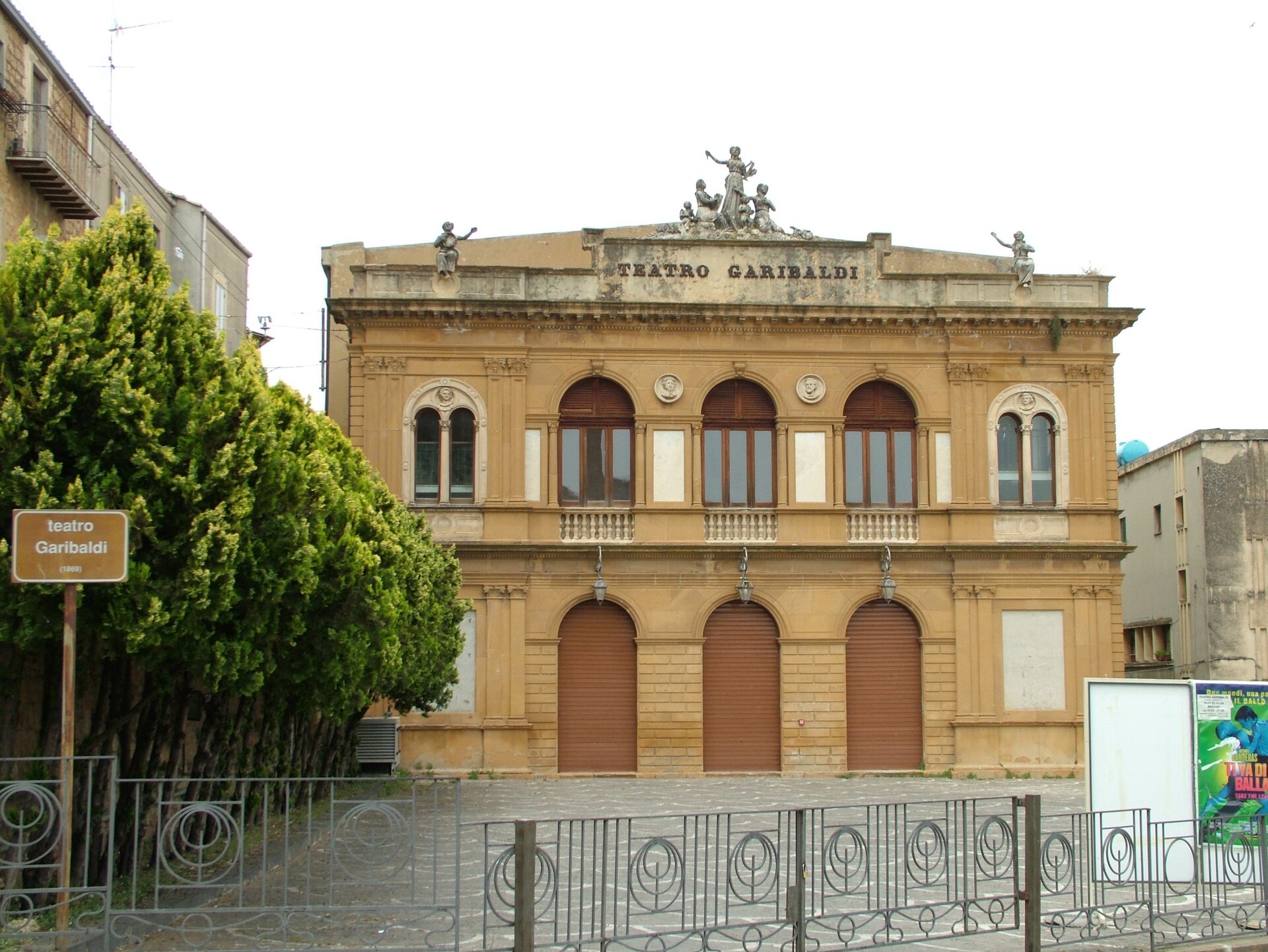
The architecture reflects the modest ambitions of a provincial theater. The facade is simple, with three arched doorways and a small balcony above the central entrance, giving little hint of the intimacy inside. The auditorium is compact, designed for a few hundred spectators seated in a semicircle of wooden chairs upholstered in worn velvet. The ceiling is adorned with delicate plasterwork, while the walls feature understated frescoes that feel more like domestic decoration than grand stagecraft. There’s no pretension here—just a space where the audience sits close enough to the performers to feel part of the experience.
Like many small theaters in Italy, Teatro Garibaldi has had its share of ups and downs. In the 20th century, as cinema and television drew audiences away, the building fell into disrepair. It was repurposed as a movie house, then abandoned, its future uncertain. But in recent years, there’s been a renewed appreciation for Italy’s lesser-known cultural spaces, and the theater has found new life. Today, it hosts a mix of performances—jazz concerts, traveling theater troupes, and even lectures on Sicilian history—proving that a venue doesn’t need to be grand to remain relevant.
Beyond the stage, the theater functions almost like a museum. The foyer displays old playbills, photographs of past performers, and documents tracing the building’s history. Occasionally, restorers can be seen carefully repairing the plasterwork or retouching the faded frescoes, their work a reminder of how much effort goes into preserving such places. It’s a slow process, but one that ensures the theater retains its character rather than becoming a hollow relic.
Visiting Teatro Garibaldi is as much about the town as it is about the building itself. Piazza Armerina rewards those who take their time, with its labyrinth of alleys, medieval churches, and quiet piazzas where locals gather in the evenings. The theater sits at the center of this world, a natural starting point for exploring. Nearby, a café serves some of the best cannoli in Sicily, while the morning market offers local cheeses, olives, and other regional specialties. In the late afternoon, when the light softens and the theater’s facade is bathed in golden hues, the square in front comes alive with conversation and music.
What makes Teatro Garibaldi special isn’t its size or fame, but the way it embodies the spirit of the town. It’s a place where art and community have always been intertwined, where a performance feels less like a spectacle and more like an extension of daily life. The theater has survived not because it was ever grand or glamorous, but because it was—and still is—a space where people come together. In an age of mass entertainment, that kind of intimacy feels increasingly rare.
For those who wander into Piazza Armerina, the theater offers more than just a glimpse into the past. It’s a reminder that culture doesn’t always need to be monumental to matter. Sometimes, all it takes is a small stage, a handful of performers, and an audience willing to listen. That’s the quiet magic of Teatro Garibaldi—a place where history isn’t just preserved, but lived.