Prague’s Dancing House is one of those rare buildings that feels like it belongs in a dream rather than a city. Completed in the late 1990s, it stands in sharp contrast to the Gothic spires, Baroque facades, and Art Nouveau curves that define much of the Czech capital. Its design evokes a pair caught in mid-dance—one tower curves gracefully, as if swaying, while the other remains upright and steady, like a partner holding the frame. The architects, Frank Gehry and Vlado Milunić, didn’t just create an office building; they crafted a statement, one that challenges the idea of what architecture should be in a city steeped in history.
The site itself carries weight. Before the Dancing House, this stretch of the Vltava riverbank was home to a building destroyed during the Allied bombing of Prague in February 1945. For decades, the empty lot served as a quiet reminder of the war’s scars. Then, in the early 1990s, as Czechoslovakia emerged from communist rule, the idea took shape to build something entirely new here—something that would reflect the country’s shifting identity. The project sparked fierce debate. Some saw it as bold and refreshing; others dismissed it as an unwelcome disruption in a city where history is etched into every stone. Today, the building has settled into the skyline, though it still divides opinion.
The structure is made up of two towers that flow into each other, their forms creating the illusion of movement. Glass and concrete blend in undulating lines, as if the building itself is caught in motion. The effect is most striking from the opposite bank of the Vltava, where the light plays off the curves and the water mirrors its silhouette. Inside, the space is just as unconventional. Offices share the building with a contemporary art gallery and a rooftop restaurant, where diners can look out over Prague’s rooftops and bridges. The top floor houses a bar, offering one of the best vantage points in the city.
Architecturally, the Dancing House is often labeled as deconstructivist—a style that dismantles traditional notions of form and space. Gehry and Milunić used unconventional materials to achieve this sense of dynamism. One tower is clad in shimmering metal panels that catch the sunlight, while the other features glass blocks that cast shifting patterns of light and shadow. The interiors follow suit, with curved walls and unexpected angles that make the space feel fluid rather than fixed. It’s a building that refuses to stand still, even when it’s literally rooted in place.
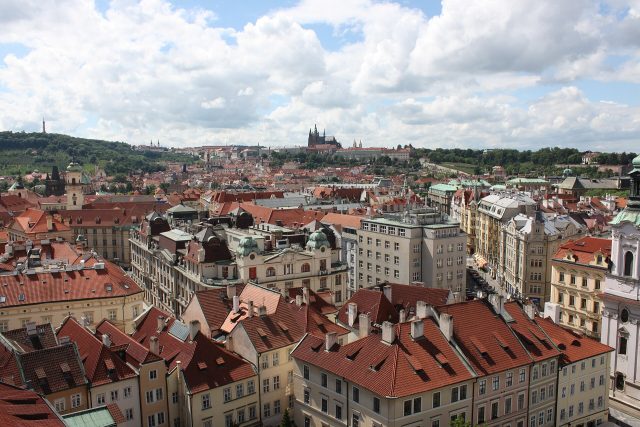
Despite its modern design, the Dancing House doesn’t clash with its surroundings. It sits alongside classical Prague townhouses, the iconic Charles Bridge, and the towering spires of St. Vitus Cathedral, yet it doesn’t compete with them. Instead, it offers a counterpoint—a reminder that Prague isn’t just a museum of the past but a living city where old and new coexist. The contrast is part of its charm. Here, medieval architecture meets contemporary boldness, and neither overshadows the other.
For visitors, the Dancing House is a different kind of Prague attraction. Unlike the crowded squares and tourist-packed lanes of the Old Town, it offers a quieter experience. There are no hordes of selfie sticks or guided tour groups, just the chance to see the city from an unexpected angle. The rooftop restaurant is popular as much for its views as for its food, with panoramas stretching across the Vltava and the city’s historic core. At night, when the lights come on, the building seems to come alive, its curves and angles taking on a new depth.
Beyond its architectural significance, the Dancing House symbolizes the changes that swept through the Czech Republic after the fall of communism. The 1990s were a time of reinvention, as the country redefined its place in Europe. The building was one of the first visible signs of that transformation—a declaration of creative freedom and a rejection of rigid conventions. Today, it’s often cited as an example of how Prague embraced modernity without losing its soul.
The area around the Dancing House has developed its own character over the years. The riverbank is a favorite spot for artists, photographers, and anyone drawn to its unconventional beauty. In the summer, small concerts and performances occasionally take place nearby, while winter brings festive markets to the square. Locals have mixed feelings about the building—some still see it as an intruder, while others take pride in Prague’s willingness to evolve. Either way, it has become part of the city’s fabric, impossible to imagine the skyline without it.
If you find yourself in Prague, take the time to walk along the Vltava and view the Dancing House from different angles. It changes with the light—airy and delicate in the morning, sharp and graphic by day, mysterious and almost surreal at night. Whether you’re a fan of contemporary architecture or not, the building invites reflection on how cities grow while staying true to themselves. It’s a place where history and innovation meet, where tradition and experimentation coexist. In a city as storied as Prague, that’s no small feat.